
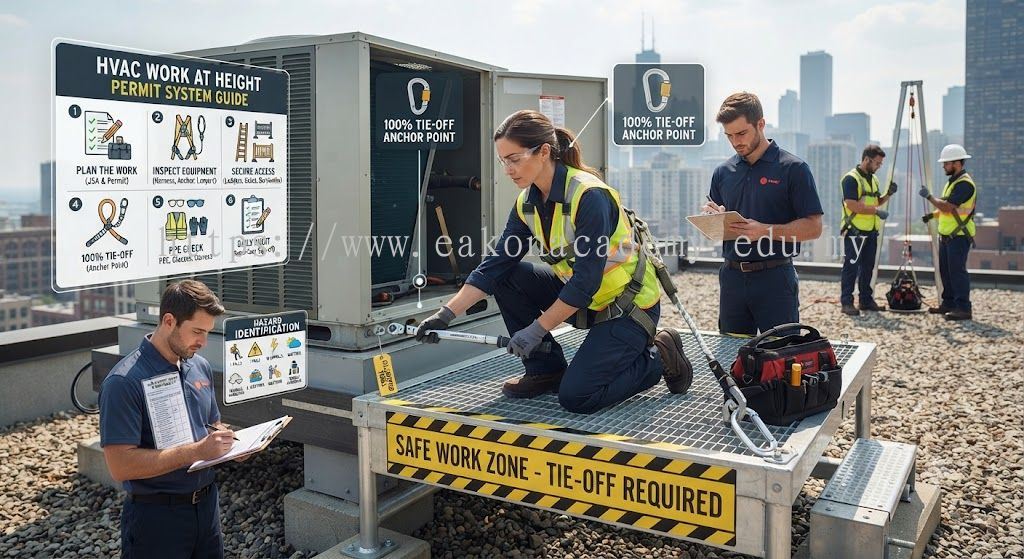
HVAC Work at Height Permit System Guide: Best Practices for Safe Air Conditioning Installation and Maintenance
The HVAC work at height permit system guide is an essential reference for air conditioning technicians, refrigeration engineers, HVAC contractors, maintenance personnel, facility managers, and safety supervisors responsible for performing work at elevated locations. In the heating, ventilation, air conditioning, and refrigeration (HVACR) industry, technicians frequently install, service, inspect, troubleshoot, and maintain equipment located on rooftops, high-rise buildings, commercial complexes, industrial facilities, hospitals, hotels, factories, warehouses, and shopping malls. These environments present significant hazards such as falls from height, electrical risks, unstable working surfaces, falling objects, adverse weather conditions, and restricted access areas. A properly managed work at height permit system ensures that every elevated HVAC task is carefully planned, authorised, supervised, and completed safely. At eakonacadem.edu.my, we provide comprehensive HVAC safety training that combines practical air conditioning technical skills with working at height permit system knowledge, helping technicians comply with industry best practices while improving workplace safety and operational efficiency.
A work at height permit system is a formal safety management process designed to control high-risk work activities before technicians begin working above ground level. Rather than simply issuing permission to start work, the permit system verifies that all foreseeable hazards have been identified, appropriate control measures have been implemented, competent personnel have been assigned, and emergency procedures are in place. Within the HVAC industry, permit systems play a vital role when technicians are installing rooftop package units, servicing chillers, repairing cooling towers, maintaining air handling units, replacing outdoor condensers, inspecting ventilation systems, or carrying out preventive maintenance on elevated mechanical equipment.
One of the most important elements of an HVAC work at height permit system is conducting a comprehensive workplace risk assessment. Before any permit is approved, supervisors and technicians should inspect the worksite to identify potential hazards including roof edges, fragile roofing materials, skylights, unstable surfaces, scaffolding conditions, ladder safety, Mobile Elevated Work Platform (MEWP) access, electrical installations, weather conditions, falling object risks, and emergency rescue access. Every identified hazard should be evaluated and appropriate control measures documented within the permit. This systematic approach significantly reduces workplace accidents while ensuring all team members understand the risks associated with the task.
A properly completed permit should clearly define the scope of work, work location, personnel involved, duration of the activity, required safety equipment, supervision arrangements, and emergency procedures. The permit should also confirm that all technicians assigned to the task are competent, medically fit where applicable, and trained in working at height safety. Ensuring only qualified personnel perform elevated HVAC work improves overall project safety while demonstrating professional responsibility and regulatory compliance.
Fall protection remains one of the most critical requirements within every HVAC work at height permit system. Whenever technicians are exposed to fall hazards, certified full-body safety harnesses, shock-absorbing lanyards, self-retracting lifelines, horizontal lifeline systems, and approved anchor points should be used according to established safety procedures. The permit should verify that all fall protection equipment has been inspected before use and remains in safe working condition. Proper documentation of equipment inspections provides additional assurance that technicians are protected throughout installation, servicing, and maintenance activities.
Safe access equipment should also be addressed within the permit system. HVAC technicians may use ladders, scaffolding, boom lifts, scissor lifts, or Mobile Elevated Work Platforms depending on the nature of the project. Before authorising work, supervisors should confirm that access equipment has undergone pre-use inspections, is positioned correctly, complies with manufacturer recommendations, and will only be operated by trained personnel. Selecting the most appropriate access method greatly improves worker safety while increasing productivity during rooftop HVAC operations.
Electrical safety is another essential consideration within HVAC work at height permit procedures. Technicians frequently work near rooftop electrical switchboards, transformers, compressors, disconnect switches, control panels, and live power supplies. The permit should verify that lockout/tagout procedures have been completed where necessary, electrical isolation has been confirmed using approved testing equipment, and insulated tools are available for electrical servicing tasks. Integrating electrical safety into the permit process reduces the likelihood of electric shock and secondary incidents that could result in falls.
Weather monitoring is an important part of any effective permit system. Heavy rain, lightning, strong winds, excessive heat, or slippery roof surfaces can create unacceptable safety risks for technicians working at height. Supervisors should continuously review weather conditions throughout the project and suspend work whenever environmental conditions become unsafe. Including weather assessments within the permit process demonstrates proactive safety management while protecting personnel and valuable HVAC equipment.
Good housekeeping and safe material management are equally important components of a work at height permit system. Refrigerant cylinders, copper piping, electrical cables, ducting materials, mounting brackets, power tools, vacuum pumps, recovery machines, and spare parts should be organised carefully to eliminate trip hazards and prevent falling objects. Mechanical lifting equipment such as cranes, hoists, or lifting slings should be used whenever heavy HVAC equipment needs to be transported to elevated work areas. Maintaining an organised worksite improves both productivity and workplace safety.
Emergency preparedness forms a critical section of every HVAC work at height permit. Before work begins, supervisors should ensure emergency rescue procedures, communication systems, first aid equipment, evacuation routes, rescue personnel, and emergency contact details are clearly established. Rescue plans should address suspension trauma, fall recovery procedures, medical emergencies, and equipment evacuation where necessary. Regular emergency drills ensure technicians understand their responsibilities and can respond effectively should an incident occur.
Continuous training and competency assessment are fundamental to maintaining an effective permit-to-work system. HVAC professionals should receive ongoing education in working at height safety, fall protection systems, safety harness inspection, ladder safety, Mobile Elevated Work Platform (MEWP) operation, workplace risk assessment, permit-to-work procedures, electrical safety, manual handling, and emergency rescue techniques. Regular refresher training strengthens workplace safety culture, improves technical competence, and supports long-term compliance with occupational health and safety requirements.
At eakonacadem.edu.my, we are dedicated to developing highly skilled HVAC professionals through practical, industry-focused training programmes that combine advanced air conditioning technical expertise with internationally recognised working at height safety practices. Our comprehensive courses include permit-to-work systems, fall protection, rooftop safety, safety harness training, ladder safety, MEWP operation, workplace risk assessment, electrical safety, emergency rescue planning, and occupational safety compliance. Students receive valuable hands-on experience that prepares them for residential, commercial, and industrial HVAC careers throughout Malaysia. By understanding and implementing an effective HVAC work at height permit system guide, technicians and employers can reduce workplace accidents, improve regulatory compliance, strengthen operational efficiency, increase customer confidence, and build a safer, more professional HVAC industry. Choosing eakonacadem.edu.my for HVAC safety education is a commitment to technical excellence, continuous professional development, and creating safer workplaces for the future.
Tingnan ang karagdagang mga detalye tungkol sa EAKON ACADEMY SDN BHD
