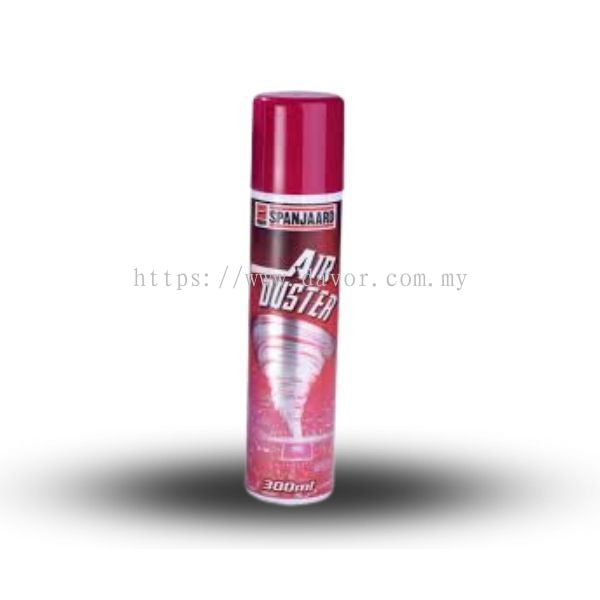
TL;DR: Choose Spanjaard air duster spray to effectively remove dust from any sensitive area where chemical cant use. This compressed air can delivers a powerful, dry gas blast suitable for all Malaysian applications, including electronics or machinery. Prioritize the non flammable version available for added safety in high risk environment.
Spanjaard Air Duster Spray delivers a high-velocity, dry gas stream designed to physically displace loose contaminants from recessed or intricate geometries. The propellant provides a non-conductive, moisture-free blast that leaves zero non-volatile residue. It is chemically inert and safe for use on sensitive industrial plastics, including those found in high-precision Malaysian manufacturing equipment and server housings.
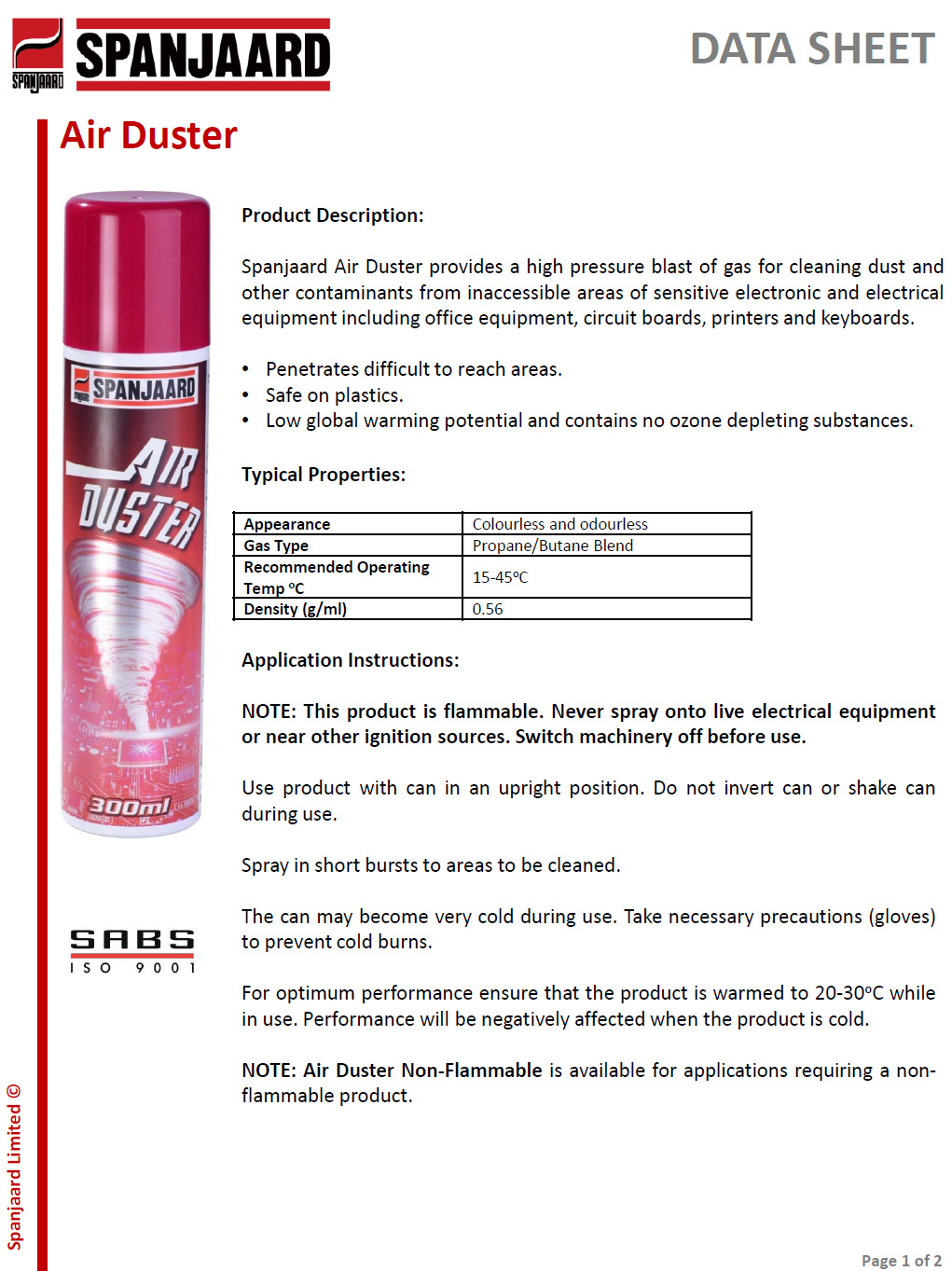
Aerosol Volume: 300ml / 300g.
Appearance: Colorless, characteristic ether-like odor.
Standard Version Gas: Propane/Butane hydrocarbon blend (Density: 0.56 g/ml).
Non-Flammable Version Gas: 1,1,1,2-Tetrafluoroethane (HFC-134a) (Density: 1.22 g/ml).
Vapour Pressure: 2100 hPa @ 20°C.
Operating Range: 15°C to 45°C (Optimized for 20-30°C).
.png)
Source: Official Spanjaard Technical Data Sheet (TDS).
Commonly used for cleaning printed circuit board (PCB) fabrications, fiber optic connectors, and automation sensors in production lines. In the Malaysian climate, it is essential for clearing dust from control panels, CNC machinery, and laboratory instruments where liquid solvents could cause electrical leakage. Do not use to remove "sticky" residues like grease, oil, or wet flux; these require a specialized solvent-based degreaser.
The product utilizes the kinetic energy of rapidly expanding liquefied gas. When released, the propellant undergoes an endothermic phase change, creating a powerful jet that shears dust away from surfaces. Using HFC-134a in the non-flammable version provides a high-density, dry discharge that is safe for energized circuits, ensuring no conductive bridges form in high-humidity environments.
Suitable for MRO engineers, IT technicians, and laboratory personnel maintaining precision optics or electronics. It is appropriate for all Malaysian industrial, office, and home environments. It is not suitable for high-volume dust removal in large open areas (which requires compressed air lines) or for cleaning equipment where active ignition sources are present if using the standard hydrocarbon variant.
Isolate sensitive equipment from power if using the flammable version.
Maintain the aerosol can in a strictly vertical position; do not tilt beyond 40°.
Attach the precision extension tube for targeted cleaning of narrow gaps.
Apply in short, 1-second bursts to prevent the internal temperature from dropping excessively.
If the can becomes frost-cold, allow it to return to ambient Malaysian room temperature (approx. 25-30°C) to restore maximum pressure.
Shaking the can: Agitating the liquid propellant increases the risk of liquid discharge instead of dry gas.
Inverting during spray: Turning the can upside down expels liquefied gas, which can cause thermal shock (frost damage) to sensitive components.
Continuous spraying: Long bursts cause adiabatic cooling, leading to a significant drop in discharge pressure and cleaning force.
Standard versions are classified as "Extremely Flammable" (Aerosol Category 1); keep away from heat and open flames. The non-flammable version is safer for live electrical work but should be used in ventilated areas to avoid high concentrations of anaesthetic vapours. Store in a cool, dry place below 50°C to prevent pressure-induced rupture. Dispose of empty cans according to Malaysian scheduled waste regulations.
What is the difference between the two propellants? The standard version uses a cost-effective propane/butane blend (flammable). The non-flammable version uses HFC-134a, which is non-combustible and safer for use on live electrical components.
Can I use this to clean my laptop's internal fan? Yes, provided the laptop is powered off. Use short bursts to prevent liquid propellant from reaching the motherboard.
Does it leave a film or residue? No. Both versions are designed to evaporate completely, leaving the surface 100% dry and free of chemical residue.
Why does the spray pressure weaken after long use? Rapid gas expansion cools the can (adiabatic cooling). When the can gets cold, internal pressure drops. Simply wait for the can to warm up to restore full pressure.
Visit our official Facebook page for the latest updates, check out our YouTube channel for exciting product demos, and explore the Davor website's News section for more insights.
 Malaysia