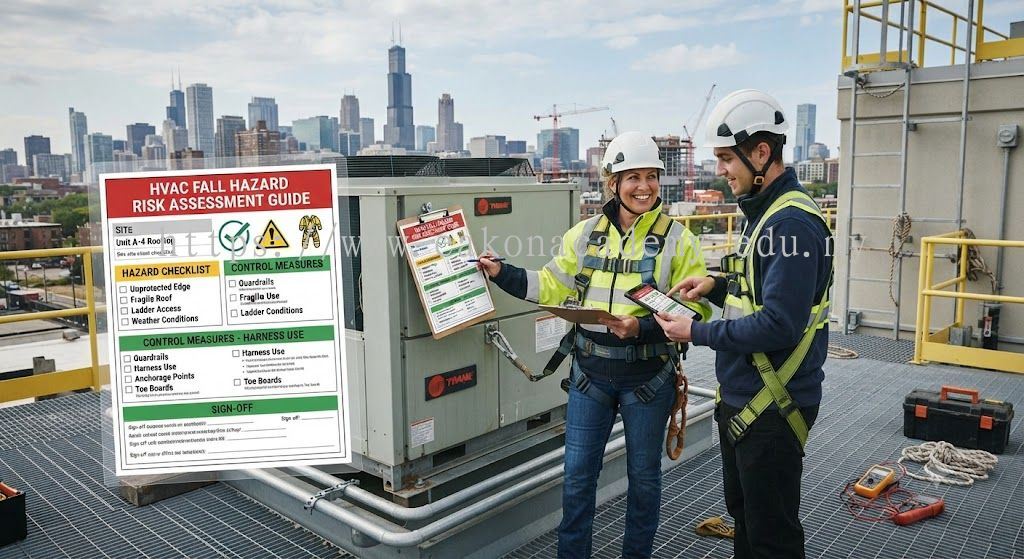
HVAC Fall Hazard Risk Assessment Guide for Safe Air Conditioning Installation and Maintenance
HVAC fall hazard risk assessment guide is an essential safety resource designed to help heating, ventilation, and air conditioning professionals identify, evaluate, and control potential fall hazards during installation, servicing, repair, and maintenance activities. In the HVAC industry, technicians frequently perform work at elevated locations such as rooftops, high walls, ceilings, mechanical rooms, commercial buildings, and industrial facilities. A proper fall hazard risk assessment guide helps HVAC technicians understand workplace risks, apply effective safety controls, and complete their tasks safely while reducing the possibility of falls, injuries, and property damage.
At Eakon Academy, eakonacadem.edu.my, HVAC training programmes focus on developing skilled technicians who understand the importance of workplace safety and professional risk management. The HVAC fall hazard risk assessment guide provides technicians, supervisors, and contractors with a systematic method to identify hazards before performing any work at height. Through proper assessment procedures, HVAC professionals can recognise unsafe conditions, select suitable safety equipment, and implement preventive measures that improve overall workplace safety.
HVAC work at height involves various fall hazards that require careful evaluation and proper control methods. Common risks include unstable ladders, improper ladder positioning, unsafe scaffolding, unprotected edges, slippery surfaces, poor lighting conditions, falling tools, electrical hazards, and incorrect use of personal protective equipment. A comprehensive fall hazard risk assessment allows technicians to analyse these risks and determine the safest methods for completing HVAC installation and maintenance activities.
An effective HVAC fall hazard risk assessment guide begins with a detailed inspection of the work environment. Before starting any elevated HVAC task, technicians should evaluate the working area, identify potential fall points, assess access methods, and determine the correct safety procedures required. For example, installing an outdoor air conditioning unit on a high-rise building requires careful assessment of working platforms, anchor points, fall protection systems, lifting procedures, and team communication. Proper preparation ensures that technicians can perform their duties safely and efficiently.
The selection and correct use of safety equipment are important components of preventing fall hazards in HVAC operations. Technicians should understand the importance of personal protective equipment (PPE), including safety helmets, protective footwear, gloves, and fall protection equipment when required. In addition, proper knowledge of ladder safety, mobile elevated work platform (MEWP) operation, secure tool handling, and safe movement techniques helps minimise the possibility of accidents. These practices support safer HVAC installation, servicing, and maintenance activities.
For HVAC contractors and technicians in Malaysia, understanding HVAC fall hazard risk assessment is essential for maintaining professional safety standards. Residential, commercial, and industrial HVAC projects often require technicians to work in challenging environments where fall risks can occur. By applying a structured risk assessment approach, companies can reduce workplace incidents, improve technician performance, and create a stronger safety culture within their operations.
Training based on an HVAC fall hazard risk assessment guide helps professionals develop practical skills in hazard identification, risk evaluation, safety planning, and emergency prevention. Technicians who understand proper fall prevention methods are better prepared to manage elevated HVAC tasks while maintaining high standards of workmanship. Employers also benefit from a safer workforce, improved productivity, and increased customer confidence in their HVAC services.
Eakon Academy provides professional HVAC training programmes designed to strengthen both technical knowledge and workplace safety awareness. By learning HVAC fall hazard risk assessment methods, air conditioning technicians can improve their ability to perform installation, servicing, and maintenance tasks safely and responsibly. Visit eakonacadem.edu.my to explore HVAC training solutions that support safer HVAC operations, professional development, and industry excellence in Malaysia.
More detail about EAKON ACADEMY SDN BHD Malaysia