
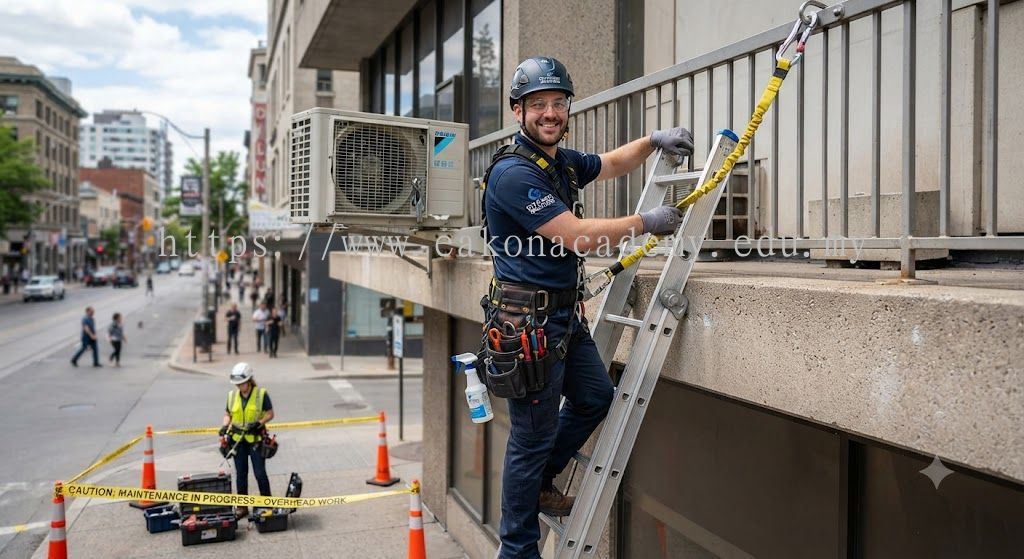
HVAC Maintenance Height Safety Procedures: Complete Safety Guide for Professional HVAC Technicians
HVAC maintenance activities require technicians to perform inspections, servicing, troubleshooting, repairs, and equipment replacement in various working environments. Many heating, ventilation, and air conditioning systems are installed at elevated locations such as rooftops, external building walls, ceiling spaces, mechanical rooms, and high-rise commercial facilities. These working conditions create potential hazards including falls, electrical exposure, unstable surfaces, falling objects, and difficult access situations. Therefore, following proper HVAC maintenance height safety procedures is essential to protect technicians, improve workplace safety, and ensure professional maintenance operations. At Eakon Academy (eakonacadem.edu.my), our HVAC training programmes focus on developing competent technicians who understand both technical maintenance skills and safe working practices required in modern HVAC environments.
Working at height is a major safety concern in the HVAC industry because technicians frequently need to access equipment installed in elevated areas. Commercial and industrial HVAC systems, rooftop air conditioning units, VRF and VRV systems, ventilation equipment, and large outdoor condensers often require specialised access methods and safety controls. Without proper procedures, technicians may face serious risks from falls, incorrect equipment usage, poor planning, and unsafe working conditions. A structured height safety approach helps reduce these risks and supports efficient maintenance activities.
The first step in HVAC maintenance height safety procedures is conducting a detailed workplace risk assessment before any maintenance task begins. Technicians should inspect the working area and identify potential hazards such as roof edges, slippery surfaces, unstable platforms, electrical components, weather conditions, access limitations, and surrounding workplace activities. A proper risk assessment allows technicians and supervisors to determine suitable safety measures, select appropriate personal protective equipment (PPE), and prepare safe work procedures.
One of the most important procedures for HVAC technicians working at height is the correct use of fall protection systems. Technicians performing maintenance in elevated areas should understand the purpose and application of full-body safety harnesses, shock-absorbing lanyards, self-retracting lifelines (SRLs), connectors, and approved anchor points. These safety systems help prevent falls or reduce injury severity during accidental fall events. Proper training ensures technicians know how to inspect, wear, connect, and maintain fall protection equipment correctly.
Safety harness inspection is an essential part of HVAC maintenance height safety procedures. Before every use, technicians should examine harness straps, stitching, buckles, D-rings, connectors, and attachment points for damage or wear. Any signs of cuts, broken stitching, corrosion, chemical damage, or excessive wear should be reported immediately. Damaged safety equipment should never be used because it may fail during a fall situation.
Correct harness fitting is also important to ensure effective protection. A full-body harness should be properly adjusted according to the technician’s body size and manufacturer instructions. Shoulder straps, chest straps, and leg loops must be positioned correctly to provide support and comfort while allowing safe movement during maintenance activities. Proper fitting improves both safety performance and work efficiency.
Safe access planning is another important component of HVAC maintenance height safety procedures. Technicians may use ladders, scaffolding, elevated work platforms, boom lifts, or scissor lifts depending on the working environment. Each access method requires proper inspection and safe operation. Ladders should be placed on stable surfaces, secured correctly, and used according to safety guidelines. Powered access equipment should only be operated by trained personnel to prevent accidents.
Personal protective equipment plays an important role in protecting HVAC technicians during elevated maintenance activities. Suitable PPE may include safety helmets with chin straps, safety footwear, protective gloves, safety glasses, high-visibility clothing, and appropriate workwear. Safety helmets help protect against falling objects, while anti-slip safety footwear improves stability on rooftops and elevated surfaces. Proper PPE selection provides additional protection against multiple workplace hazards.
Electrical safety must always be considered when performing HVAC maintenance at height. Many air conditioning systems contain electrical components such as compressors, motors, capacitors, control panels, and wiring systems. Technicians should follow safe electrical procedures, including power isolation, electrical testing, and proper use of insulated tools. These practices help prevent electric shock, burns, and equipment damage.
Refrigerant handling safety is another important part of professional HVAC maintenance procedures. Technicians may perform refrigerant recovery, leak testing, vacuum procedures, pressure checks, and charging activities while working in elevated areas. Proper refrigerant tools and protective equipment should be used to reduce exposure risks and support environmentally responsible HVAC servicing practices.
Tool management is essential when technicians work at height. Tools and materials should be organised properly and secured using tool bags, tool belts, or tool lanyards. Dropped tools can create serious hazards for workers below and may damage expensive HVAC equipment. Good tool control improves workplace safety, efficiency, and professionalism.
Environmental conditions should also be assessed before starting elevated HVAC maintenance. Rain, strong winds, extreme temperatures, and slippery surfaces can increase the risk of accidents. Technicians should monitor weather conditions and stop work when the environment becomes unsafe. Proper planning ensures maintenance activities are carried out under controlled conditions.
Emergency rescue planning is a critical part of HVAC maintenance height safety procedures. If a technician experiences a fall while connected to a harness system, quick rescue action is required to reduce the risk of suspension trauma. Employers should prepare rescue plans, provide emergency communication methods, maintain first aid equipment, and train workers on emergency response procedures.
Continuous safety training is necessary to maintain high safety standards among HVAC professionals. Training should cover hazard identification, risk assessment, fall protection systems, PPE usage, ladder safety, electrical protection, refrigerant handling, and emergency procedures. Proper training helps technicians perform maintenance tasks safely while improving confidence and professionalism.
At Eakon Academy (eakonacadem.edu.my), we are committed to providing professional HVAC training that develops technicians with strong technical abilities and workplace safety awareness. Our comprehensive HVAC programmes cover air conditioning installation, servicing, maintenance, troubleshooting, working at height safety, fall protection equipment, PPE requirements, electrical safety, refrigerant management, and industry best practices. Through practical hands-on training, students gain the knowledge and skills required to perform HVAC work safely in residential, commercial, and industrial environments. By applying proper HVAC Maintenance Height Safety Procedures, technicians can minimise workplace hazards, improve maintenance performance, protect themselves and others, comply with safety requirements, and deliver reliable HVAC services with confidence and professionalism.
More detail about EAKON ACADEMY SDN BHD Malaysia
