
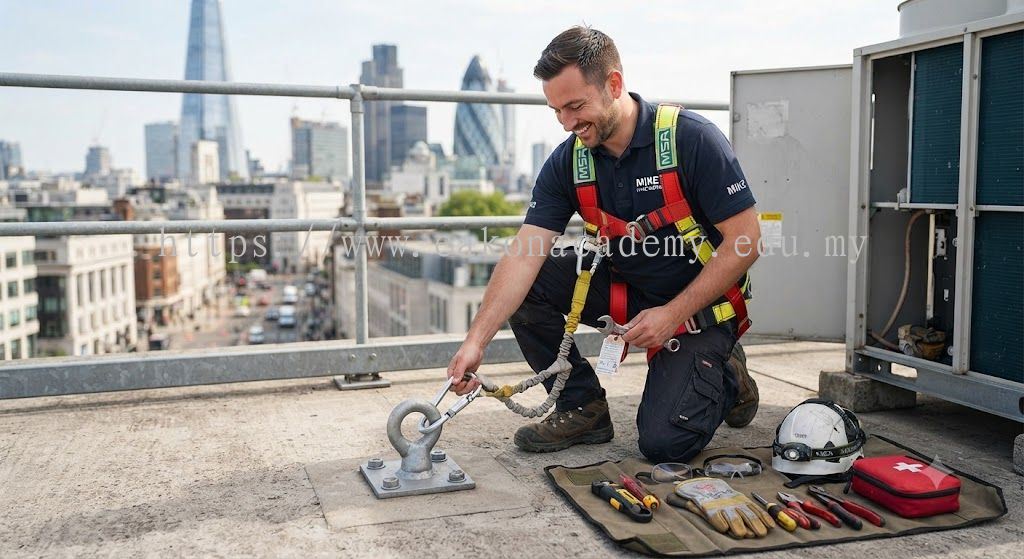
Aircond Technician Anchor Point Safety Equipment: A Complete Guide to Safe Fall Protection for HVAC Professionals
Air conditioning technicians frequently perform installation, servicing, maintenance, and repair work in elevated locations where fall hazards are a major concern. Whether installing outdoor condenser units on high-rise buildings, servicing rooftop air conditioning systems, maintaining VRF and VRV equipment, or inspecting commercial HVAC installations, technicians rely on effective fall protection systems to ensure their safety. One of the most critical components of every fall protection system is the anchor point. Understanding the correct use of aircond technician anchor point safety equipment is essential for preventing falls, reducing workplace accidents, and complying with Malaysia’s occupational safety regulations. At Eakon Academy (eakonacadem.edu.my), we provide hands-on HVAC training that combines technical air conditioning expertise with comprehensive working-at-height safety education, ensuring technicians are prepared to work safely in real-world environments.
An anchor point is the secure attachment point that connects a technician’s fall protection system to a stable structure. It forms the foundation of the entire fall arrest system because even the highest-quality safety harness and lanyard cannot provide protection if they are connected to an unsuitable anchor. Certified anchor points are specifically designed and tested to withstand the forces generated during a fall. Air conditioning technicians should always ensure that anchor points meet recognised safety standards and are capable of supporting the required load before beginning any work at height. Selecting an incorrect anchor point can result in equipment failure, serious injury, or fatal accidents.
The complete fall protection system used by HVAC technicians consists of several essential components working together. These include a full-body safety harness, shock-absorbing lanyard or self-retracting lifeline (SRL), connecting hardware such as carabiners and connectors, and a certified anchor point. Each component must be compatible with the others and inspected before every use. A full-body harness distributes fall arrest forces across the shoulders, chest, thighs, and pelvis, while the lanyard or lifeline connects the technician securely to the anchor point. The anchor itself must remain stable throughout the work activity and should never be subjected to loads beyond its rated capacity.
Aircond technicians often work in challenging environments where suitable anchor points may not always be immediately available. Rooftops, balconies, elevated work platforms, mechanical plant rooms, cooling towers, and building façades each present unique challenges. Permanent anchor points installed on commercial buildings provide an excellent solution for routine maintenance activities because they are engineered specifically for fall protection. In situations where permanent anchors are unavailable, temporary anchor devices may be used, provided they are installed correctly by trained personnel and comply with recognised safety requirements. Professional HVAC safety training teaches technicians how to assess each worksite and identify the safest anchorage solution before work begins.
Technicians should never attach their fall protection equipment to unsuitable structures. Refrigerant pipes, electrical conduits, handrails, ductwork, cable trays, scaffolding components not designed for fall protection, or lightweight roof structures should never be used as anchor points. These structures may fail under fall arrest loads, placing the technician at extreme risk. Instead, certified structural steel members, engineered roof anchors, permanent fall protection systems, or approved temporary anchorage devices should always be selected according to manufacturer instructions and workplace safety procedures.
Inspection of anchor point safety equipment is a critical responsibility for every air conditioning technician. Before starting work, technicians should examine anchor devices, connectors, carabiners, and associated hardware for signs of corrosion, deformation, cracks, loose fasteners, excessive wear, or other damage. Harnesses and lanyards should also be inspected for damaged stitching, worn webbing, frayed edges, or defective buckles. Equipment that has previously arrested a fall should be removed from service immediately and replaced, regardless of whether visible damage is present. Regular inspection and maintenance ensure the entire fall protection system remains reliable throughout its service life.
Working safely at height requires more than simply wearing protective equipment. A comprehensive workplace risk assessment should always be completed before air conditioning installation or maintenance begins. HVAC technicians should evaluate roof conditions, structural stability, weather, overhead electrical hazards, access routes, falling object risks, and the location of suitable anchor points. The risk assessment helps determine whether additional control measures such as guardrails, elevated work platforms, scaffolding, or exclusion zones are required. Proper planning allows technicians to identify hazards early and select the most appropriate safety equipment for the job.
Elevated work platforms (EWPs) such as boom lifts and scissor lifts are commonly used during commercial HVAC projects and often provide safer access than ladders. When working from an elevated work platform, technicians should follow the manufacturer's operating procedures and wear fall protection equipment whenever required. They should understand platform load limits, emergency controls, inspection procedures, and safe operating techniques. Correct use of elevated work platforms significantly reduces fall risks while improving efficiency during air conditioning installation and maintenance.
Ladder safety remains an important consideration for residential air conditioning technicians. Before climbing, ladders should be inspected for structural damage, loose fittings, or worn anti-slip feet. Ladders should be positioned on firm, level surfaces and secured to prevent movement. Maintaining three points of contact, avoiding overreaching, and using tool belts instead of carrying equipment by hand all contribute to safer ladder use. However, where work is prolonged or involves heavy equipment, elevated work platforms or scaffolding may provide a safer solution than ladders.
Emergency rescue planning is another essential aspect of working with anchor point safety equipment. Every work-at-height activity should include a documented rescue plan outlining procedures for safely recovering a worker following a fall. Air conditioning technicians should understand suspension trauma, emergency communication procedures, first aid response, and rescue equipment operation. Regular emergency drills help ensure that rescue can be performed quickly and effectively, reducing the severity of injuries if an incident occurs.
Continuous safety training is essential as HVAC technology, workplace regulations, and fall protection equipment continue to evolve. Technicians should receive regular instruction covering harness inspection, anchor point selection, fall clearance calculations, elevated work platform safety, ladder safety, hazard identification, emergency response, and occupational health requirements. Employers who invest in ongoing work-at-height training create safer workplaces, reduce accident rates, improve productivity, and strengthen compliance with Malaysian safety legislation.
At Eakon Academy (eakonacadem.edu.my), we are committed to developing highly skilled HVAC professionals who understand that workplace safety is fundamental to successful air conditioning installation and servicing. Our comprehensive training programmes combine practical HVAC technical skills with specialised education in anchor point safety equipment, fall protection systems, risk assessments, elevated work platforms, ladder safety, emergency rescue procedures, and occupational health best practices. Students gain valuable hands-on experience using industry-standard equipment under the guidance of experienced instructors, preparing them for the demands of Malaysia’s rapidly growing HVAC industry. By understanding and correctly applying Aircond Technician Anchor Point Safety Equipment, technicians can minimise fall hazards, protect themselves and their colleagues, comply with occupational safety regulations, improve customer confidence, and deliver safe, efficient, and professional air conditioning services that meet the highest industry standards.
More detail about EAKON ACADEMY SDN BHD Malaysia
