
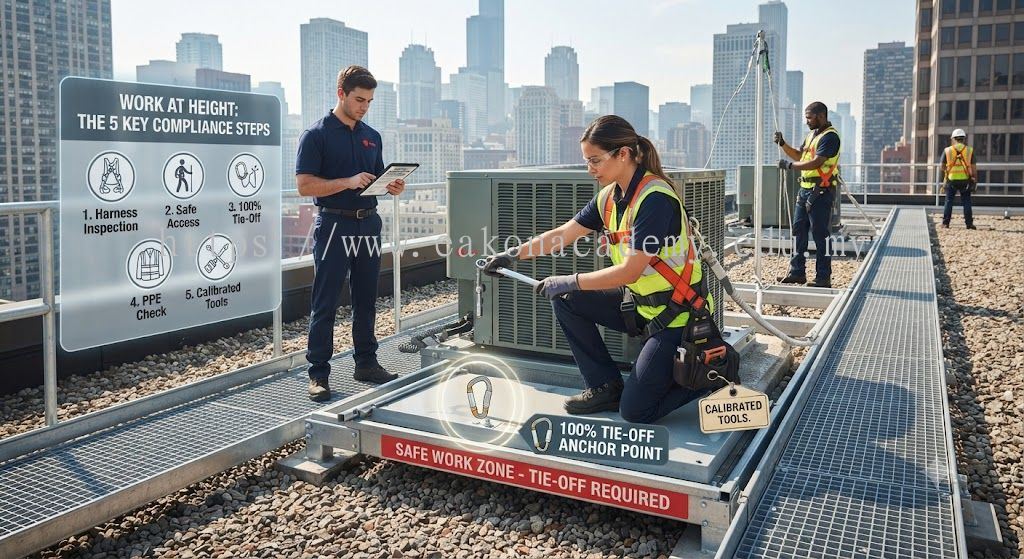
HVAC Work at Height Compliance Standards: A Complete Guide to Safe and Compliant Air Conditioning Operations
HVAC work at height compliance standards are essential for ensuring the safety of air conditioning technicians, refrigeration engineers, HVAC installers, maintenance personnel, mechanical contractors, and facility management professionals who regularly perform work at elevated locations. Modern heating, ventilation, air conditioning, and refrigeration (HVACR) systems are commonly installed on rooftops, commercial buildings, industrial facilities, hospitals, hotels, shopping malls, warehouses, factories, and high-rise developments where technicians are exposed to significant fall hazards. Working at height without proper safety controls can result in serious injuries, equipment damage, project delays, and legal consequences. Following recognised compliance standards helps HVAC companies create safer workplaces, improve operational efficiency, meet regulatory obligations, and build stronger customer confidence. At eakonacadem.edu.my, we provide industry-focused HVAC safety training that combines technical air conditioning knowledge with practical working at height compliance practices, preparing technicians to perform their duties safely while meeting industry expectations.
Compliance with HVAC work at height standards begins with understanding the responsibilities of employers, supervisors, and technicians. Every organisation involved in HVAC installation, servicing, maintenance, or repair should establish safe work procedures that prioritise hazard elimination and risk reduction before work begins. Employers should provide appropriate training, certified personal protective equipment, safe access systems, competent supervision, and documented safety procedures for all personnel working at height. Likewise, technicians have a responsibility to follow established safety procedures, inspect equipment before use, report hazards immediately, and participate in ongoing safety training. A strong safety culture supported by clear compliance standards benefits both employees and employers while improving workplace performance.
One of the most important compliance requirements is conducting a comprehensive workplace risk assessment before every elevated HVAC task. Technicians should inspect rooftops, roof edges, ladders, scaffolding, Mobile Elevated Work Platforms (MEWPs), suspended ceilings, access routes, skylights, structural stability, nearby electrical hazards, weather conditions, and emergency rescue access. Identifying potential hazards allows contractors to implement suitable control measures before installation or maintenance work begins. Proper documentation of risk assessments also demonstrates regulatory compliance and supports continuous improvement in workplace safety management.
Fall prevention and fall protection remain the core elements of HVAC work at height compliance standards. Wherever possible, hazards should be eliminated through proper planning, engineering controls, or safer work methods. When fall hazards cannot be completely eliminated, technicians should use certified fall protection equipment including full-body safety harnesses, shock-absorbing lanyards, self-retracting lifelines, horizontal lifeline systems, and approved anchor points. All fall protection equipment should comply with recognised safety standards and undergo regular inspection before every use. Technicians should also receive practical training in the correct selection, fitting, adjustment, inspection, and use of fall arrest systems to ensure maximum protection while working on rooftops or elevated structures.
Safe access equipment is another major requirement under HVAC work at height compliance standards. Ladders should only be used for short-duration work and should always be inspected before use. They must be placed on firm and level surfaces, secured against movement, and used according to manufacturer recommendations. For larger commercial HVAC projects, scaffolding, boom lifts, scissor lifts, and Mobile Elevated Work Platforms provide safer working platforms. Operators should be properly trained, understand equipment limitations, conduct pre-operation inspections, and follow safe operating procedures to minimise the risk of falls or equipment failure.
Personal protective equipment (PPE) forms another critical part of compliance. Air conditioning technicians should wear safety helmets with chin straps, anti-slip safety footwear, protective gloves, eye protection, hearing protection where appropriate, and high-visibility clothing. PPE complements fall protection systems by reducing injuries caused by falling objects, electrical hazards, sharp metal edges, refrigerant exposure, and slips on rooftop surfaces. Regular inspection, maintenance, and replacement of damaged PPE ensure continued protection and support compliance with workplace safety requirements.
Electrical safety is closely integrated with work at height compliance because HVAC technicians frequently work near rooftop electrical switchboards, transformers, disconnect switches, compressors, control panels, and live power supplies. Before performing electrical work, lockout/tagout procedures should be implemented whenever possible to isolate hazardous energy sources. Electrical isolation should be verified using approved testing equipment, and insulated tools should always be used when working on electrical systems. Proper electrical safety procedures reduce the likelihood of electric shock and secondary incidents that may result in falls from height.
Weather conditions should always be considered when applying HVAC work at height compliance standards. Rain, thunderstorms, strong winds, excessive heat, and slippery roof surfaces create additional workplace hazards that increase the likelihood of accidents. Contractors should monitor weather forecasts continuously and suspend rooftop work whenever environmental conditions become unsafe. Safe scheduling protects technicians while preserving equipment, maintaining installation quality, and preventing avoidable incidents.
Emergency preparedness is another essential compliance requirement. Every HVAC worksite should have a documented emergency response plan that includes rescue procedures for suspended workers, first aid equipment, communication systems, emergency contact information, evacuation routes, and designated rescue personnel. Regular emergency response drills help technicians understand rescue procedures, suspension trauma awareness, and incident reporting requirements. Well-prepared emergency systems significantly reduce injury severity and improve overall workplace safety performance.
Continuous training and competency development are fundamental to maintaining compliance standards. HVAC technicians should regularly attend certified working at height courses, fall protection training, safety harness training, ladder safety instruction, Mobile Elevated Work Platform (MEWP) operator courses, workplace risk assessment training, electrical safety education, manual handling instruction, and emergency rescue programmes. Ongoing professional development ensures technicians remain current with evolving safety regulations, modern equipment technologies, and industry best practices while strengthening their technical competence and employability.
At eakonacadem.edu.my, we are committed to producing highly skilled HVAC professionals through practical, industry-oriented training programmes that integrate advanced air conditioning technical expertise with internationally recognised work at height compliance standards. Our hands-on courses cover rooftop safety, fall protection systems, safety harness training, ladder safety, MEWP operation, workplace risk assessment, electrical safety, emergency rescue planning, occupational safety compliance, and practical HVAC installation and maintenance techniques. Students gain valuable real-world experience that prepares them for residential, commercial, and industrial HVAC careers throughout Malaysia. By understanding and applying HVAC work at height compliance standards, technicians can reduce workplace accidents, improve operational efficiency, comply with legal and industry requirements, strengthen customer confidence, and build successful long-term careers in the air conditioning and refrigeration industry. Choosing eakonacadem.edu.my for professional HVAC safety training demonstrates a commitment to excellence, regulatory compliance, and creating safer workplaces for the future.
More detail about EAKON ACADEMY SDN BHD Malaysia
