
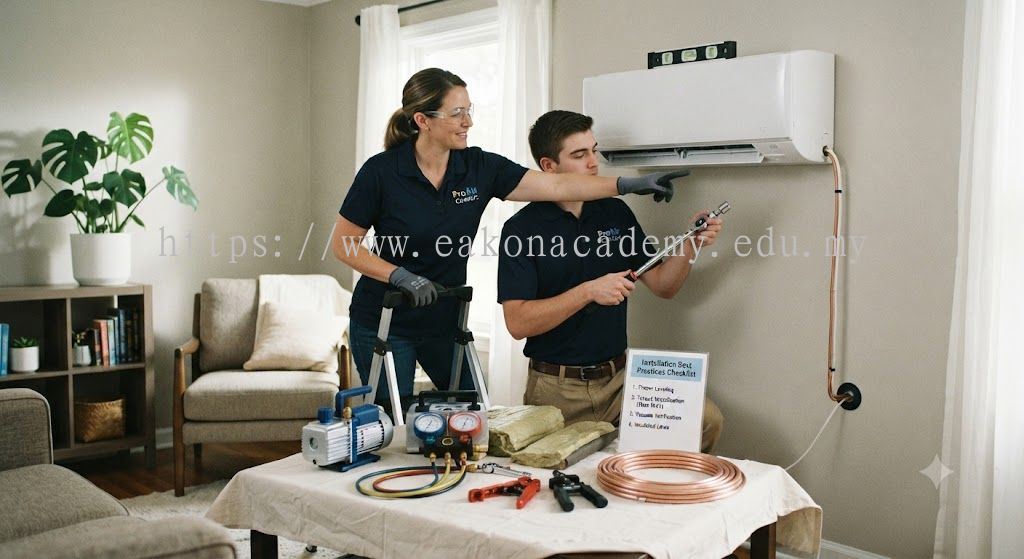
HVAC Installation Procedures Best Practices for Professional Training and High-Quality System Installation
HVAC installation procedures best practices are essential guidelines that help HVAC technicians perform heating, ventilation, and air conditioning installations safely, accurately, and efficiently. Proper installation procedures ensure that HVAC systems operate at optimal performance, improve energy efficiency, reduce maintenance requirements, and provide long-term reliability. A professional HVAC installation requires detailed planning, technical knowledge, correct equipment handling, and quality workmanship. Eakon Academy provides professional HVAC training programs designed to develop practical skills and technical expertise in HVAC installation procedures best practices for individuals pursuing careers in the HVAC industry.
A successful HVAC installation begins with proper preparation and assessment of the installation site. Technicians must inspect building conditions, evaluate system requirements, review equipment specifications, and prepare the necessary tools and materials before beginning installation work. Following a structured installation procedure helps prevent mistakes and ensures that every stage of the project is completed according to industry standards. Professional HVAC training teaches participants how to approach installation tasks systematically and maintain high-quality workmanship.
One of the most important HVAC installation procedures best practices is selecting and positioning the HVAC equipment correctly. Proper equipment selection ensures that the system can meet the heating and cooling requirements of the space. Technicians must consider factors such as system capacity, airflow requirements, energy efficiency, and application conditions. Correct placement of indoor and outdoor units also plays an important role in system performance, allowing effective airflow, proper heat exchange, and easier maintenance access.
Refrigerant piping installation is another critical procedure in HVAC system installation. Technicians must follow correct methods for pipe measurement, cutting, bending, flaring, brazing, insulation, and connection. Proper refrigerant piping ensures efficient refrigerant circulation and prevents common issues such as leaks, pressure imbalance, and reduced cooling performance. Professional HVAC training provides hands-on experience in refrigerant system preparation, vacuum procedures, pressure testing, and proper charging methods.
Electrical installation procedures are also essential for safe and reliable HVAC operation. Technicians must understand power supply requirements, wiring connections, circuit protection, grounding methods, and control system installation. Incorrect electrical work can cause equipment failure, safety hazards, and unstable system performance. By following professional electrical installation procedures, HVAC technicians can ensure that systems operate safely and efficiently.
Proper airflow and ventilation setup are important parts of HVAC installation procedures best practices. Technicians must ensure that ductwork, air filters, fans, and ventilation components are installed correctly to achieve balanced airflow throughout the building. Poor airflow management can reduce comfort, increase energy consumption, and create unnecessary stress on HVAC equipment. Professional training helps technicians understand airflow principles and apply suitable installation techniques.
After completing installation work, system testing and commissioning must be performed to confirm proper operation. Technicians should check refrigerant conditions, electrical performance, temperature output, airflow levels, and control system operation. These procedures help identify installation issues and ensure that the HVAC system meets performance expectations. Accurate commissioning improves system reliability and provides better value to customers.
Safety is a fundamental part of HVAC installation procedures best practices. Technicians must follow workplace safety requirements, use appropriate tools, handle refrigerants correctly, and apply safe working methods when installing HVAC equipment. Maintaining safety standards protects technicians, customers, and the equipment throughout the installation process.
Learning professional HVAC installation procedures best practices helps technicians improve their technical abilities, increase workplace confidence, and provide higher-quality services. Skilled HVAC professionals can deliver efficient installation solutions that support energy savings, system reliability, and customer satisfaction.
Eakon Academy offers HVAC training courses focused on practical installation methods, troubleshooting techniques, and industry-relevant skills. By mastering HVAC installation procedures best practices, participants can develop the expertise required to handle modern HVAC systems and prepare for professional opportunities in installation, servicing, and maintenance. Comprehensive HVAC education helps create qualified technicians capable of delivering safe, efficient, and reliable HVAC solutions for residential, commercial, and industrial applications.
More detail about EAKON ACADEMY SDN BHD Malaysia
