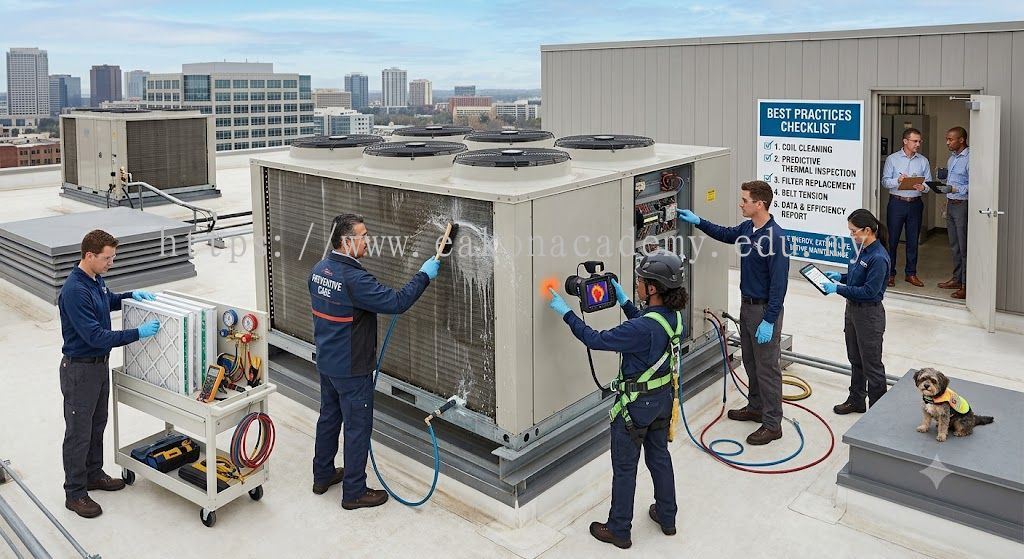
Commercial HVAC Maintenance Best Practices for Reliable Building Cooling Performance and Professional Technician Training
Commercial HVAC maintenance best practices are essential for maintaining efficient, reliable, and cost-effective heating, ventilation, and air conditioning systems in commercial buildings. Proper HVAC maintenance helps businesses reduce operational costs, improve indoor comfort, prevent unexpected equipment failures, and extend the lifespan of expensive cooling systems. At Eakon Academy, we provide professional HVAC training programs that focus on practical commercial HVAC servicing techniques, preventive maintenance procedures, troubleshooting skills, and industry-standard maintenance practices for technicians and engineering professionals.
Commercial HVAC systems operate continuously to provide comfortable indoor environments for offices, shopping malls, factories, hospitals, hotels, and other commercial facilities. Due to their larger capacity and complex design, these systems require systematic maintenance planning and skilled technicians who understand proper inspection, servicing, and repair procedures. Learning commercial HVAC maintenance best practices enables technicians to identify potential issues early, improve system performance, and maintain reliable cooling operations throughout the year.
One of the most important commercial HVAC maintenance best practices is implementing a regular preventive maintenance schedule. Routine inspections allow technicians to check critical components such as air filters, evaporator coils, condenser coils, fans, compressors, electrical controls, and refrigerant systems. Regular maintenance helps prevent dirt accumulation, airflow problems, mechanical failures, and reduced cooling efficiency. A well-planned preventive maintenance program ensures that commercial HVAC systems continue operating at optimal performance while reducing costly emergency repairs.
Airflow management is another essential aspect of commercial HVAC maintenance. Blocked filters, dirty duct systems, and restricted airflow can significantly reduce system efficiency and increase energy consumption. Professional HVAC technicians must understand proper cleaning methods, airflow measurement, and system adjustment techniques to maintain balanced air distribution. Through hands-on HVAC training, participants can develop the skills needed to perform accurate inspections and improve overall system efficiency.
Refrigerant management is also a key part of commercial HVAC maintenance best practices. Incorrect refrigerant levels, leakage problems, or improper charging methods can affect cooling capacity and increase energy usage. Qualified HVAC technicians need knowledge of refrigerant pressure testing, leak detection, recovery procedures, vacuum techniques, and charging processes to maintain safe and efficient system operation. Eakon Academy’s HVAC courses provide practical training to help participants understand modern refrigerant handling requirements and professional servicing methods.
Electrical system inspection plays an important role in commercial HVAC maintenance. Technicians should regularly examine wiring connections, control panels, capacitors, contactors, motors, and safety devices to prevent electrical failures and equipment damage. Proper electrical troubleshooting skills allow technicians to quickly diagnose system problems and perform effective repairs. These maintenance practices improve equipment reliability while ensuring safer HVAC operations in commercial environments.
Another important practice is maintaining accurate service records and performance reports. Commercial facilities require detailed maintenance documentation to track equipment conditions, identify repeated problems, and plan future servicing activities. Proper maintenance records help facility managers make informed decisions regarding repairs, replacements, and energy improvement strategies. Professional HVAC technicians trained in maintenance documentation can provide better service quality and improve customer confidence.
Energy efficiency is a major goal of commercial HVAC maintenance. Regular servicing reduces unnecessary energy consumption, improves system performance, and helps businesses lower operating expenses. Well-maintained HVAC equipment provides consistent cooling comfort while supporting sustainable building operations. Proper maintenance practices also help reduce environmental impact by ensuring efficient refrigerant usage and minimizing system losses.
Eakon Academy offers comprehensive HVAC training courses designed to develop skilled technicians with strong knowledge of commercial HVAC maintenance, system troubleshooting, equipment servicing, and preventive maintenance strategies. Our training programs are suitable for new learners, experienced technicians, contractors, and industry professionals who want to enhance their technical expertise and career opportunities.
By understanding and applying commercial HVAC maintenance best practices, technicians can deliver higher-quality services, improve equipment reliability, and support efficient building operations. Visit eakonacadem.edu.my to discover professional HVAC training programs that prepare you with practical skills and industry knowledge required for modern commercial HVAC maintenance and servicing applications.
More detail about EAKON ACADEMY SDN BHD Malaysia