Brazing vs Soldering HVAC Differences – Understanding the Correct Pipe Joining Method for Professional HVAC Systems
Understanding the brazing vs soldering HVAC differences is an important topic for HVAC technicians, refrigeration engineers, and industry professionals who want to achieve reliable, safe, and long-lasting air conditioning and refrigeration installations. Selecting the correct copper pipe joining method plays a major role in maintaining HVAC system performance, preventing refrigerant leaks, and improving overall equipment efficiency. Eakon Academy provides professional HVAC training programs designed to help students and technicians develop essential skills in refrigeration technology, copper pipe installation, brazing techniques, and modern air conditioning system maintenance.
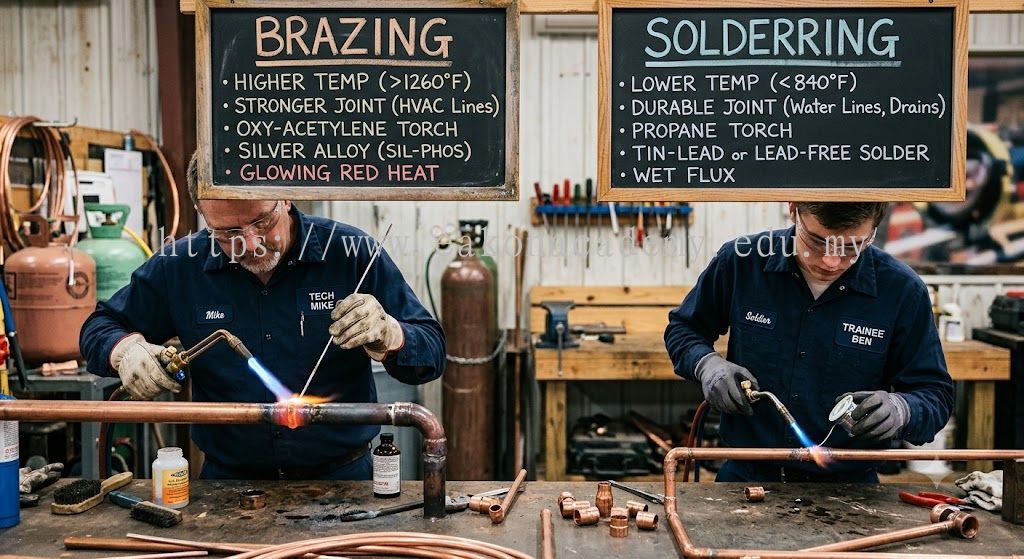
The main difference between brazing and soldering HVAC systems is the temperature used, filler material, joint strength, and application suitability. Brazing is a high-temperature joining process where the filler metal melts above 450°C, while soldering uses a lower-temperature process where the filler material melts below 450°C. Because brazing creates stronger and more heat-resistant joints, it is the preferred method for most HVAC refrigeration systems that operate under high pressure and continuous temperature changes.
Brazing HVAC pipes is commonly used for refrigeration copper tubing, air conditioning systems, VRF and VRV systems, chillers, commercial cooling equipment, and industrial refrigeration applications. The brazing process requires heating the copper pipe joint area using an oxy-acetylene torch or suitable brazing equipment until the correct temperature is reached. The brazing alloy then flows into the joint through capillary action, creating a strong connection between the copper tubes. This method provides excellent durability, vibration resistance, and pressure tolerance, making it suitable for demanding HVAC environments.
In comparison, soldering HVAC pipes is generally used for lower-pressure applications where extreme strength and temperature resistance are not required. Soldering uses softer filler materials and lower heating temperatures, making it easier to perform but less suitable for refrigeration circuits. Modern HVAC systems require reliable connections because refrigerant lines operate under pressure and are exposed to expansion, contraction, and mechanical vibration. Poor pipe joining methods may result in refrigerant leakage, reduced cooling performance, and increased repair costs.
One of the important brazing vs soldering HVAC differences is the level of preparation and technical skill required. Professional HVAC brazing requires proper copper tube cleaning, correct joint clearance, accurate flame control, and suitable filler rod selection. Technicians must also understand nitrogen purging techniques during brazing to prevent oxidation inside copper pipes. Internal oxidation can create harmful contaminants that may damage compressors, expansion valves, and other refrigeration components. Proper brazing procedures help maintain system cleanliness and improve equipment reliability.
Another major difference is the strength and lifespan of the connection. Brazed joints are designed to withstand high-pressure refrigerants and harsh operating conditions, making them the standard choice for professional HVAC installations. Soldered joints may be acceptable for certain applications, but they are generally not recommended for critical refrigeration piping where safety and durability are priorities.
Eakon Academy focuses on providing practical HVAC training that equips technicians with industry-relevant knowledge and hands-on experience. Our courses cover essential skills such as copper pipe brazing, refrigeration system installation, air conditioning servicing, refrigerant handling, and professional troubleshooting techniques. Learning the correct brazing vs soldering HVAC differences helps technicians make better decisions during installation, repair, and maintenance work.
For individuals searching for HVAC brazing training, refrigeration copper pipe joining techniques, air conditioning installation courses, and professional HVAC technician skills, understanding the differences between brazing and soldering is a fundamental requirement. Proper training improves workmanship quality, enhances system reliability, and helps HVAC professionals meet modern industry standards.
Visit eakonacadem.edu.my to explore professional HVAC training programs and develop the technical expertise needed for today’s air conditioning and refrigeration industry. Mastering the brazing vs soldering HVAC differences allows technicians to perform safer installations, reduce system problems, and build stronger career opportunities in the HVAC field.
More detail about EAKON ACADEMY SDN BHD Malaysia