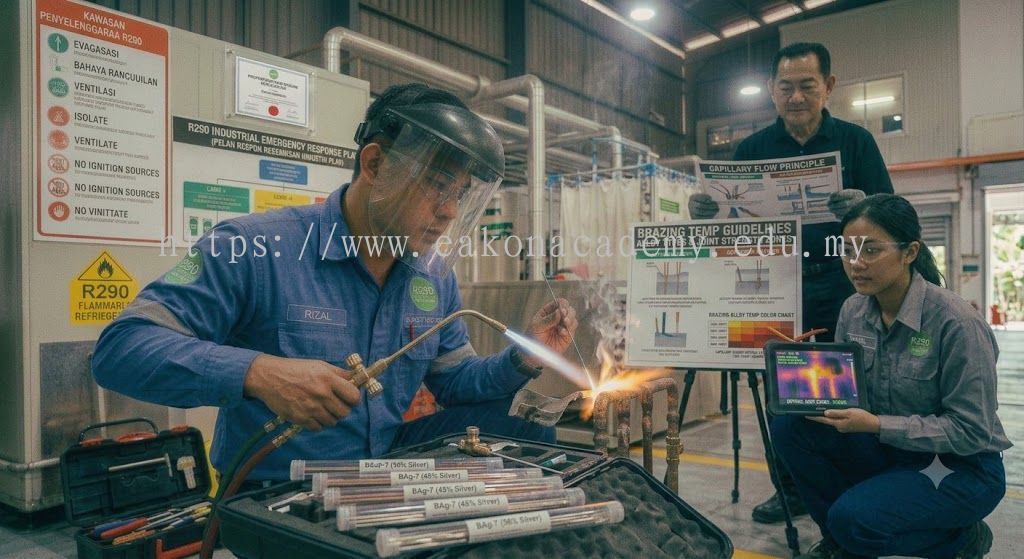
HVAC Brazing Temperature Control: Precision Techniques for Strong and Leak-Free Copper Pipe Joints
HVAC brazing temperature control is one of the most critical skills in air conditioning and refrigeration installation, directly affecting the strength, reliability, and leak-free performance of copper pipe connections. Proper temperature management ensures that brazing filler material flows correctly into the joint, creating a strong bond between copper surfaces without damaging the tubing. In modern HVAC systems, where refrigerant pressure and efficiency standards are increasingly demanding, precise temperature control during brazing is essential. At Eakon Academy, HVAC training programs focus on teaching technicians how to master brazing temperature control to achieve professional-quality installation results.
HVAC brazing temperature control refers to the ability to regulate heat during the brazing process so that the copper joint reaches the correct temperature range for proper filler metal flow. If the temperature is too low, the brazing material will not melt or flow properly, resulting in weak joints and potential refrigerant leakage. If the temperature is too high, the copper pipe may become oxidized, weakened, or even damaged, reducing the long-term durability of the system. Understanding how to maintain the correct heat balance is a fundamental skill for every HVAC technician working with refrigeration piping.
One of the key aspects of HVAC brazing temperature control is understanding heat distribution across the copper joint. Technicians must apply heat evenly around the fitting rather than focusing on a single point. This ensures that the entire joint reaches the correct brazing temperature simultaneously, allowing the filler material to flow smoothly through capillary action. Proper torch movement, flame adjustment, and distance control all play a role in achieving consistent heat distribution during brazing operations.
Another important factor in temperature control is recognizing the correct brazing temperature visually and practically. Experienced HVAC technicians learn to identify changes in copper color, brightness, and heat response as indicators of proper temperature levels. The copper surface typically changes appearance as it approaches brazing temperature, helping technicians determine when to apply the filler rod. This skill is essential for producing strong and reliable brazed joints in air conditioning and refrigeration systems.
Nitrogen purging also supports better HVAC brazing temperature control by maintaining internal pipe cleanliness during heating. When copper tubing is exposed to high temperatures, oxidation can occur inside the pipe, affecting system performance. By introducing nitrogen flow during brazing, technicians can reduce internal oxidation and maintain better overall system quality. This ensures that temperature-controlled brazing results in clean, efficient, and durable refrigeration piping.
Selecting the correct torch settings is another critical part of HVAC brazing temperature control. Different pipe sizes and joint types require different levels of heat input. Technicians must adjust flame intensity and fuel-oxygen balance to achieve optimal heating conditions. Proper torch control ensures that the brazing filler material melts at the correct rate and forms a strong, uniform bond between copper components.
Cooling and post-brazing temperature management are also important steps in the process. After brazing is completed, joints should be allowed to cool naturally to prevent thermal stress or cracking. Rapid cooling methods should be avoided, as they may weaken the structural integrity of the brazed connection. Proper cooling practices help ensure long-lasting joint strength and system reliability.
At Eakon Academy, HVAC training emphasizes practical learning of brazing temperature control techniques through hands-on exercises and real-world applications. Technicians are trained to understand heat behavior, flame control, and proper brazing procedures to ensure high-quality installation work. This training helps build confidence and technical accuracy in refrigeration piping systems.
Mastering HVAC brazing temperature control is essential for technicians who want to achieve professional standards in air conditioning and refrigeration work. Proper temperature management improves joint strength, reduces refrigerant leakage risks, and enhances overall system efficiency. With strong technical training and practical experience, HVAC professionals can deliver reliable, high-performance cooling systems for residential, commercial, and industrial applications.
More detail about EAKON ACADEMY SDN BHD Malaysia