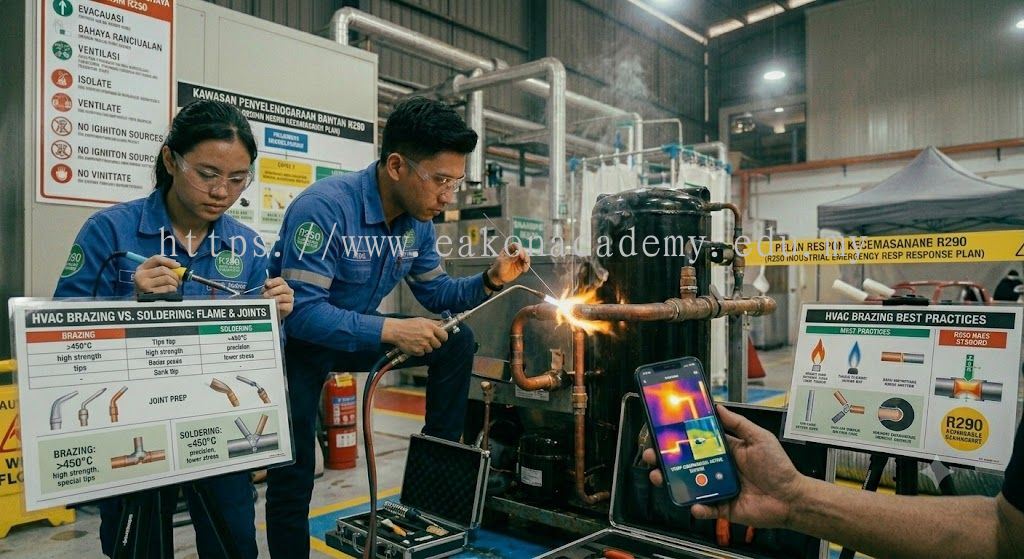
Brazing vs Soldering HVAC: Understanding the Differences for Professional Air Conditioning and Refrigeration Pipe Joining
Brazing vs soldering HVAC is an important topic for technicians, installers, and professionals working in air conditioning and refrigeration systems. Understanding the difference between brazing and soldering helps HVAC technicians choose the correct joining method for copper pipes, refrigerant lines, and system components. The right connection technique directly affects system reliability, refrigerant leak prevention, energy efficiency, and long-term equipment performance. At Eakon Academy, professional HVAC training focuses on developing practical knowledge of pipe joining methods, refrigeration installation techniques, and industry best practices to help technicians achieve high-quality workmanship.
Brazing and soldering are both metal joining processes that use a filler material to connect components, but they operate at different temperature levels and are used for different applications. Brazing involves using a filler metal that melts at a higher temperature, typically above 450°C, creating strong joints suitable for high-pressure HVAC and refrigeration systems. Soldering uses a lower melting temperature filler material and is commonly used for applications that require less mechanical strength. Understanding brazing vs soldering HVAC allows technicians to select the appropriate method based on system requirements.
In air conditioning and refrigeration applications, brazing is the preferred method for joining copper refrigerant pipes because HVAC systems operate under high pressure and continuous temperature changes. Brazed joints provide stronger mechanical connections that can withstand vibration, pressure fluctuations, and demanding operating conditions. This makes brazing essential for refrigerant piping installation, compressor connections, condenser lines, evaporator connections, and other critical HVAC components.
Soldering, while useful in certain plumbing and low-pressure applications, is generally not recommended for modern refrigerant piping systems that require high strength and durability. The lower bonding strength of soldered joints may increase the risk of failure when exposed to refrigerant pressure, thermal expansion, and system vibration. For this reason, professional HVAC technicians are trained to use brazing techniques when installing and repairing air conditioning and refrigeration systems.
One of the major differences between brazing and soldering HVAC applications is the strength and temperature resistance of the final joint. Brazed connections provide excellent durability because the filler material creates a strong bond between metal surfaces without melting the base copper tubing. This allows the pipe structure to maintain its integrity while providing reliable performance throughout the lifespan of the HVAC system. Soldered connections may be suitable for some low-pressure applications but generally do not provide the same level of reliability required for refrigeration systems.
Another important consideration when comparing brazing vs soldering HVAC methods is the impact on system cleanliness and safety. During HVAC brazing, technicians often use nitrogen purging to prevent oxidation inside copper tubing. This helps protect system components from contamination and supports better cooling efficiency. Proper brazing procedures, including surface preparation, correct heating control, and suitable filler rod selection, are essential for creating leak-free refrigeration connections.
Professional HVAC training provides technicians with the knowledge required to understand when and why brazing should be used instead of soldering. By learning correct brazing techniques, technicians can improve installation quality, reduce refrigerant leakage risks, and provide more reliable air conditioning services. Eakon Academy supports HVAC professionals through practical education that covers essential skills such as copper pipe joining, refrigeration system installation, and maintenance procedures.
Understanding brazing vs soldering HVAC is a valuable skill for anyone working in the air conditioning and refrigeration industry. Choosing the correct joining method improves system safety, enhances equipment performance, and reduces future repair costs. As HVAC technology continues to develop with advanced refrigerants and higher efficiency requirements, professional brazing knowledge remains a critical competency for modern technicians.
By mastering the differences between brazing and soldering, HVAC professionals can make better installation decisions and achieve higher standards of workmanship. Proper training in HVAC pipe joining techniques helps technicians build confidence, improve technical abilities, and deliver reliable cooling solutions for residential, commercial, and industrial applications.
More detail about EAKON ACADEMY SDN BHD Malaysia