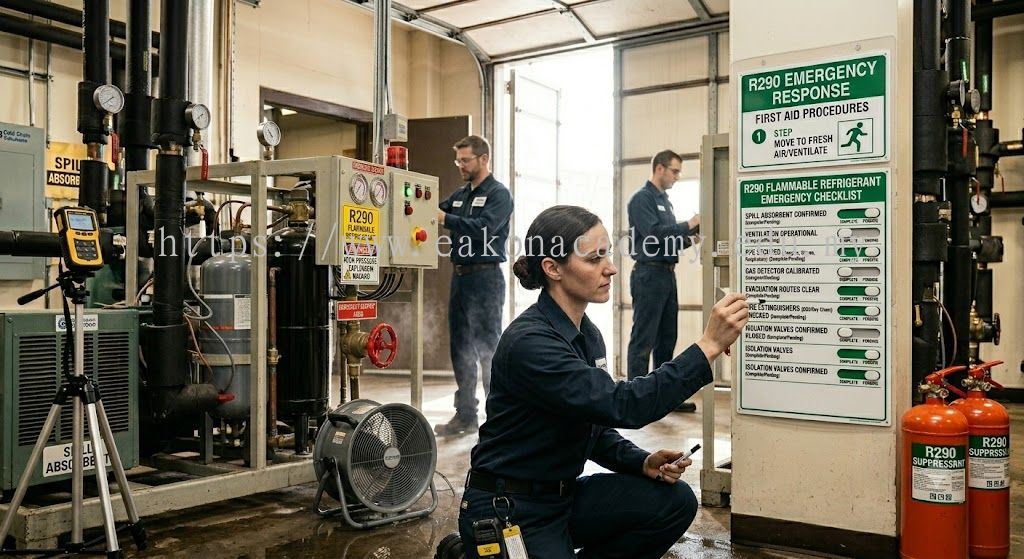
R290 EMERGENCY SAFETY CHECKLIST – HVAC RISK MANAGEMENT, FLAMMABLE REFRIGERANT SAFETY PROTOCOLS, AND INDUSTRIAL COMPLIANCE GUIDE
An R290 emergency safety checklist is an essential tool in modern HVAC and refrigeration safety management, designed to ensure structured, consistent, and effective response to emergencies involving propane (R290) refrigerant systems. As the HVAC industry continues to adopt environmentally friendly refrigerants with low global warming potential (GWP), R290 has become a widely used solution in residential, commercial, and industrial cooling systems. However, due to its highly flammable nature, strict safety measures are required. An R290 emergency safety checklist provides technicians and engineers with a clear step-by-step guide to manage risks, prevent accidents, and ensure safe system operation under emergency conditions.
The purpose of an R290 emergency safety checklist is to standardize emergency preparedness and response procedures. It helps HVAC professionals quickly identify hazards, take immediate corrective actions, and minimize the risk of fire, explosion, or equipment damage. Since R290 is a hydrocarbon refrigerant, even minor leaks can create hazardous conditions if exposed to ignition sources. Therefore, the checklist begins with essential safety verifications such as ensuring gas detection systems are active, confirming proper ventilation, and verifying that all emergency shutoff systems are operational.
A key element in the R290 emergency safety checklist is leak detection and hazard identification. Technicians must confirm whether hydrocarbon gas detectors are functioning correctly and properly calibrated. If a leak is suspected or detected, the checklist requires immediate activation of alarm systems and notification of all personnel in the affected area. Early detection is critical in preventing escalation, as R290 can quickly reach flammable concentrations in confined environments.
Another important step in the checklist is the elimination of ignition sources. This includes ensuring that all electrical equipment is switched off, avoiding the use of mobile devices, and confirming that no open flames or spark-producing tools are present. The checklist emphasizes strict control measures because even a small ignition source can trigger combustion when R290 is present. Once the area is secured, ventilation systems must be activated to disperse the refrigerant gas and reduce its concentration to safe levels.
System shutdown and isolation procedures are also included in the R290 emergency safety checklist. Technicians must verify that emergency stop controls are accessible and functional, and that service valves can be quickly closed to isolate the refrigerant system. In many modern HVAC installations, automatic shutdown systems are integrated to improve response time and reduce human error during emergencies. These engineering safeguards are essential for minimizing risk and ensuring system stability.
Personal safety is another critical component of the checklist. Technicians must ensure the use of appropriate personal protective equipment (PPE), including anti-static clothing, gloves, safety goggles, and flame-resistant gear. The checklist also specifies that only trained and authorized personnel should handle R290 emergency situations. In high-risk scenarios, evacuation of the area is mandatory, and coordination with emergency response teams such as fire departments may be required.
Training and education play a major role in effective implementation of R290 emergency safety checklist procedures. Institutions such as eakonacadem.edu.my provide specialized HVAC training programs that equip learners with the knowledge and skills needed to safely manage flammable refrigerants. Through structured coursework, hands-on training, and emergency simulations, technicians learn how to apply safety checklists effectively in real-world situations. Compliance with international safety standards such as ISO 817 and EN 378 further strengthens professional competency and industry safety practices.
Post-emergency procedures are also included in advanced safety checklists. After an incident involving R290, the system must be inspected, repaired, and tested before being returned to operation. Proper documentation is required to record the incident, response actions, and corrective measures taken. This ensures continuous improvement in safety systems and helps prevent future occurrences.
From an SEO perspective, R290 emergency safety checklist is a highly valuable keyword for HVAC training providers, refrigeration safety educators, and industrial safety platforms. By publishing detailed and informative content on this topic, websites such as eakonacadem.edu.my can significantly improve search engine rankings, attract targeted organic traffic, and strengthen domain authority. This positions the website as a trusted resource for HVAC professionals and learners seeking advanced refrigeration safety knowledge.
In conclusion, an R290 emergency safety checklist is a vital tool for ensuring safe, structured, and effective emergency response in HVAC systems using flammable refrigerants. With proper training, adherence to safety protocols, and consistent use of checklists, risks can be significantly reduced. As the HVAC industry continues to adopt sustainable refrigerant technologies, safety checklists will remain an essential part of professional best practices.
More detail about EAKON ACADEMY SDN BHD Malaysia