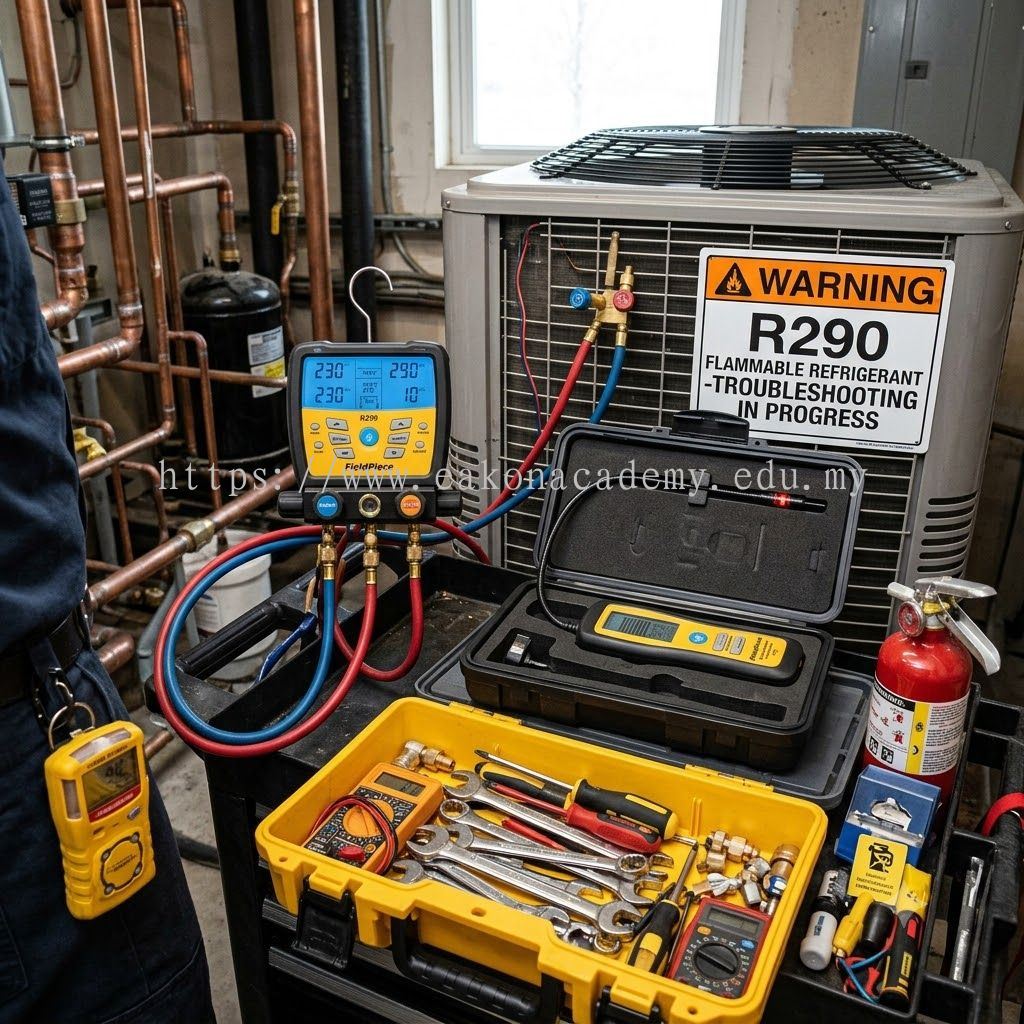
R290 HVAC System Troubleshooting Tools Guide for Professional Technicians and Sustainable Refrigeration Maintenance
R290 HVAC system troubleshooting tools are essential resources for HVAC technicians, refrigeration engineers, air conditioning contractors, and maintenance professionals who work with propane refrigerant systems. As the HVAC industry continues to adopt environmentally friendly and energy-efficient refrigeration technologies, the ability to correctly diagnose and maintain R290 systems has become an important technical skill. Proper troubleshooting requires not only knowledge of refrigeration principles but also the correct selection and application of specialised tools for system analysis, refrigerant handling, electrical testing, and safety inspection. At eakonacadem.edu.my, professional HVAC training focuses on enhancing technician competency in R290 system operation, troubleshooting methods, safe servicing practices, and the effective use of professional HVAC tools.
R290 HVAC systems have unique characteristics that require technicians to apply accurate diagnostic methods when identifying faults and maintaining system performance. Compared with traditional refrigerant systems, R290 propane refrigerant requires careful handling due to its flammable properties and specific operating conditions. Using the correct troubleshooting tools allows technicians to evaluate system performance, detect problems early, improve repair accuracy, and ensure safe operation. Professional knowledge of these tools is essential for technicians involved in installation, maintenance, and repair of R290 refrigeration and air conditioning systems.
One of the most important R290 HVAC system troubleshooting tools is the digital manifold gauge set, which allows technicians to measure refrigerant pressure and analyse system operating conditions. Accurate pressure readings help identify issues such as incorrect refrigerant charge, restricted refrigerant flow, compressor problems, and abnormal operating conditions. When combined with temperature measurements, pressure analysis helps technicians evaluate refrigeration performance and determine the correct troubleshooting approach.
Temperature measurement tools such as digital thermometers and temperature probes are also important for R290 system diagnosis. These tools help technicians monitor evaporator temperature, condenser temperature, suction line temperature, and discharge temperature. Accurate temperature data allows professionals to calculate superheat and subcooling values, evaluate heat transfer performance, and identify potential system inefficiencies.
Leak detection equipment is another critical tool for R290 HVAC troubleshooting. Since R290 propane refrigerant is classified as an A3 flammable refrigerant, detecting refrigerant leaks quickly and accurately is essential for maintaining system safety. Professional leak detection tools help technicians locate refrigerant escape points in piping connections, valves, joints, and system components. Early leak identification reduces safety risks and prevents loss of system efficiency.
Electrical testing tools are also necessary when troubleshooting R290 HVAC systems. Multimeters, clamp meters, and electrical diagnostic instruments allow technicians to inspect voltage, current, resistance, compressor operation, fan motor performance, and control circuit conditions. Many HVAC system failures are related to electrical issues, making proper electrical testing an important part of the troubleshooting process.
Refrigerant recovery equipment and accurate charging tools are also essential for safe R290 system servicing. Technicians require suitable recovery equipment, charging scales, and handling tools to ensure correct refrigerant management during repair and maintenance activities. Proper refrigerant charging improves system efficiency, prevents compressor stress, and supports reliable long-term operation.
Safety inspection tools and protective equipment are equally important when working with R290 HVAC systems. Technicians must understand the importance of ventilation monitoring, ignition source control, and safe working procedures when performing troubleshooting tasks. Proper training ensures that professionals can use troubleshooting tools effectively while maintaining safe working conditions.
As the demand for sustainable cooling technology increases, technicians with knowledge of R290 HVAC system troubleshooting tools will have valuable skills for the future HVAC industry. Correct tool selection and proper diagnostic techniques enable professionals to improve service quality, reduce equipment downtime, and maintain energy-efficient refrigeration systems.
At eakonacadem.edu.my, HVAC and ACMV training programmes are designed to equip technicians, contractors, and industry learners with practical knowledge of modern refrigeration technologies. Learning how to use R290 HVAC system troubleshooting tools helps professionals develop stronger diagnostic abilities, improve repair performance, and support the safe adoption of natural refrigerant systems. Through technical training in measurement methods, fault analysis, refrigerant handling, and safety practices, HVAC professionals can confidently manage advanced R290 applications.
Whether you are an HVAC technician, refrigeration engineer, maintenance specialist, or someone building expertise in sustainable cooling solutions, understanding R290 HVAC system troubleshooting tools provides valuable knowledge for career development. Professional training enables technicians to diagnose system problems accurately, improve energy efficiency, extend equipment lifespan, and contribute to safer and more environmentally responsible HVAC practices.
More detail about EAKON ACADEMY SDN BHD Malaysia