
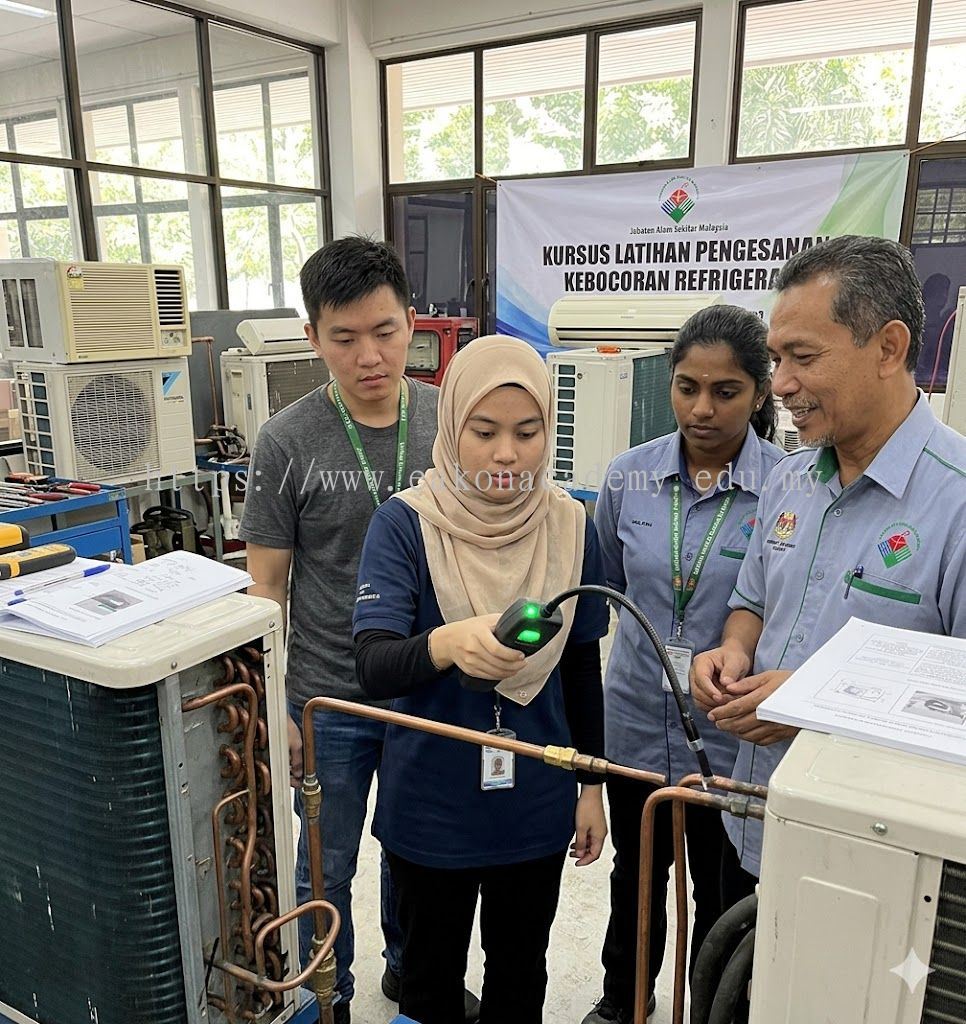
REFRIGERANT LEAK DETECTION TRAINING MALAYSIA DOE
Refrigerant leak detection training in Malaysia under DOE standards is an essential professional development program within the HVACR (Heating, Ventilation, Air Conditioning, and Refrigeration) industry. This training is designed to equip technicians, engineers, and service personnel with the knowledge and practical skills required to detect, control, and prevent refrigerant gas leaks in compliance with Department of Environment (DOE) regulations. As refrigerants such as hydrofluorocarbons (HFCs) and hydrochlorofluorocarbons (HCFCs) have high global warming potential (GWP), proper leak detection training is critical to reducing environmental impact, improving system efficiency, and ensuring regulatory compliance. Therefore, refrigerant leak detection training Malaysia DOE plays a vital role in building a competent and environmentally responsible HVACR workforce.
The primary objective of DOE-aligned refrigerant leak detection training is to provide participants with a comprehensive understanding of leak detection principles, equipment handling, and environmental safety procedures. Trainees learn how to identify refrigerant leaks early and apply correct repair and prevention techniques to minimize emissions. The training covers all stages of HVACR system operation, including installation, commissioning, maintenance, troubleshooting, and decommissioning. This ensures that technicians are fully capable of managing real-world HVACR systems while maintaining compliance with environmental regulations.
Malaysia DOE refrigerant leak detection training includes both theoretical knowledge and hands-on practical exercises. Participants are trained to inspect critical HVACR system components such as compressors, evaporators, condensers, valves, piping joints, and fittings for potential leak sources. They are also introduced to various approved leak detection methods, including electronic leak detectors, which are highly sensitive devices capable of detecting even trace amounts of refrigerant gas in the air. Pressure testing using nitrogen gas is also taught as a standard method for verifying system integrity by identifying pressure drops that indicate leaks.
Other important techniques covered in refrigerant leak detection training Malaysia DOE include ultraviolet (UV) dye testing and soap bubble testing. UV dye testing allows technicians to detect hidden or slow leaks using fluorescent dye and UV light, while soap bubble testing provides a simple and effective visual method for confirming leak points. In addition, trainees are educated on safe handling practices for different refrigerants, including low-GWP alternatives such as R32, R290 (propane), and carbon dioxide (CO ), which require careful handling due to flammability or high-pressure characteristics.
This training is aligned with international environmental agreements such as the Montreal Protocol and Kigali Amendment, which promote the reduction of high-GWP refrigerants and encourage sustainable cooling technologies. As Malaysia continues to transition toward greener HVACR solutions, refrigerant leak detection training becomes increasingly important for ensuring safety, efficiency, and environmental compliance across the industry.
Institutions such as Eakon Academy (eakonacadem.edu.my) play a key role in delivering structured HVACR training programs that align with DOE requirements and industry standards. These programs provide participants with both classroom-based learning and real-world practical training, ensuring they are fully prepared to perform professional leak detection tasks in various HVACR applications. Graduates of these programs are equipped with industry-relevant skills that enhance employability and support career advancement in the HVACR sector.
Proper documentation and reporting are also emphasized during training. Participants learn how to record leak detection activities, inspection results, repair actions, and refrigerant recovery data in accordance with DOE guidelines. This ensures transparency, supports compliance audits, and promotes continuous improvement in maintenance practices.
In conclusion, refrigerant leak detection training Malaysia DOE is essential for developing skilled HVACR professionals, ensuring environmental protection, and maintaining regulatory compliance. By undergoing structured training programs at institutions like Eakon Academy (eakonacadem.edu.my), technicians gain the expertise needed to implement effective leak detection practices, reduce refrigerant emissions, and contribute to a more sustainable and environmentally responsible HVACR industry in Malaysia.
More detail about EAKON ACADEMY SDN BHD Malaysia
