

Executing a large-scale industrial project requires a structured, multi-disciplinary approach to navigate technical complexity and regulatory requirements. From the initial conceptualization of a process plant to its final commissioning, each phase serves a specific purpose in mitigating risks and ensuring operational reliability.
For over two decades, L-Vision Engineering Pte Ltd has provided comprehensive engineering and project management services across the minerals, food processing, oil and gas, and chemical industries. Understanding the project lifecycle is essential for plant owners and stakeholders to manage budgets, timelines, and technical standards effectively.
This guide outlines the six fundamental stages of an industrial engineering project, highlighting the technical rigor required at every step.
The lifecycle begins with a feasibility study to determine if the proposed project is technically viable and economically sound. During this phase, engineers evaluate process requirements, site constraints, and preliminary regulatory considerations.
The goal of this stage is to provide stakeholders with enough data to make an informed "Go/No-Go" decision. A well-executed feasibility study prevents the waste of resources on projects that face insurmountable technical or regulatory hurdles later.
Once the project is approved, it enters the Front-End Engineering Design (FEED) phase. This is perhaps the most critical stage of the engineering lifecycle. Decisions made during FEED can significantly influence the total installed cost (TIC) and long-term operability, even though the phase represents only a small fraction of the total budget.
The FEED phase focuses on defining technical requirements and providing a firm basis for the Detailed Engineering Design (DED) for process plant engineering, industrial automation, and turnkey engineering services scopes.
In Singapore and Malaysia, FEED documentation must align with applicable international standards such as ASME B31.3, API 650, IEC, or relevant client specifications. This ensures that the technical foundation is robust before high-capital commitments are made.
The Detailed Engineering Design (DED) phase translates the FEED package into a complete set of blueprints, specifications, and 3D models required for construction and fabrication. Accuracy is paramount here; any error in DED can lead to costly rework during installation.
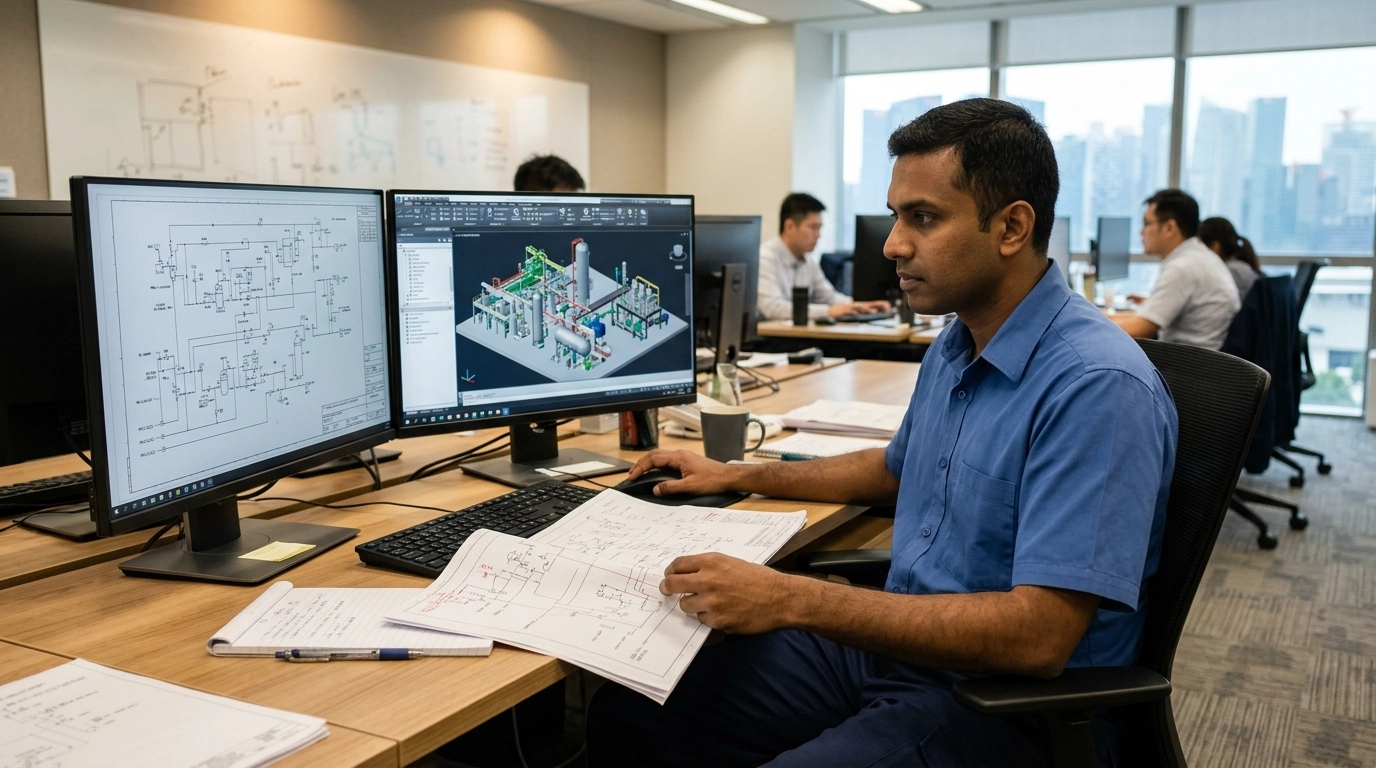
During DED, multi-disciplinary teams (Civil, Structural, Mechanical, Electrical, and Automation) work concurrently. At L-Vision Engineering, the use of 3D Plant Design and Building Information Modeling (BIM) allows for clash detection and precise spatial coordination, which is vital in the often-congested environments of chemical and food processing plants. For a brownfield plant upgrade, 3D Laser Scanning is also used to capture existing conditions and reduce clashes before site work begins.
| Standard | Application in DED |
|---|---|
| ASME B31.3 | Design and material selection for process piping systems. |
| API 620/650 | Design of large, welded, low-pressure or atmospheric storage tanks. |
| SS CP 5 | Singapore standard for the electrical installations of buildings. |
| IEC 61511 | Functional safety for the process industry sector, including SIL assessment requirements. |
With finalized designs in hand, the project moves into the procurement and fabrication phase. Procurement involves the strategic sourcing of materials and equipment, while fabrication involves the off-site assembly of components like pressure vessels, skid-mounted units, and piping spools.
In industrial engineering, "Long-Lead Items" are components that take several months to manufacture, such as custom reactors, large compressors, or specialized alloy valves. Procurement for these items often starts during the FEED phase to prevent project delays.
Fabrication must be strictly monitored to ensure compliance with the DED specifications. This includes:
The installation phase is where the physical plant takes shape. This stage requires rigorous site management to coordinate various contractors and ensure that safety protocols are strictly followed.
In Singapore, the Ministry of Manpower (MOM) governs workplace safety and health (WSH) through the WSH Act. All lifting operations, scaffolding, and confined space entries must adhere to MOM regulations. Additionally, any installation involving hazardous materials must comply with applicable SCDF Petroleum & Flammable Materials (P&FM) requirements, SCDF fire safety requirements, and relevant NEA regulations.
The final phase is commissioning, which involves the systematic testing of all plant components to ensure they function according to the design intent. Commissioning is divided into two main stages: Dry Commissioning and Wet Commissioning.
The project concludes with the handover of the "As-Built" documentation, O&M manuals, and maintenance schedules. This ensures the plant owner has all the necessary information to maintain the facility throughout its operational life and supports orderly process plant commissioning closeout.
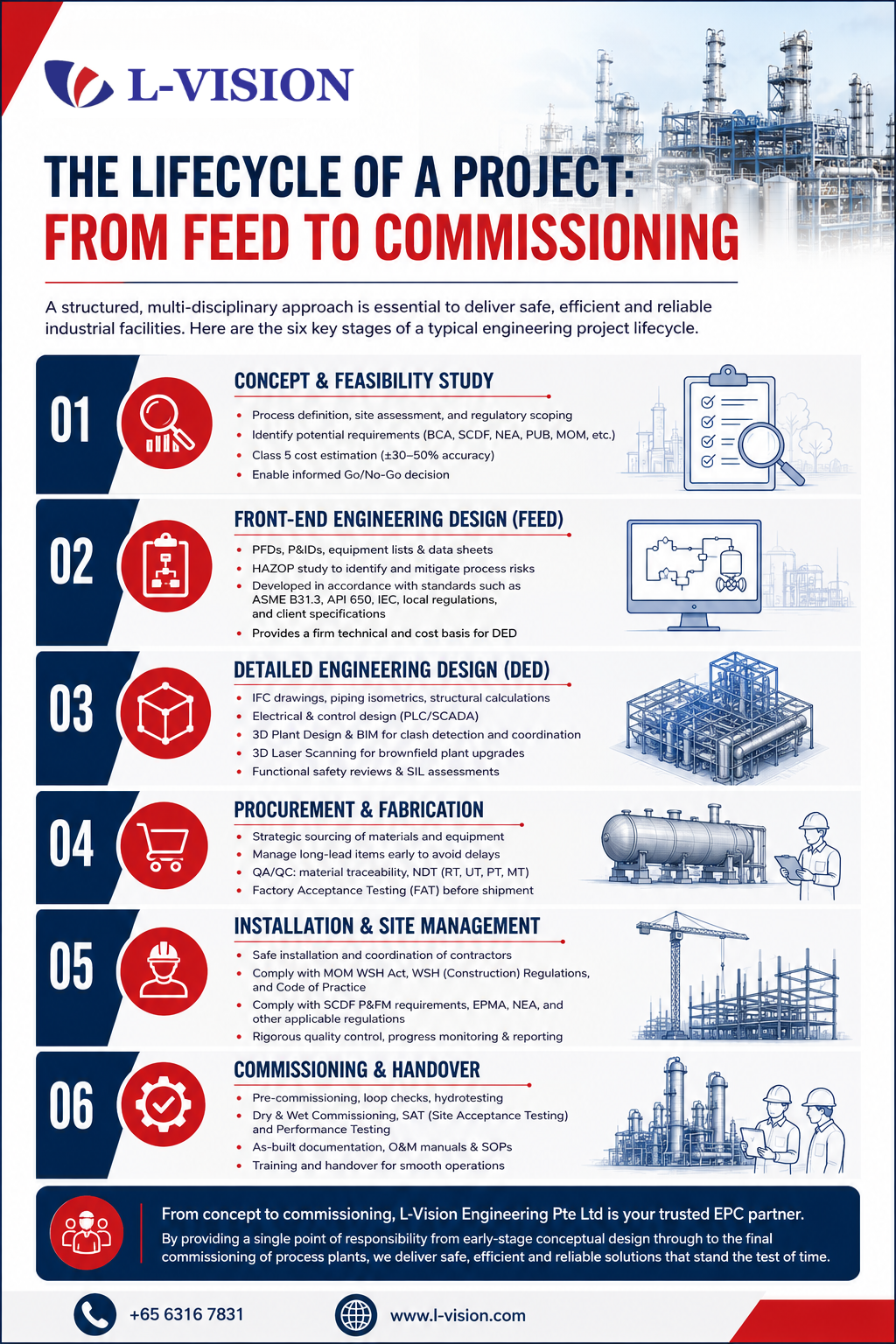
Navigating these six stages requires more than just technical knowledge; it requires the ability to integrate diverse engineering disciplines into a cohesive whole. Discrepancies between the FEED and DED phases, or poor coordination during fabrication, are the leading causes of budget overruns in the industrial sector.
L-Vision Engineering Pte Ltd specializes in managing this entire lifecycle. By providing a single point of responsibility from early-stage conceptual design through to the final commissioning of process plants, we help our clients in Southeast Asia and beyond minimize technical risks and ensure regulatory compliance.
Whether you are planning a new chemical processing facility in Indonesia, engaging an EPC contractor Singapore for industrial automation works, or executing a brownfield plant upgrade for an edible oil plant in Malaysia, a structured engineering roadmap is the key to project success.
For professional consultancy and project management services, contact the engineering team at L-Vision to discuss your project requirements. You can also explore our full range of engineering services to learn more about our capabilities in plant design and installation.

 Philippines