

No ionising radiation
HyFoSy uses ultrasound imaging. HSG uses fluoroscopic X-rays.
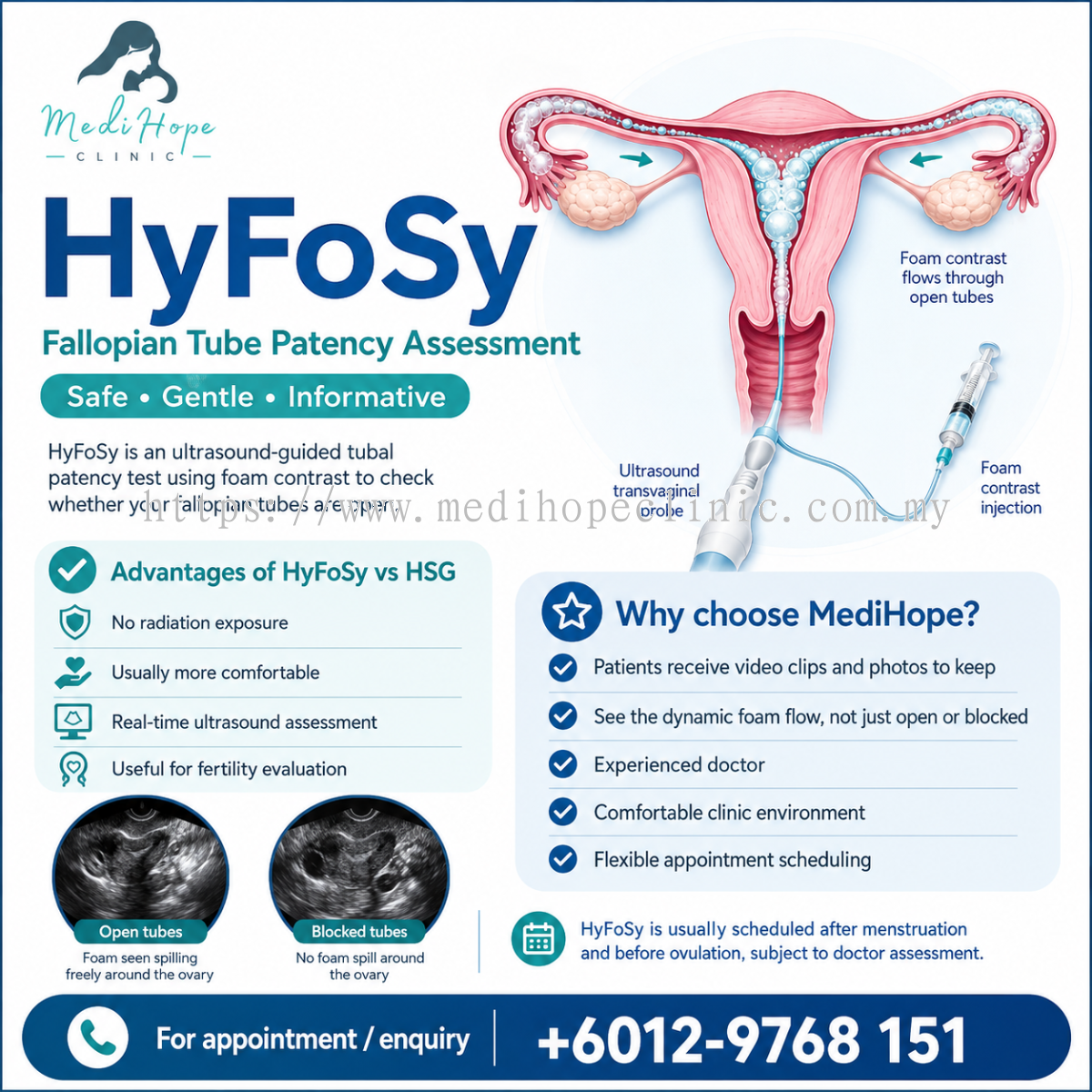
A real-time, ultrasound-guided assessment using foam contrast to check whether the fallopian tubes appear open—without X-ray radiation.

HyFoSy—hysterosalpingo-foam sonography—is an ultrasound-guided procedure used to assess fallopian tube patency. A small amount of ultrasound-visible foam is introduced into the uterine cavity while the doctor observes its movement using transvaginal ultrasound.
A tube may be considered patent when foam passage is observed through the tube with spill into the pelvic cavity. The findings are interpreted together with the patient’s clinical history and the rest of the fertility assessment.
Both HyFoSy and HSG are used to assess tubal patency. HyFoSy offers several practical and patient-centred advantages because it uses ultrasound instead of fluoroscopic X-ray imaging.
HyFoSy uses ultrasound imaging. HSG uses fluoroscopic X-rays.
Temporary cramping may still occur, but HyFoSy is generally associated with less pain than HSG.
The doctor observes the foam moving through the fallopian tubes and looks for free spill around each side during the examination.
The uterus, uterine cavity, ovaries and surrounding pelvic structures can also be reviewed where clinically appropriate.
HyFoSy uses ultrasound-visible foam rather than the iodinated radiographic contrast commonly used for HSG.
The observed findings can normally be discussed with the patient immediately after the examination.
| Feature | HyFoSy | HSG |
|---|---|---|
| Imaging method | Transvaginal ultrasound | Fluoroscopic X-ray |
| Contrast medium | Ultrasound-visible foam | Radiographic contrast, commonly iodinated |
| Radiation exposure | No ionising radiation | Uses ionising radiation |
| Real-time assessment | Foam movement and pelvic spill are observed during ultrasound | Contrast filling and spill are observed using X-ray imaging |
| Other pelvic structures | The uterus and ovaries can be reviewed by ultrasound | Primarily assesses the uterine cavity and fallopian tubes |
| Comfort | Usually less painful on average, although cramping may occur | May cause moderate cramping or discomfort |
| Limitations | Results may be influenced by tubal spasm or technical factors | Results may also be influenced by tubal spasm or technical factors |
Our aim is not only to complete the examination, but also to help patients understand what was observed and how the findings fit into their overall fertility assessment.
Patients can see the observed movement of the foam bubbles while the doctor explains the tubal passage and spill pattern. These observations add clinical context but do not independently prove normal tubal function.
The procedure is performed and interpreted by a doctor experienced in fertility assessment, transvaginal ultrasound and tubal-patency testing.
Patient privacy, clear communication and comfort are prioritised throughout the examination.
The doctor explains how the findings fit with the rest of the fertility assessment instead of providing only an isolated report.
Appointments are arranged according to the patient’s menstrual cycle, availability and medical suitability.
HyFoSy is normally scheduled after menstrual bleeding has stopped and before ovulation. It is commonly performed around cycle day 6 to day 11, although the exact date depends on the patient’s cycle and medical circumstances.
Pregnancy must be excluded before the procedure. The examination should not be performed during known or suspected pregnancy.
Not always. Many patients find it more comfortable than HSG, but temporary cramping or discomfort may still occur during foam administration.
No. HyFoSy assesses whether the tubes appear patent. Fertility also depends on factors such as ovulation, egg reserve, sperm quality, age, uterine factors and normal microscopic tubal function.
No. It is normally scheduled after menstruation and before ovulation. The clinic must confirm the appropriate date and exclude pregnancy before the procedure.
Temporary tubal spasm, catheter position and technical factors can affect the appearance. The doctor may recommend repeat assessment, HSG, laparoscopy or another investigation depending on the clinical situation.
Contact MediHope Clinic to discuss your menstrual cycle, medical suitability and the appropriate appointment date.
This webpage provides general information and does not replace consultation, examination or personalised medical advice. HyFoSy assesses tubal patency. It cannot confirm normal microscopic tubal function or guarantee pregnancy. Temporary tubal spasm, catheter position, injection pressure and technical factors may affect the result.