
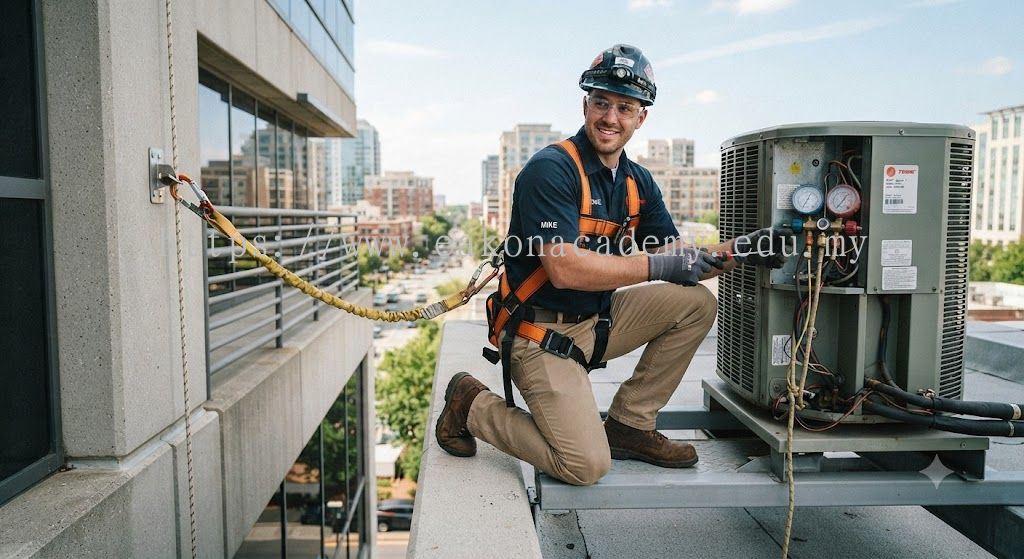
Working at Height Safety Equipment for Aircond Technicians: Complete Safety Guide for Professional HVAC Work
Air conditioning installation and maintenance often require technicians to perform tasks at elevated locations, including rooftops, high-rise buildings, commercial facilities, industrial plants, ceiling areas, and external building structures. These working environments expose aircond technicians to various hazards such as falls from height, falling objects, electrical risks, unstable surfaces, and difficult access conditions. Understanding and applying the correct working at height safety equipment for aircond technicians is essential to ensure safer work practices, reduce workplace accidents, and improve the overall quality of HVAC installation and maintenance services. Proper safety equipment not only protects technicians but also supports compliance with workplace safety requirements and professional industry standards. At Eakon Academy (eakonacadem.edu.my), our HVAC training programmes focus on developing skilled technicians who understand that safety protection is an essential part of professional air conditioning work.
Working at height safety begins with proper hazard identification and risk assessment before any air conditioning activity starts. Aircond technicians must evaluate the working environment, including rooftop conditions, access routes, electrical systems, weather conditions, equipment weight, and potential falling hazards. A detailed risk assessment helps determine the correct safety equipment required for each task. Whether installing split air conditioning systems, servicing outdoor condenser units, maintaining VRF and VRV systems, or repairing commercial HVAC equipment, technicians must be prepared with suitable safety protection before beginning elevated work.
The most important safety equipment for aircond technicians working at height is the full-body safety harness system. A full-body harness provides essential fall protection by distributing the forces generated during a fall across stronger areas of the body, including the shoulders, chest, thighs, and pelvis. Unlike traditional safety belts, full-body harnesses are designed specifically for fall arrest applications and provide better protection when technicians work on rooftops, ladders, scaffolding, or elevated platforms. Proper harness fitting, adjustment, and inspection are important skills that every professional air conditioning technician should understand.
A complete harness system requires additional components such as shock-absorbing lanyards, self-retracting lifelines (SRLs), connectors, and certified anchor points. These components work together to create a reliable fall protection system. Shock-absorbing lanyards reduce the impact force during a fall, while self-retracting lifelines provide greater movement flexibility while maintaining safety connection. Certified anchor points provide secure attachment locations and must be suitable for fall arrest purposes. Aircond technicians should never attach safety equipment to unsuitable structures such as refrigerant pipes, electrical cables, ductwork, or temporary supports because these may fail during an emergency.
A safety helmet with chin strap is another essential piece of working at height safety equipment. During air conditioning installation and servicing, technicians may be exposed to falling tools, loose materials, construction debris, and overhead hazards. A suitable safety helmet protects the head from impact injuries, while the chin strap ensures the helmet remains secure during climbing, movement, and elevated work activities. Regular inspection of helmets is necessary to identify cracks, damaged suspension systems, and signs of wear.
Proper safety footwear is also required for aircond technicians working at height. Rooftop and elevated work areas may contain slippery surfaces, dust, water, oil, or uneven flooring that can increase the risk of slips and falls. Safety boots with anti-slip soles, steel toe protection, and durable materials provide better stability while protecting technicians from dropped equipment, sharp materials, and heavy HVAC components. Good footwear improves confidence and reduces fatigue during long installation or maintenance tasks.
Protective gloves are another important part of working at height safety equipment. Air conditioning technicians regularly handle copper pipes, sheet metal, electrical wiring, tools, and mechanical components that may cause cuts or injuries. Cut-resistant gloves provide protection against sharp edges, while heat-resistant gloves are suitable for brazing and high-temperature work. Choosing the correct gloves for each HVAC task improves hand protection while maintaining work efficiency.
Safety glasses and face protection help protect technicians from airborne hazards during installation and repair activities. Drilling, cutting, brazing, refrigerant handling, and equipment servicing may produce dust, metal particles, sparks, and chemical exposure risks. Impact-resistant safety glasses protect the eyes and allow technicians to perform detailed HVAC tasks safely without compromising visibility.
For aircond technicians working at elevated locations, proper tool management is also important. Tool belts, tool bags, and tool lanyards help prevent tools from falling while technicians are working on rooftops, ladders, or platforms. Dropped tools can injure workers below and damage expensive HVAC equipment. Securing tools properly improves workplace safety, organisation, and productivity.
Safe access equipment is another important part of working at height protection. Depending on the installation requirements, aircond technicians may use ladders, scaffolding, boom lifts, or scissor lifts. Ladders should be inspected before use, positioned on stable surfaces, and secured properly. For larger commercial and industrial HVAC projects, elevated work platforms provide safer access and better working conditions. Technicians operating powered access equipment should receive proper training and follow manufacturer safety instructions.
Electrical safety equipment should also be considered when technicians work at height. Air conditioning systems contain electrical components such as compressors, motors, control panels, and wiring connections that create potential shock hazards. Insulated tools, voltage testers, electrical gloves, lockout/tagout devices, and warning signs help reduce electrical risks. Proper electrical isolation procedures must be followed before servicing HVAC equipment.
Emergency rescue equipment is an important requirement for any working-at-height activity. If a technician falls while connected to a harness, quick rescue is necessary to reduce the risk of suspension trauma. A suitable rescue plan should include rescue equipment, communication methods, first aid preparation, and trained personnel who understand emergency procedures. Regular safety training ensures teams are prepared to respond effectively during unexpected incidents.
Continuous safety training plays a major role in improving workplace protection for aircond technicians. Training should include correct PPE selection, harness inspection, fall protection procedures, ladder safety, elevated platform operation, electrical safety, refrigerant handling, hazard identification, and emergency response. Technicians with proper safety knowledge are better prepared to identify risks and complete HVAC work professionally.
At Eakon Academy (eakonacadem.edu.my), we are committed to producing highly skilled HVAC professionals who understand the importance of combining technical expertise with workplace safety. Our specialised HVAC training programmes provide practical learning in air conditioning installation, servicing, maintenance, troubleshooting, working at height safety, fall protection systems, PPE usage, electrical safety, refrigerant handling, and emergency procedures. Through hands-on training and industry-focused education, students gain the knowledge required to perform HVAC tasks safely and efficiently. By applying the correct Working at Height Safety Equipment for Aircond Technicians, professionals can reduce workplace hazards, improve safety performance, protect themselves and their colleagues, comply with safety requirements, and deliver reliable air conditioning services with confidence and professionalism.
Lebih maklumat tentang EAKON ACADEMY SDN BHD Malaysia
