
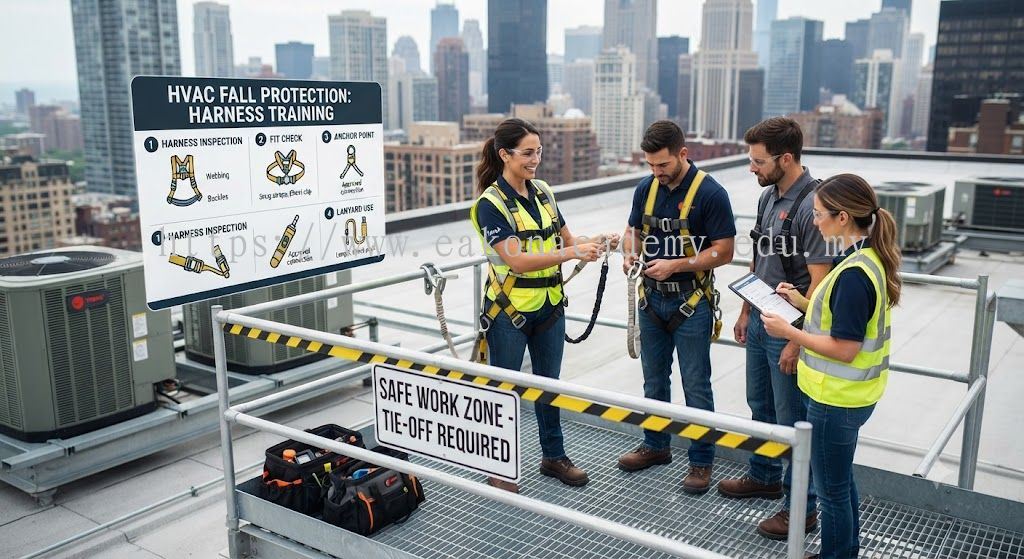
HVAC Safety Harness Training for Technicians: Professional Fall Protection Training for Air Conditioning and Refrigeration Professionals
HVAC safety harness training for technicians is an essential component of workplace safety in the heating, ventilation, air conditioning, and refrigeration (HVACR) industry. Air conditioning technicians, refrigeration engineers, maintenance personnel, HVAC installers, and mechanical contractors frequently work at elevated locations such as rooftops, high-rise buildings, industrial facilities, shopping malls, hospitals, office towers, and commercial buildings. These work environments expose technicians to serious fall hazards that can result in severe injuries or fatalities if proper fall protection measures are not implemented. Safety harness training equips HVAC professionals with the knowledge and practical skills required to correctly select, inspect, wear, adjust, and use fall protection equipment while performing installation, maintenance, servicing, and repair work at height. At eakonacadem.edu.my, we provide industry-focused HVAC safety harness training that combines technical air conditioning expertise with comprehensive working at height safety education, preparing technicians to meet industry best practices and workplace safety requirements.
As modern HVAC systems become more sophisticated and are increasingly installed on rooftops and elevated structures, technicians are regularly required to access outdoor condenser units, rooftop package units, cooling towers, air handling units, ventilation systems, VRF and VRV equipment, and industrial refrigeration systems positioned above ground level. Working in these environments presents multiple hazards, including roof edges, unstable surfaces, electrical equipment, adverse weather conditions, and falling objects. Professional HVAC safety harness training enables technicians to recognise these hazards and implement effective fall protection strategies before beginning work, significantly reducing the risk of workplace accidents.
One of the most important elements of HVAC safety harness training for technicians is hazard identification and workplace risk assessment. Before accessing elevated work areas, technicians should inspect the worksite for roof stability, structural integrity, access routes, anchor points, skylights, fragile roofing materials, nearby electrical hazards, environmental conditions, and emergency rescue access. Conducting a comprehensive risk assessment allows contractors to identify potential fall hazards and establish suitable control measures before installation or maintenance activities commence. Proper planning forms the foundation of every successful working at height safety program.
Correct selection and use of safety harnesses is a major focus of professional training. HVAC technicians learn the differences between various types of full-body safety harnesses, shock-absorbing lanyards, self-retracting lifelines, horizontal lifeline systems, and certified anchor points. Participants receive practical instruction on fitting the harness correctly, adjusting shoulder straps, chest straps, waist straps, and leg straps to ensure a secure and comfortable fit. Proper harness adjustment prevents equipment failure while allowing technicians to move safely and efficiently during rooftop installation and maintenance activities.
Routine inspection of fall protection equipment is another essential aspect of HVAC safety harness training. Before every use, technicians should carefully inspect webbing, stitching, buckles, D-rings, connectors, hooks, lanyards, energy absorbers, and anchor devices for signs of wear, corrosion, cuts, fraying, deformation, or other damage. Equipment that does not meet safety standards should be removed from service immediately. Learning proper inspection techniques helps prevent equipment failures and ensures technicians remain fully protected while working at height.
Anchor point selection is equally important for effective fall protection. Professional training teaches technicians how to identify approved anchor points capable of supporting fall arrest loads while complying with relevant safety standards. Understanding the difference between permanent anchors, temporary anchors, horizontal lifeline systems, and engineered anchor devices enables technicians to select the most appropriate fall protection solution for each worksite. Correct anchor point selection significantly improves worker safety during rooftop air conditioning installation, outdoor condenser servicing, and elevated maintenance work.
Safe movement while wearing a safety harness is another key topic covered during training. HVAC technicians often need to move around rooftops while carrying tools, refrigerant gauges, electrical testing equipment, copper piping, and installation materials. Participants learn how to maintain continuous fall protection, avoid swing fall hazards, position lanyards correctly, and safely navigate roof edges and elevated structures without compromising safety. These practical skills improve both efficiency and accident prevention during daily HVAC operations.
Safety harness training also emphasizes the importance of integrating fall protection with other workplace safety practices. Personal protective equipment (PPE), including safety helmets with chin straps, anti-slip safety footwear, protective gloves, eye protection, and high-visibility clothing, provides additional protection against falling objects, electrical hazards, and slips. Technicians also receive instruction on ladder safety, Mobile Elevated Work Platform (MEWP) operation, scaffolding awareness, electrical isolation, manual handling techniques, and housekeeping practices to create a comprehensive working at height safety program.
Emergency preparedness is a vital component of HVAC safety harness training. Every technician should understand emergency rescue procedures in the event of a fall. Training covers rescue planning, suspension trauma awareness, emergency communication systems, first aid response, evacuation procedures, and incident reporting. Regular practical rescue exercises ensure technicians are prepared to respond quickly and effectively during workplace emergencies, minimizing injury severity and improving overall safety performance.
Malaysia's rapidly growing construction, facilities management, and commercial building sectors continue to increase demand for skilled HVAC professionals who possess both technical expertise and strong workplace safety competencies. Employers increasingly value technicians who understand proper fall protection systems, risk assessment procedures, and working at height regulations. Completing professional HVAC safety harness training demonstrates a commitment to workplace safety, enhances employability, strengthens professional credibility, and supports compliance with Malaysian occupational health and safety requirements.
At eakonacadem.edu.my, we are committed to developing highly competent HVAC professionals through practical, industry-oriented training programs that combine advanced air conditioning technical skills with internationally recognised working at height safety practices. Our comprehensive courses include safety harness training, fall protection systems, rooftop safety, ladder safety, Mobile Elevated Work Platform (MEWP) safety, workplace risk assessment, electrical safety, emergency rescue planning, manual handling, and occupational safety compliance. Students gain valuable hands-on experience that prepares them for residential, commercial, and industrial HVAC projects throughout Malaysia. By completing HVAC safety harness training for technicians, professionals improve workplace safety, reduce fall risks, comply with industry regulations, increase employer confidence, enhance customer trust, and build successful long-term careers in the air conditioning and refrigeration industry. Choosing eakonacadem.edu.my for HVAC safety training is an investment in professional excellence, technical competence, and a safer future for every HVAC technician working at height.
Lebih maklumat tentang EAKON ACADEMY SDN BHD Malaysia
