
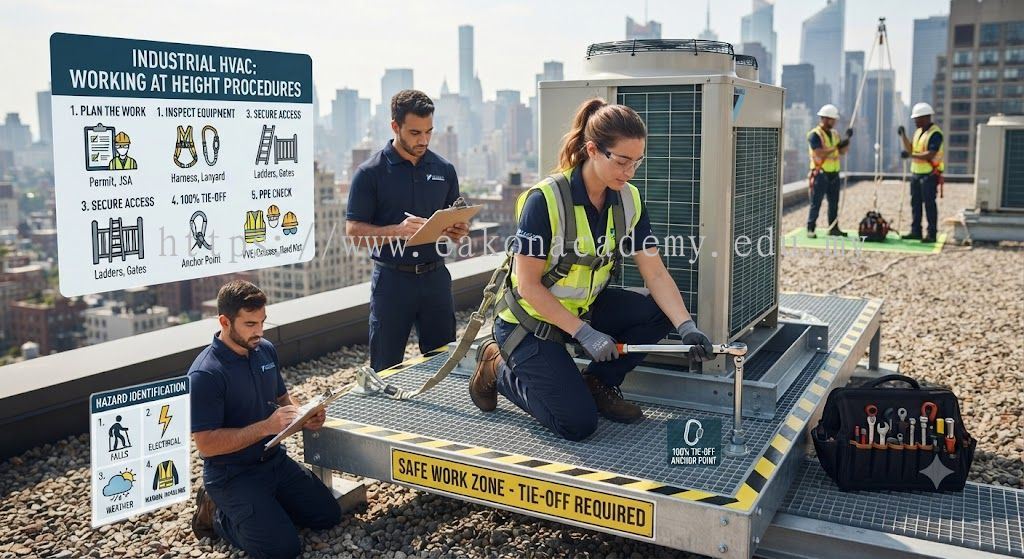
Industrial HVAC Working at Height Procedures: Essential Safety Practices for Industrial HVAC Technicians
Industrial HVAC working at height procedures are essential safety guidelines designed to help HVAC technicians perform installation, maintenance, inspection, and repair activities safely in industrial environments. Industrial facilities such as factories, manufacturing plants, warehouses, power facilities, processing centres, and large commercial buildings often require complex HVAC systems that are installed in elevated locations. Technicians may need to access rooftops, mechanical platforms, cooling towers, ductwork systems, industrial ventilation equipment, chillers, and large air conditioning units located several metres above ground level. Without proper safety procedures, industrial HVAC working at height activities can expose technicians to serious hazards, including falls, electrical risks, equipment handling accidents, and unsafe working conditions. At Eakon Academy (eakonacadem.edu.my), we provide professional HVAC training that combines advanced technical knowledge with workplace safety practices to prepare technicians for safe and efficient industrial HVAC operations.
Industrial HVAC systems are typically larger and more complex compared to residential air conditioning systems. They often include central air conditioning systems, chilled water systems, industrial ventilation systems, VRF and VRV systems, rooftop package units, cooling towers, and large refrigeration equipment. Maintenance and servicing of these systems frequently require technicians to work at elevated areas using ladders, scaffolding, mobile elevated work platforms (MEWPs), and other access equipment. Understanding industrial HVAC working at height procedures allows technicians to identify potential hazards, implement safety controls, and complete their tasks while maintaining professional safety standards.
The first step in safe industrial HVAC height work is conducting a comprehensive workplace risk assessment. Before starting any elevated HVAC activity, technicians and supervisors must inspect the work area, evaluate access conditions, identify hazards, and establish appropriate safety measures. Industrial environments may contain additional risks such as heavy machinery, moving equipment, electrical systems, high-temperature areas, restricted spaces, and complex building structures. Proper risk assessment helps technicians understand the working environment and develop safe procedures before installation, maintenance, or repair work begins.
A critical component of industrial HVAC working at height procedures is selecting the correct access equipment. Depending on the project requirements, technicians may use industrial ladders, scaffolding systems, mobile elevated work platforms, boom lifts, scissor lifts, or permanent access platforms. Each type of equipment must be inspected before use to ensure stability, proper operation, and suitability for the working environment. Technicians should understand equipment limitations, safe operating procedures, and inspection requirements. Proper access equipment selection reduces fall risks and improves efficiency during industrial HVAC servicing activities.
Fall protection systems are another important aspect of industrial HVAC height safety. Technicians working on elevated platforms, rooftops, or industrial structures may require full-body harnesses, fall arrest systems, safety lanyards, anchor points, and lifelines. Proper training ensures technicians understand how to inspect, wear, connect, and maintain fall protection equipment correctly. Safety harnesses and related equipment should always be checked before use to identify any signs of damage, wear, or defects. Correct use of fall protection systems provides additional protection and reduces the risk of serious injuries.
Industrial HVAC working at height procedures also involve proper handling of tools, materials, and heavy equipment. Industrial HVAC technicians often work with compressors, motors, refrigerant components, copper piping, electrical tools, testing equipment, and replacement parts. Carrying and moving these items at height requires careful planning to prevent dropped objects and workplace injuries. Technicians should use secure tool storage systems, lifting equipment, proper manual handling techniques, and effective communication between team members. These practices improve safety while maintaining project efficiency.
Electrical safety is a major consideration during industrial HVAC height work because many industrial systems involve complex electrical controls, motors, panels, and automation systems. Technicians performing troubleshooting, electrical testing, and commissioning must follow safe electrical procedures, including power isolation, lockout and tagout practices, electrical hazard identification, and safe tool usage. Combining electrical safety with height safety procedures ensures technicians are protected from multiple workplace risks during industrial HVAC operations.
Environmental conditions are also important factors when performing industrial HVAC work at height. Industrial sites may experience strong airflow, high temperatures, noise exposure, rain, wind, and limited visibility depending on the location. Technicians must evaluate workplace conditions before beginning elevated work and take appropriate precautions when hazards are present. Proper communication, supervision, emergency planning, and continuous monitoring help create safer industrial HVAC working environments.
Good housekeeping and workplace organisation are essential parts of industrial HVAC working at height procedures. Tools, cables, refrigerant hoses, materials, and equipment should be arranged properly to prevent trips, falls, and obstruction of access routes. Maintaining a clean and organised work area improves technician movement, reduces risks, and supports efficient completion of industrial HVAC projects.
At eakonacadem.edu.my, our HVAC training programmes are designed to develop highly skilled technicians who understand both technical performance and workplace safety requirements. Students receive practical training in industrial HVAC installation, commercial air conditioning systems, refrigeration equipment, chiller systems, troubleshooting, preventive maintenance, electrical diagnostics, refrigerant handling, and commissioning procedures. Safety training includes working at height procedures, hazard identification, risk assessment, fall prevention methods, safety harness usage, ladder safety, scaffold awareness, emergency response planning, and safe equipment handling. This practical approach prepares technicians to manage real-world industrial HVAC challenges.
For industrial HVAC contractors and facility operators, implementing proper industrial HVAC working at height procedures provides many advantages. Effective safety practices help reduce workplace accidents, improve maintenance efficiency, increase equipment reliability, enhance regulatory compliance, and strengthen company reputation. A well-trained HVAC workforce can complete complex industrial projects with greater confidence while maintaining high-quality service standards.
As Malaysia’s industrial sector continues to grow, the demand for skilled HVAC technicians with advanced technical knowledge and safety awareness continues to increase. Understanding industrial HVAC working at height procedures enables professionals to perform installation, maintenance, and repair activities safely while meeting industry expectations. Eakon Academy is committed to providing industry-relevant HVAC education that combines hands-on technical training with comprehensive workplace safety practices. Visit eakonacadem.edu.my to explore our professional HVAC courses, industrial HVAC training programmes, maintenance workshops, and safety-focused education designed to prepare technicians for successful careers in the heating, ventilation, air conditioning, and refrigeration industry.
Lebih maklumat tentang EAKON ACADEMY SDN BHD Malaysia
