HVAC Repair Technician Course for Professional Repair Skills and Career Development in the HVAC Industry
HVAC repair technician course is a professional training program designed to equip individuals with the essential technical knowledge and practical skills required to diagnose, repair, service, and maintain heating, ventilation, and air conditioning systems. As HVAC systems become increasingly important in residential, commercial, and industrial environments, skilled repair technicians are needed to ensure reliable cooling performance, energy efficiency, and long-term equipment operation. Eakon Academy, available at eakonacadem.edu.my, provides professional HVAC training programs that focus on practical learning, technical competency, and industry-based applications to help participants develop the expertise needed for a successful career in the HVAC industry.
A comprehensive HVAC repair technician course provides participants with a complete understanding of HVAC system operation, component functions, troubleshooting methods, and professional repair procedures. Through structured training, learners gain knowledge about different types of HVAC equipment and how each component contributes to overall system performance. Participants learn about compressors, evaporator coils, condenser units, expansion devices, refrigerant circuits, fans, motors, electrical controls, sensors, and other important HVAC components. This technical foundation enables technicians to identify faults accurately and apply effective repair solutions.
One of the main objectives of an HVAC repair technician course is to develop strong troubleshooting and diagnostic abilities. HVAC systems can experience various problems, including insufficient cooling, refrigerant leakage, electrical faults, poor airflow, abnormal noises, compressor issues, and control system failures. Professional technicians must understand how to analyze system symptoms, perform technical testing, and identify the root causes of equipment problems. Through practical training, participants develop a systematic approach to fault diagnosis and improve their ability to complete repairs efficiently.
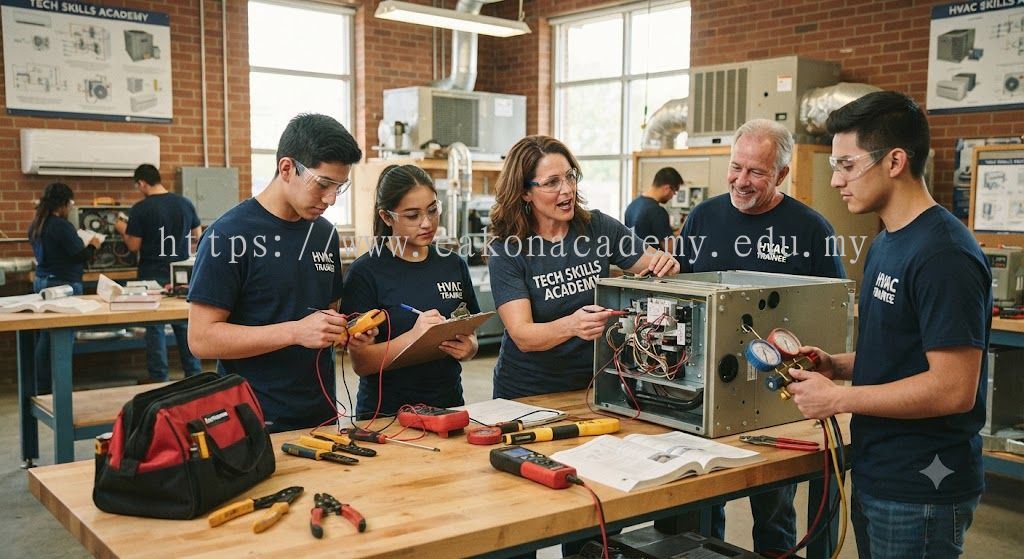
Hands-on practical training is an important component of an HVAC repair technician course. Participants gain direct experience working with HVAC equipment, using service tools, inspecting components, and performing repair procedures. Practical sessions allow learners to understand real-world repair challenges and develop confidence in handling different HVAC systems. This approach helps bridge the gap between classroom knowledge and actual workplace requirements, preparing technicians for professional service environments.
Refrigerant system repair and maintenance are key areas covered in professional HVAC technician training. Proper refrigerant handling is essential for maintaining cooling efficiency and protecting important components such as compressors and heat exchangers. Participants learn refrigerant pressure testing, leak detection techniques, recovery procedures, and correct charging methods. Understanding refrigerant systems enables technicians to maintain reliable HVAC operation while following safe and responsible handling practices.
Electrical troubleshooting is another critical skill developed through an HVAC repair technician course. Modern HVAC systems use advanced electrical and electronic components, including capacitors, contactors, wiring systems, sensors, control boards, and inverter technology. Participants learn how to inspect electrical circuits, test components, identify faults, and perform safe repair procedures. Strong electrical knowledge allows technicians to solve complex HVAC issues and improve system reliability.
Preventive maintenance knowledge is also emphasized during HVAC repair technician training. Although repair skills are essential, professional technicians must understand how proper maintenance can prevent recurring system failures. Participants learn inspection procedures, cleaning techniques, performance testing methods, and maintenance strategies that improve equipment efficiency and extend system lifespan.
Safety procedures are a vital part of professional HVAC repair training. Participants learn safe working practices when handling electrical systems, mechanical components, tools, and refrigerants. Understanding safety requirements ensures technicians can perform repair activities professionally while reducing workplace risks.
Completing an HVAC repair technician course provides valuable career opportunities for individuals seeking professional growth in the HVAC industry. Graduates can pursue careers as HVAC repair technicians, air conditioning service specialists, maintenance technicians, building facility professionals, and technical support personnel. Strong repair capabilities allow technicians to provide reliable solutions and meet the growing demand for qualified HVAC professionals.
Eakon Academy delivers industry-focused HVAC training programs that combine technical knowledge with hands-on practical experience. Participants gain valuable skills in HVAC troubleshooting, repair techniques, maintenance procedures, and system performance evaluation. The training approach helps learners develop professional confidence and technical expertise required for modern HVAC service environments.
Investing in an HVAC repair technician course is a valuable step for individuals who want to improve their technical abilities and advance their HVAC careers. Professional training enables technicians to enhance repair accuracy, reduce equipment downtime, improve energy efficiency, and deliver high-quality HVAC services. With proper knowledge and practical experience, HVAC professionals can contribute to safer, more reliable, and efficient HVAC systems across residential, commercial, and industrial applications.
Lebih maklumat tentang EAKON ACADEMY SDN BHD Malaysia