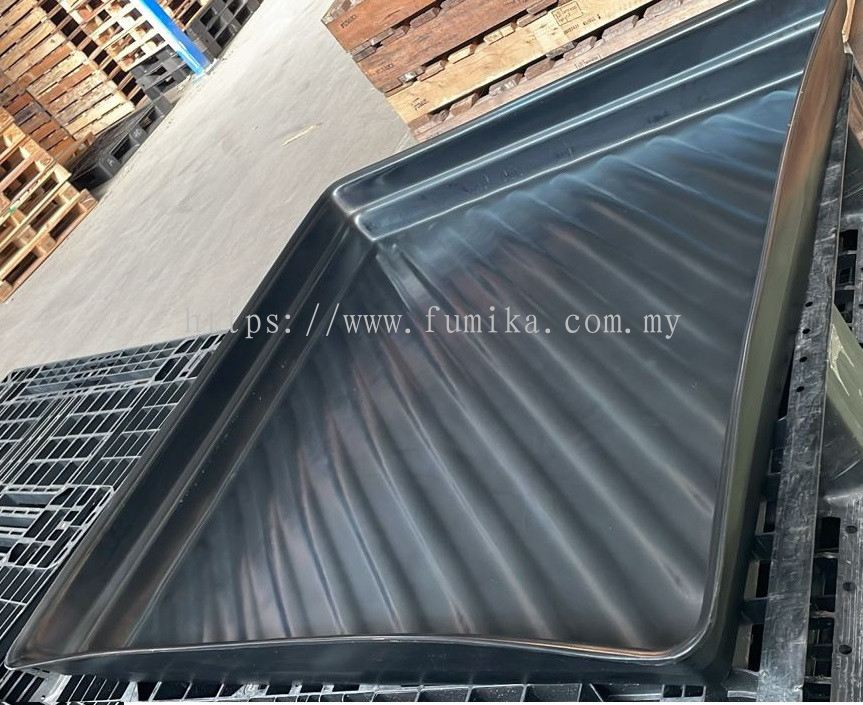
In modern industrial environments, managing hazardous liquids is a major operational challenge. Whether you handle chemical reagents in a laboratory, lubricants on a manufacturing floor, or bulk oils in a warehouse, accidental leaks are an ever-present risk.
An industrial spill tray (often referred to as a secondary containment tray) is your first line of defense against hazardous liquid releases. Far from being a simple piece of plastic or metal, a properly specified spill tray protects your workforce, keeps your facility compliant with strict environmental laws, and prevents catastrophic cleanup costs.
This comprehensive guide breaks down everything you need to know about spill trays—from material science and regulatory compliance to calculating precise capacity requirements.
A spill tray is a specialized, low-profile containment vessel designed to sit beneath containers holding chemicals, oils, fuels, or hazardous wastes. Its primary job is secondary containment: if a primary container (like a bottle, drum, or carboy) cracks, leaks, or overflows during dispensing, the spill tray captures the liquid before it can reach the floor, contaminate the drainage system, or react with incompatible materials.
Neglecting secondary containment rarely ends well. A single minor leak can trigger a domino effect of workplace disruptions:
Slip and Fall Hazards: The leading cause of industrial workplace injuries.
Environmental Fines: Discharging oils or corrosive chemicals into municipal drains can lead to crippling penalties from environmental protection agencies.
Property Damage: Corrosive fluids can dissolve concrete floors, eat through structural steel, and destroy sensitive electronics.
Using a spill tray isn't just best practice—it is strictly mandated by workplace safety and environmental protection laws globally.
In the United States, the Environmental Protection Agency (EPA) governs container storage under 40 CFR 264.175. Meanwhile, the Occupational Safety and Health Administration (OSHA) regulates workplace safety under 29 CFR 1910.1450 for laboratory safety and subparts for general industry.
The core design mandate for any secondary containment system hinges on a straightforward mathematical equation, often called the 10% / 100% rule:
The Legal Capacity Requirement:
A secondary containment system must be large enough to contain 10% of the total volume of all stored containers, OR 100% of the volume of the largest single container, whichever is greater.
Let’s look at how this applies in real-world scenarios to ensure your facility remains fully compliant.
| Scenario | Stored Containers | Total Aggregate Volume | 10% of Total Volume | 100% of Largest Container | Minimum Legal Tray Capacity Required |
| Scenario A | Four 5-Gallon Jugs | 20 Gallons | 2 Gallons | 5 Gallons | 5 Gallons (100% of largest container wins) |
| Scenario B | Twenty 5-Gallon Jugs | 100 Gallons | 10 Gallons | 5 Gallons | 10 Gallons (10% of total aggregate wins) |
| Scenario C | One 55-Gallon Drum | 55 Gallons | 5.5 Gallons | 55 Gallons | 55 Gallons (100% of largest container wins) |
Always look for the manufacturer's certified sump capacity rating when purchasing a spill tray to verify it can legally hold your calculated volume.
A spill tray is completely useless if the captured liquid melts, dissolves, or corrodes the tray itself. Selecting the right construction material is the most critical technical decision you will make. Industrial spill trays are overwhelmingly dominated by three primary materials:
HDPE is the undisputed workhorse of laboratory and industrial spill containment.
Best Used For: Strong acids (hydrochloric, sulfuric), aggressive bases (sodium hydroxide), water-based fluids, and most industrial detergents.
Pros: Exceptionally broad chemical resistance, completely rust-proof, lightweight, and impact resistant.
Cons: Degrades under prolonged exposure to certain highly concentrated organic solvents or extreme heat.
Polypropylene behaves similarly to HDPE but offers higher thermal resistance.
Best Used For: Laboratory environments featuring heated chemical processes or highly specialized chemical testing.
Pros: Marginally higher melting point and rigidity than HDPE; excellent chemical resistance.
Cons: Can become brittle at sub-zero temperatures.
When dealing with heavy-duty fluids and rugged mechanical workspaces, metals take the lead.
Best Used For: Petroleum products, oils, diesel fuels, chlorinated solvents, and high-temperature liquids.
Pros: Fireproof, extremely durable under heavy mechanical wear, and unaffected by volatile organic compounds (VOCs).
Cons: Heavy, prone to rusting if the protective zinc layer on galvanized steel scratches off, and highly vulnerable to acid corrosion.
When sourcing spill trays for your facility, do not treat them as commodity plastic bins. Look for these engineered design characteristics to maximize safety and longevity:
Removable Low-Profile Gratings: High-quality spill trays feature a robust, slip-resistant top grid or grating. This keeps the primary chemical containers elevated abovethe liquid sump area. If a leak happens, the fluid drains down, keeping the bottom of your bottles clean and eliminating splash risks when removing the leaky container.
Integrated Sump Drains: For larger spill trays or outdoor setups, a threaded drain plug allows your team to safely drain out captured liquids or rainwater without needing to lift and tilt a heavy, fluid-filled tray.
Nestable Designs: If your facility scales up and down or requires temporary containment setups, look for nestable trays. These fit tightly inside one another when empty, slashing storage space requirements.
Forklift Pockets: For large-scale setups supporting 4-drum configurations, integrated forklift channels are crucial for moving heavy, loaded containment platforms safely across the warehouse floor.
Deploying secondary containment effectively requires systematic planning. Use this workflow to correctly integrate spill trays into your workplace:
A cracked or dirty spill tray creates a false sense of security. Incorporate these basic upkeep rules into your routine facility inspections:
Weekly Visual Audits: Inspect sumps for any accumulation of debris, rainwater, or minor drips. Standing liquid reduces the remaining available capacity of the tray, dropping it below legal compliance thresholds.
Stress Crack Monitoring: Industrial plastics exposed to direct sunlight or fluctuating temperatures can suffer from environmental stress cracking over several years. Look for micro-fissures around structural corners and load-bearing columns.
Decontamination Protocols: If an acid or solvent leaks into a tray, do not just wash it out with water down a standard sink. Treat the captured liquid and rinse residue as hazardous waste, disposing of it according to local environmental regulations.
| Attribute | Polyethylene (HDPE) Spill Trays | Stainless/Galvanized Steel Trays |
| Primary Chemical Targets | Acids, Bases, Alcohols, Water-Based Solutions | Oils, Fuels, Hydrocarbons, Volatile Solvents |
| Corrosion Resistance | Total resistance to rust and oxidation | Vulnerable to rusting and strong acid degradation |
| Impact Performance | High elasticity; flexes and bounces back | Resists puncturing but may dent under massive impact |
| Fire Safety | Can melt or burn when exposed to direct flames | Inherently fireproof; contains flammable liquid hazards |
Protecting your facility from fluid leaks is an easily solvable challenge. By assessing your chemical profiles, applying the 10%/100% volume rule, and investing in durable, high-density polyethylene or heavy-gauge steel trays, you protect your workers, secure your environmental compliance, and ensure your facility operations run smoothly.
Lebih maklumat tentang Fuka Industries Sdn Bhd Malaysia