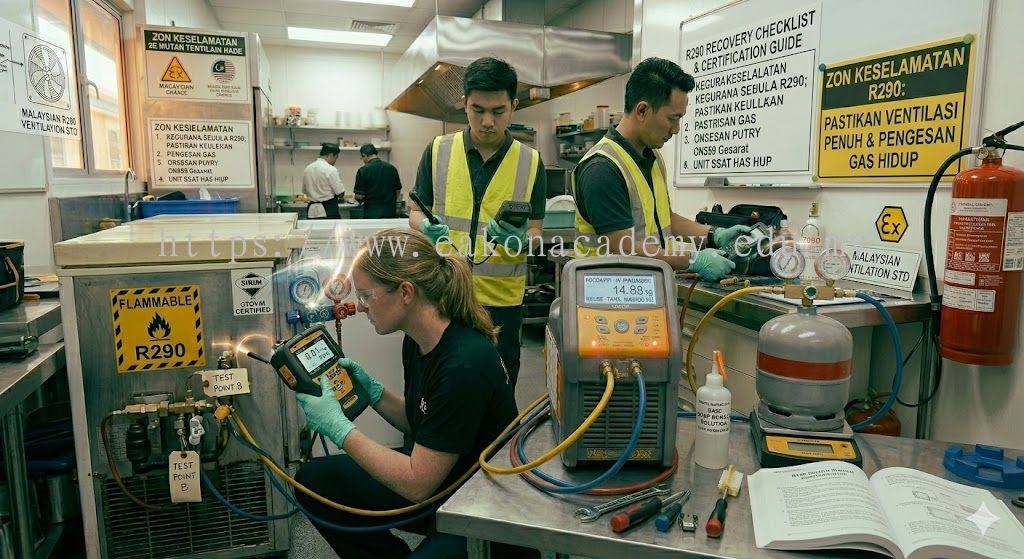
R290 REFRIGERANT LEAK DETECTION FOR SAFE, EFFICIENT, AND COMPLIANT HVAC-R SYSTEM OPERATIONS
R290 refrigerant leak detection is a critical process in modern HVAC-R systems designed to ensure the safe handling, monitoring, and maintenance of propane (R290) as a natural refrigerant. As the HVAC industry transitions toward environmentally friendly refrigerants with low global warming potential (GWP), R290 has become a widely adopted solution due to its high energy efficiency and minimal environmental impact. However, because R290 is highly flammable, accurate and reliable leak detection is essential to prevent safety hazards, maintain system performance, and ensure regulatory compliance. At eakonacadem.edu.my, we focus on providing professional HVAC education and technical training that supports the safe application of R290 refrigerant leak detection practices in real-world industry environments.
R290 refrigerant leak detection involves a combination of advanced technologies and systematic inspection methods used to identify and locate refrigerant leaks in HVAC systems. One of the most common approaches is electronic leak detection, where portable gas detectors equipped with sensitive sensors are used to scan system components such as compressors, evaporators, condensers, valves, and piping connections. These devices are capable of detecting even small concentrations of propane gas in the air and provide immediate visual and audible alerts when a leak is found. This allows technicians to quickly locate and address the issue before it escalates into a safety risk.
Another important method in R290 refrigerant leak detection is infrared technology. Infrared gas detectors work by identifying changes in gas concentration based on the absorption of specific wavelengths of light by propane molecules. This method provides highly accurate, stable, and continuous monitoring, making it suitable for both commercial and industrial HVAC applications. Infrared detection is especially useful in environments that require long-term monitoring and high precision.
Soap bubble testing is also widely used as a simple yet effective R290 refrigerant leak detection method. This technique involves applying a soap solution to suspected leak points. If refrigerant gas is escaping, bubbles will form at the exact location of the leak. Although traditional, this method remains highly reliable for confirming leak locations identified by electronic or infrared detection tools and is commonly used during maintenance and repair work.
Ultrasonic leak detection is another advanced technique used in modern HVAC systems. This method detects the high-frequency sound produced by escaping pressurized gas. Ultrasonic detectors are particularly effective in noisy industrial environments where traditional gas sensors may be less reliable. This technique provides an additional layer of accuracy and is often used alongside other detection methods for comprehensive system coverage.
Fixed gas detection systems also play an important role in R290 refrigerant leak detection, especially in large-scale HVAC installations. These systems are permanently installed in critical areas such as compressor rooms, cold storage facilities, and industrial refrigeration plants. They continuously monitor air quality for the presence of propane gas and trigger alarms or automated safety responses when leaks are detected. Integration with building management systems (BMS) ensures real-time monitoring and rapid emergency response.
At eakonacadem.edu.my, we emphasize the importance of proper training in R290 refrigerant leak detection for HVAC professionals. Technicians must understand how different detection methods work, how to operate equipment correctly, and how to interpret results accurately. Proper training ensures compliance with safety regulations and improves overall system reliability and efficiency.
Furthermore, effective leak detection contributes to environmental sustainability by reducing refrigerant emissions and improving energy efficiency. Early detection and repair of leaks help minimize gas loss, reduce system strain, and lower operational costs, supporting greener HVAC operations.
In conclusion, R290 refrigerant leak detection is essential for ensuring the safe, efficient, and environmentally responsible operation of HVAC-R systems. By combining electronic detection, infrared technology, ultrasonic methods, soap bubble testing, and fixed monitoring systems, technicians can effectively identify and manage refrigerant leaks. This comprehensive approach enhances safety, compliance, and sustainability, making it a key focus area for HVAC education and training platforms like eakonacadem.edu.my.
Lebih maklumat tentang EAKON ACADEMY SDN BHD Malaysia