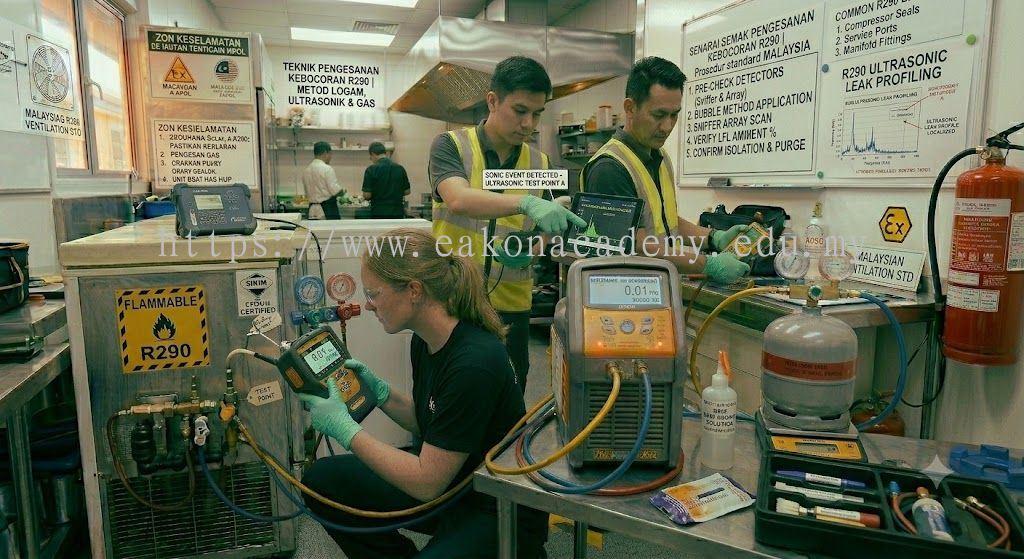
R290 LEAK TESTING METHODS FOR SAFE, ACCURATE, AND EFFICIENT HVAC-R SYSTEM VERIFICATION
R290 leak testing methods are essential procedures used in HVAC-R systems to ensure the safe operation, reliability, and environmental compliance of refrigeration and air conditioning equipment that uses propane (R290) as a natural refrigerant. As the HVAC industry increasingly adopts low global warming potential (GWP) refrigerants, R290 has become a preferred choice due to its excellent energy efficiency and eco-friendly properties. However, because R290 is highly flammable, proper leak testing methods are critical to detect refrigerant losses early, prevent safety hazards, and maintain system performance. At eakonacadem.edu.my, we focus on providing professional HVAC education and technical training that supports the correct application of R290 leak testing methods in real-world industry environments.
R290 leak testing methods typically begin with a visual inspection of the entire HVAC system. Technicians examine key components such as compressors, evaporators, condensers, valves, and piping connections for visible signs of leakage. Indicators may include oil stains, corrosion, frost buildup, or loose fittings. This initial step helps identify potential problem areas before more advanced testing methods are applied.
One of the most widely used R290 leak testing methods is electronic leak detection. This method involves the use of portable gas detectors equipped with highly sensitive sensors designed to detect hydrocarbon refrigerants. Technicians systematically scan all critical points in the system, including joints, seals, and connection areas. When a leak is detected, the device provides immediate visual and audible alerts, allowing for quick identification and response. Electronic detection is highly accurate and widely used in both residential and commercial HVAC applications.
Another important method is infrared leak testing, which uses infrared sensors to detect changes in gas concentration based on light absorption characteristics of R290. This method offers high precision and stability, making it suitable for continuous monitoring in industrial and commercial HVAC systems. Infrared testing is especially effective in environments where long-term reliability and accuracy are required.
Soap bubble testing is also a commonly used R290 leak testing method. This traditional technique involves applying a soap solution to suspected leak points. If refrigerant gas is escaping, bubbles will form at the exact location of the leak. Although simple, this method is highly effective for confirming leaks identified by electronic or infrared detection tools. It remains an important part of HVAC maintenance and repair procedures.
Ultrasonic leak testing is another advanced method used in modern HVAC systems. This technique detects high-frequency sound waves produced by escaping pressurized gas. Ultrasonic detectors are particularly useful in noisy industrial environments where traditional gas sensors may be less effective. This method provides an additional layer of accuracy and is often used alongside other testing techniques.
Fixed gas detection systems also play a key role in R290 leak testing methods for large-scale HVAC installations. These systems are permanently installed in mechanical rooms, cold storage facilities, and industrial refrigeration plants. They continuously monitor air quality for refrigerant presence and trigger alarms or automatic safety responses when leaks are detected. Integration with building management systems (BMS) enhances real-time monitoring and emergency response capabilities.
At eakonacadem.edu.my, we emphasize the importance of proper training in R290 leak testing methods for HVAC professionals. Technicians must understand how each testing method works, how to apply them correctly, and how to interpret results accurately. Proper training ensures compliance with safety regulations and improves overall system reliability and performance.
Furthermore, effective leak testing methods help reduce refrigerant emissions, improve energy efficiency, and extend equipment lifespan. Early detection of leaks prevents system damage, reduces operational costs, and supports environmental sustainability efforts.
In conclusion, R290 leak testing methods are essential for ensuring the safe and efficient operation of HVAC-R systems using propane refrigerants. By combining visual inspection, electronic detection, infrared technology, ultrasonic testing, and traditional methods, technicians can effectively identify and manage leaks. These methods not only enhance safety and compliance but also support environmental responsibility, making them a key focus area for HVAC education and training platforms like eakonacadem.edu.my.
Lebih maklumat tentang EAKON ACADEMY SDN BHD Malaysia