
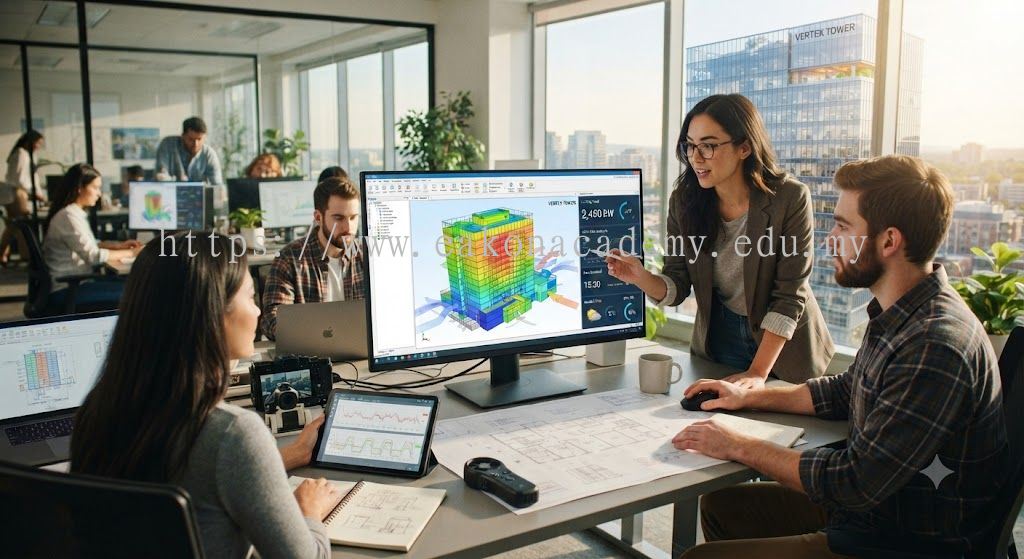
Commercial Building Cooling Load Simulation Method for Accurate HVAC Design and Energy-Efficient Building Performance
The commercial building cooling load simulation method is an advanced HVAC engineering approach used to accurately predict the cooling requirements of commercial buildings before an air conditioning system is installed. Unlike traditional estimation techniques that rely on simplified assumptions, cooling load simulation uses detailed building data, climate information, occupancy schedules, and equipment operating conditions to create a realistic model of how a building behaves throughout the day and across different seasons. This method enables HVAC engineers, consultants, designers, and contractors to optimise system performance, improve energy efficiency, and reduce operating costs. At Eakon Academy, we provide comprehensive HVAC training and technical education that equips professionals with the knowledge and practical skills required to understand commercial building cooling load simulation methods, modern HVAC design practices, and energy-efficient air conditioning solutions.
Commercial buildings have complex cooling demands due to varying occupancy levels, diverse operating schedules, large floor areas, extensive lighting systems, office equipment, manufacturing machinery, ventilation requirements, and changing outdoor weather conditions. A commercial building cooling load simulation method analyses these variables simultaneously to determine the precise cooling capacity needed for different zones within a building. This level of accuracy is especially valuable for offices, shopping malls, hotels, hospitals, educational institutions, factories, warehouses, airports, data centres, and other commercial facilities where cooling loads fluctuate throughout the day.
A comprehensive cooling load simulation begins by collecting detailed building information. This includes architectural drawings, building orientation, geographical location, local climate data, roof and wall construction, insulation performance, window glazing characteristics, shading devices, ceiling height, occupancy density, lighting power density, equipment heat gains, ventilation rates, infiltration levels, and operating schedules. Every parameter influences the building's thermal behaviour and contributes to the overall cooling demand. By incorporating these variables into a simulation model, HVAC professionals can evaluate the building's performance under realistic operating conditions rather than relying on simplified assumptions.
One of the greatest advantages of using a commercial building cooling load simulation method is its ability to evaluate both sensible heat load and latent heat load with exceptional accuracy. Sensible heat is generated from solar radiation, lighting systems, occupants, office equipment, electrical appliances, and heat transfer through the building envelope. Latent heat results from moisture introduced by occupants, outdoor ventilation air, infiltration, and indoor processes. Accurate simulation ensures that HVAC systems are designed to control both temperature and humidity effectively, improving indoor comfort, maintaining excellent indoor air quality, and supporting occupant wellbeing.
Modern commercial building cooling load simulation methods are based on internationally recognised engineering principles and are commonly integrated into advanced HVAC software platforms. Engineers often utilise methodologies derived from ASHRAE standards, the Heat Balance Method (HBM), Radiant Time Series (RTS) Method, and dynamic building energy modelling techniques. These simulation tools calculate hourly cooling loads by considering changing weather conditions, solar heat gain, occupancy patterns, equipment operation, thermal storage effects, and building material characteristics. As a result, HVAC professionals can identify peak cooling demands more accurately and optimise equipment selection before construction begins.
Accurate cooling load simulation provides significant advantages for HVAC system design and project planning. By understanding how cooling demands change throughout the day, engineers can select appropriately sized chillers, VRF systems, packaged air conditioning units, air handling units, fan coil units, cooling towers, and ventilation equipment. Proper equipment sizing improves energy efficiency, reduces electricity consumption, minimises unnecessary maintenance, extends equipment lifespan, and lowers total operating costs. It also prevents common HVAC issues associated with oversized or undersized systems, including short cycling, inconsistent indoor temperatures, poor humidity control, excessive energy usage, and reduced occupant comfort.
Commercial building cooling load simulation also plays a vital role in sustainable building development and green construction practices. Building owners, developers, and facility managers increasingly rely on simulation methods to evaluate energy performance before construction or renovation projects begin. Simulation results can be used to compare different HVAC system configurations, insulation materials, glazing options, ventilation strategies, renewable energy integration, and energy conservation measures. This allows decision-makers to optimise building performance while reducing environmental impact and supporting long-term sustainability goals.
For HVAC engineers, consultants, contractors, and technicians, mastering commercial building cooling load simulation methods provides a valuable competitive advantage. Professionals with expertise in simulation-based HVAC design can improve project accuracy, reduce costly design errors, optimise energy performance, and deliver higher-quality solutions for commercial clients. As digital engineering technologies continue to evolve, cooling load simulation has become an essential skill for professionals working on modern commercial HVAC projects.
Eakon Academy is dedicated to developing highly skilled HVAC professionals through specialised training programmes covering commercial building cooling load simulation methods, HVAC system design, cooling load calculations, building energy analysis, air conditioning installation, commissioning, troubleshooting, preventive maintenance, and energy-efficient building technologies. Our industry-focused training combines engineering theory with practical applications, enabling participants to confidently apply cooling load simulation techniques in real-world commercial projects. Whether you are an HVAC engineer, consultant, contractor, technician, or student, learning commercial building cooling load simulation methods will strengthen your technical expertise, improve HVAC design accuracy, enhance energy efficiency, and support the successful delivery of reliable, sustainable, and high-performance commercial air conditioning systems.
更多 EAKON ACADEMY SDN BHD 相关资料 Malaysia
