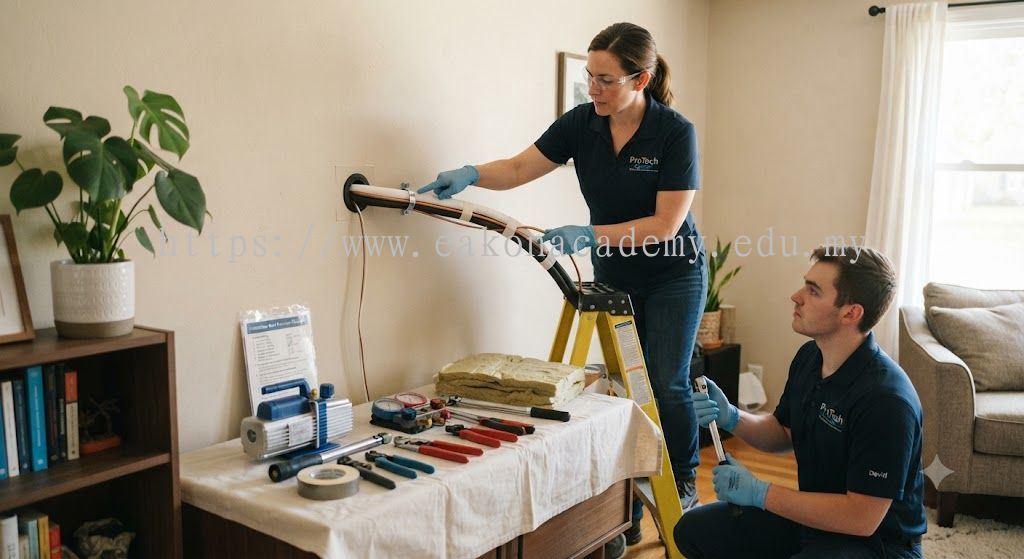
AC Piping Installation Best Practices for Professional HVAC Training and Industry Skills Development
AC piping installation best practices are essential knowledge for every HVAC technician, air conditioning installer, and maintenance professional who wants to achieve reliable, efficient, and long-lasting cooling system performance. Proper piping installation plays a critical role in ensuring that air conditioning systems operate smoothly, maintain correct refrigerant flow, reduce energy consumption, and prevent common issues such as refrigerant leakage, poor cooling performance, compressor failure, and excessive maintenance costs. At Eakon Academy, professional HVAC training focuses on developing practical skills and technical understanding in AC piping installation techniques that meet modern industry requirements.
A well-designed AC piping system requires careful planning, accurate measurement, and proper installation procedures. Following AC piping installation best practices helps technicians select the correct pipe size, apply suitable insulation methods, perform accurate pipe routing, and maintain proper installation standards for different air conditioning applications. Whether working on residential split air conditioners, commercial HVAC systems, or advanced cooling equipment, technicians must understand how piping design affects overall system efficiency and reliability.
One of the most important aspects of AC piping installation is selecting the correct copper pipe size according to manufacturer specifications and system capacity. Incorrect pipe sizing can lead to restricted refrigerant flow, reduced cooling capacity, higher energy consumption, and potential damage to the compressor. Professional HVAC training provides learners with knowledge of refrigerant piping principles, suction and liquid line installation, pipe bending techniques, and proper connection methods to ensure optimal air conditioning performance.
Proper copper pipe handling is another key element of effective AC piping installation. Technicians must learn how to cut, deburr, flare, and connect copper tubing correctly to prevent leaks and maintain system efficiency. Poor workmanship during piping installation may create weak joints, refrigerant loss, and system breakdowns. Through hands-on HVAC training, students can develop practical installation skills using professional tools and industry-approved techniques.
AC piping insulation is also an important factor in achieving energy-efficient operation. Correct insulation prevents condensation problems, reduces heat transfer, and improves the overall cooling performance of air conditioning systems. Technicians must understand insulation material selection, insulation thickness requirements, and proper sealing methods to ensure long-term system protection. These skills are valuable for anyone pursuing a career in HVAC installation, servicing, and maintenance.
Another important AC piping installation best practice is maintaining proper pipe positioning and support. Incorrect pipe arrangement, excessive bending, or poor support methods can affect refrigerant circulation and create unnecessary stress on system components. Professional installers must follow recommended installation procedures to ensure neat, safe, and reliable piping layouts. Good installation practices not only improve system performance but also enhance the appearance and professionalism of completed HVAC projects.
Leak testing, vacuum procedures, and commissioning checks are also essential steps after completing AC piping installation. Technicians must be able to identify potential leaks, remove moisture and air from the refrigerant system, and verify that the air conditioner operates according to performance requirements. These procedures help extend equipment lifespan, improve energy efficiency, and reduce future repair expenses.
Eakon Academy provides HVAC training programs designed to enhance technical competency in air conditioning installation, servicing, and maintenance. By learning AC piping installation best practices, participants can improve their practical abilities, increase workplace confidence, and develop the skills needed to meet industry expectations. Professional knowledge in AC piping installation is highly valuable for HVAC technicians, contractors, and individuals seeking career opportunities in the growing air conditioning and refrigeration industry.
Investing in proper AC piping installation training helps create skilled technicians who can deliver high-quality HVAC solutions while supporting energy efficiency, system reliability, and customer satisfaction. Through comprehensive learning and practical experience, Eakon Academy continues to support the development of qualified HVAC professionals equipped with modern installation knowledge and industry-relevant expertise.
更多 EAKON ACADEMY SDN BHD 相关资料 Malaysia