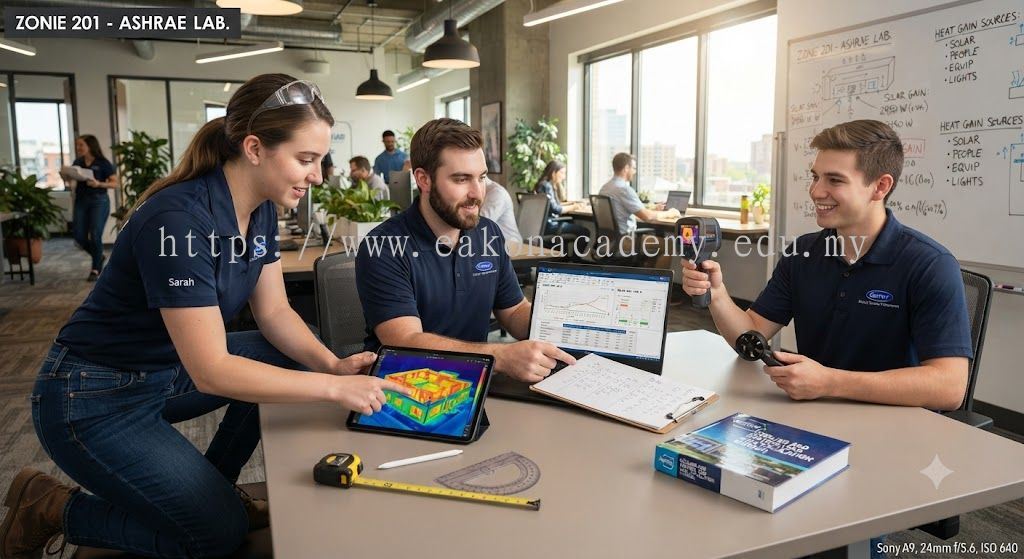
ASHRAE HVAC Cooling Load Estimation Method: A Professional Guide for Accurate Air Conditioning Design and Energy-Efficient HVAC Systems
The ASHRAE HVAC cooling load estimation method is one of the most widely recognized approaches used by HVAC engineers, consultants, designers, and professionals to accurately calculate cooling requirements for buildings. Proper cooling load estimation is a critical part of HVAC system design because it determines the correct air conditioning capacity needed to maintain indoor comfort, control humidity, improve energy efficiency, and ensure reliable system operation. By applying the ASHRAE HVAC cooling load estimation method, professionals can analyse building heat gains, evaluate thermal performance, optimize equipment selection, and design HVAC systems that meet modern engineering requirements. At Eakon Academy (eakonacadem.edu.my), we provide professional HVAC training programmes that help participants understand advanced cooling load calculation techniques, HVAC design principles, and industry-standard methods used in real-world air conditioning projects.
The ASHRAE HVAC cooling load estimation method is based on detailed engineering analysis of all factors that contribute to heat gain within a building. Unlike simple cooling estimation methods that rely only on room size or general rules of thumb, the ASHRAE approach evaluates multiple variables including solar radiation, building materials, occupancy levels, lighting systems, electrical equipment, ventilation requirements, infiltration, and indoor environmental conditions. This detailed analysis allows HVAC professionals to determine the actual cooling capacity required for residential, commercial, and industrial applications.
One of the key principles of the ASHRAE HVAC cooling load estimation method is understanding the difference between heat gain and cooling load. Heat gain refers to the amount of heat entering a space from external and internal sources, while cooling load represents the amount of heat that must be removed by the HVAC system at a specific time. Not all heat gain immediately becomes cooling load because building materials and indoor surfaces can absorb and release heat over time. ASHRAE calculation methods consider these time-based effects to provide more accurate cooling load results compared to simplified approaches.
The ASHRAE Heat Balance Method (HBM) is one of the most advanced cooling load calculation techniques used by HVAC professionals. This method analyses heat transfer processes by considering conduction, convection, radiation, and energy storage effects within the building structure. The Heat Balance Method provides highly accurate results by evaluating how heat moves through walls, roofs, windows, floors, and internal surfaces. This approach is particularly useful for complex commercial buildings, high-performance buildings, and projects where energy efficiency and precise HVAC performance are important.
Another widely applied ASHRAE HVAC cooling load estimation method is the Radiant Time Series (RTS) method. The RTS method simplifies the complex heat transfer process by analysing radiant heat gain and converting it into cooling load over time. This method considers the delay between heat entering a building and the time when that heat affects the HVAC system. The Radiant Time Series method is commonly used by HVAC designers because it provides accurate results while being practical for many building applications.
The Cooling Load Temperature Difference (CLTD) method is another traditional approach associated with ASHRAE cooling load calculations. This method uses temperature difference values to estimate heat transfer through building components such as walls and roofs. Although modern HVAC design increasingly uses more advanced methods, CLTD remains a useful learning approach for understanding the fundamentals of heat transfer and cooling load calculation principles. HVAC professionals often study CLTD concepts as part of their technical development before applying advanced calculation methods.
Accurate application of the ASHRAE HVAC cooling load estimation method requires detailed analysis of building envelope characteristics. Engineers evaluate wall construction, roof design, insulation levels, window glazing, shading systems, and building orientation to determine external heat gain. Solar heat gain through windows and exposed surfaces is especially important in tropical climates such as Malaysia, where high temperatures and strong solar radiation can significantly increase cooling requirements. Proper evaluation of these factors helps HVAC designers select efficient air conditioning systems that provide reliable performance throughout the year.
Internal heat gain calculation is also an important part of ASHRAE cooling load estimation. Occupants, lighting fixtures, computers, appliances, machinery, and other equipment contribute heat inside conditioned spaces. Different building types have different heat generation patterns, requiring detailed evaluation during the design process. Offices, hotels, hospitals, factories, shopping centres, and educational facilities all require different cooling load considerations based on occupancy and operational activities. Accurate internal load calculation ensures that HVAC systems are properly sized according to actual usage conditions.
Ventilation and infiltration loads are also considered in the ASHRAE HVAC cooling load estimation method. Outdoor air entering a building introduces both sensible heat and moisture, affecting the overall cooling requirement. HVAC engineers analyse ventilation rates, outdoor air conditions, air leakage, and humidity levels to determine the additional cooling capacity required. This is especially important in Malaysia’s hot and humid environment, where effective humidity control is essential for maintaining indoor comfort and air quality.
A complete ASHRAE cooling load calculation includes both sensible cooling load and latent cooling load evaluation. Sensible load affects indoor temperature, while latent load involves moisture removal from the air. Proper calculation of both components ensures that HVAC systems can maintain comfortable temperature and humidity levels. Incorrect estimation of latent loads may result in poor indoor conditions, condensation problems, mould development, and reduced system efficiency. HVAC professionals use psychrometric analysis together with ASHRAE principles to achieve accurate system design.
Modern HVAC design software integrates ASHRAE cooling load estimation methods to improve calculation accuracy and efficiency. Professional software allows engineers to create building models, analyse thermal performance, simulate different operating conditions, calculate peak cooling requirements, and evaluate energy consumption. These tools support better HVAC equipment selection and allow designers to develop optimized solutions for energy-efficient buildings. Combining ASHRAE knowledge with HVAC software skills is an essential capability for modern HVAC professionals.
At Eakon Academy, our HVAC training programmes provide practical education on the ASHRAE HVAC cooling load estimation method through technical lessons, engineering calculations, software applications, and real project examples. Participants learn how to analyse building information, apply ASHRAE calculation principles, evaluate heat gain sources, perform cooling load calculations, conduct psychrometric analysis, and select appropriate HVAC equipment. Our training is suitable for HVAC technicians, engineers, contractors, consultants, and facility managers who want to strengthen their professional skills and improve their understanding of advanced HVAC system design.
The benefits of using the ASHRAE HVAC cooling load estimation method include improved HVAC system efficiency, accurate equipment sizing, reduced energy consumption, better indoor comfort, and lower operating costs. Correctly designed HVAC systems avoid problems caused by oversized or undersized equipment. Oversized systems may consume excessive energy and provide poor humidity control, while undersized systems may fail to maintain comfort during peak conditions. Accurate ASHRAE-based cooling load calculations ensure that HVAC systems operate effectively and reliably.
As the HVAC industry continues to develop with smart building technologies, energy-efficient systems, Variable Refrigerant Flow (VRF), Building Management Systems (BMS), and sustainable design practices, knowledge of the ASHRAE HVAC cooling load estimation method has become increasingly valuable. Through specialized HVAC training at Eakon Academy (eakonacadem.edu.my), participants gain the technical knowledge, practical experience, and industry-focused expertise required to perform accurate cooling load calculations, optimize HVAC system design, improve energy efficiency, and deliver professional air conditioning solutions. Mastering ASHRAE cooling load estimation techniques is an essential step toward developing successful HVAC careers and supporting the creation of comfortable, sustainable, and high-performance buildings.
More detail about EAKON ACADEMY SDN BHD Malaysia