
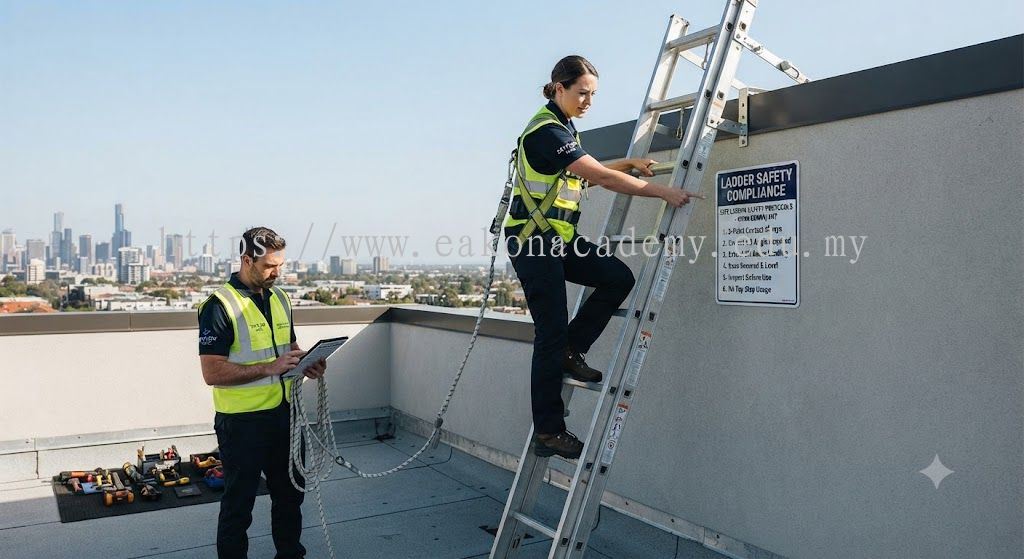
HVAC Ladder Safety Compliance Standards: Essential Guidelines for Safe Air Conditioning Installation and Maintenance Work
HVAC ladder safety compliance standards are essential guidelines that help air conditioning technicians perform installation, maintenance, and repair activities safely when using ladders in residential, commercial, and industrial environments. Ladders are commonly used by HVAC professionals to access indoor units, ceiling systems, electrical connections, piping routes, outdoor equipment locations, and elevated work areas. Although ladders are simple and widely used tools, improper selection, setup, and usage can create serious risks such as falls, injuries, equipment damage, and workplace accidents. Following proper HVAC ladder safety compliance standards helps technicians improve workplace safety, maintain professional installation quality, and reduce the risks associated with working at height. At Eakon Academy (eakonacadem.edu.my), we provide professional HVAC training programs that focus on ladder safety, working at height procedures, tool handling, installation practices, and practical skills required for modern air conditioning technicians.
Ladder safety is an important part of HVAC working at height procedures because technicians often depend on ladders to complete installation and maintenance tasks efficiently. Before using any ladder, technicians should conduct a basic safety inspection to check for damage, loose components, unstable parts, or conditions that may affect safe operation. A proper ladder inspection ensures that equipment is suitable for use and reduces the possibility of accidents caused by faulty equipment. Professional HVAC technicians understand that ladder safety begins before climbing and requires proper preparation.
One of the key elements of HVAC ladder safety compliance standards is selecting the correct ladder type for the specific task. Different HVAC activities may require different ladder designs, including step ladders, extension ladders, or specialized access equipment. Technicians should consider working height, installation location, surface conditions, and task requirements before selecting a ladder. Using an unsuitable ladder can create instability and increase the likelihood of falls. Proper ladder selection improves technician confidence and supports safer air conditioning installation practices.
Correct ladder positioning is another important safety requirement for HVAC technicians. Ladders should always be placed on stable, level, and suitable surfaces before use. Technicians should ensure that ladders are properly positioned to provide adequate support and prevent movement during work activities. Avoiding unstable surfaces, slippery areas, and unsafe angles helps reduce fall risks. Proper ladder setup is especially important when technicians perform tasks such as mounting indoor units, connecting electrical wiring, installing copper piping, or conducting air conditioning maintenance.
Maintaining three-point contact is an important ladder safety practice included in HVAC ladder safety compliance standards. Technicians should maintain proper balance by keeping secure contact with the ladder while climbing or working. Carrying excessive tools or materials while climbing can reduce stability and increase accident risks. HVAC professionals should use tool bags, tool belts, or lifting methods to transport equipment safely instead of carrying too many items while climbing ladders.
Tool management is closely connected with ladder safety during HVAC work. Technicians commonly use tools such as drills, screwdrivers, torque wrenches, pipe cutters, flaring tools, multimeters, and refrigerant equipment while working from ladders. Tools should be properly secured and organized to prevent drops and allow technicians to maintain safe positioning. Using tool holders, safety lanyards, and proper storage methods helps improve productivity while reducing the risk of falling objects.
Personal protective equipment (PPE) also supports ladder safety compliance for HVAC technicians. Suitable PPE includes safety helmets, protective gloves, safety footwear, and protective eyewear. Safety footwear with proper grip helps improve stability when standing on ladder surfaces, while helmets provide protection from falling objects. Proper PPE usage enhances overall workplace safety and supports professional HVAC installation practices.
Environmental conditions should also be considered when applying HVAC ladder safety procedures. Technicians working outdoors or in construction environments may encounter rain, strong winds, uneven surfaces, and slippery conditions. These factors can affect ladder stability and increase accident risks. Evaluating workplace conditions before ladder use allows technicians to make safer decisions and apply additional precautions when required.
Training and competency development are important parts of maintaining HVAC ladder safety compliance standards. Professional training helps technicians understand ladder inspection, setup procedures, safe climbing methods, hazard identification, and emergency response practices. Hands-on training allows HVAC professionals to develop practical skills and confidence when performing installation and maintenance work at height.
Regular workplace safety reviews and continuous improvement also help maintain effective ladder safety practices. HVAC companies should encourage technicians to follow safety procedures, report unsafe conditions, and maintain proper equipment standards. A strong safety culture improves productivity, reduces workplace incidents, and supports professional service delivery.
At Eakon Academy (eakonacadem.edu.my), we are committed to developing skilled HVAC professionals through practical and industry-focused training programs. Our courses cover air conditioning installation safety, ladder safety procedures, working at height practices, tool handling, electrical safety, refrigerant management, and professional HVAC standards. By understanding and applying HVAC ladder safety compliance standards, technicians can reduce workplace hazards, improve installation efficiency, protect themselves and others, and deliver reliable air conditioning services. Proper ladder safety knowledge is an essential foundation for creating a safer, more efficient, and professional HVAC industry.
More detail about EAKON ACADEMY SDN BHD Malaysia
