
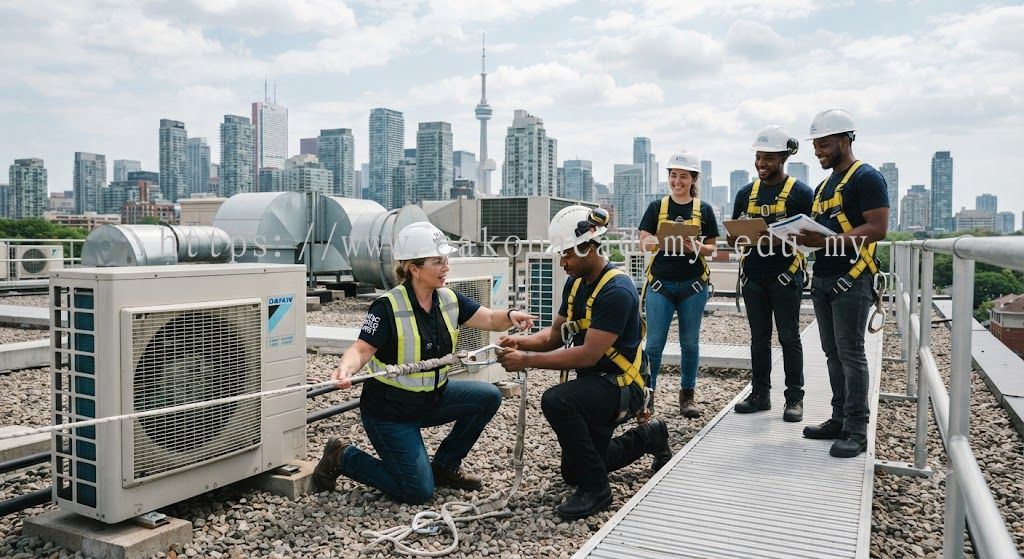
Air Conditioning Rooftop Safety Training Course: Developing Professional Skills for Safe HVAC Work at Height
Air conditioning rooftop safety training course is an essential professional training program designed to provide HVAC technicians with the knowledge, skills, and safety practices required to perform air conditioning installation, maintenance, and repair activities on rooftop environments. Rooftop HVAC work involves various hazards, including elevated working areas, uneven surfaces, weather exposure, limited access routes, and potential fall risks. Proper safety training helps technicians understand these challenges and apply effective prevention methods to protect themselves while maintaining high-quality HVAC service standards. At Eakon Academy, professional HVAC training focuses on improving technician competency, workplace safety awareness, and practical skills required for safe rooftop HVAC operations.
Rooftop air conditioning systems are commonly installed in commercial buildings, industrial facilities, and large properties where technicians need to access outdoor units, condenser systems, ventilation equipment, and mechanical components located above ground level. Maintenance activities such as refrigerant checking, electrical inspection, coil cleaning, system troubleshooting, and equipment servicing often require technicians to work in elevated areas. Without proper safety preparation, these tasks may expose workers to risks such as falls, slips, incorrect equipment usage, and unsafe movement around rooftop areas. An air conditioning rooftop safety training course helps technicians recognize these hazards and develop safer working methods.
A major focus of rooftop safety training is hazard identification and workplace risk assessment. Before performing any rooftop HVAC activity, technicians should learn how to inspect the working environment and identify potential dangers. Important factors include rooftop conditions, roof edges, access points, surface stability, weather conditions, equipment positioning, and surrounding obstacles. Proper risk assessment enables technicians to prepare suitable safety procedures, select appropriate equipment, and reduce exposure to workplace hazards.
Fall prevention systems are an important part of an air conditioning rooftop safety training course. Technicians are trained to understand the correct use of safety harnesses, lanyards, anchor points, lifelines, and other protective equipment when working at height. Training includes proper equipment inspection, correct fitting procedures, safe attachment methods, and understanding the limitations of fall protection systems. This knowledge helps HVAC professionals perform rooftop installation and maintenance tasks with improved confidence and safety.
The course also covers safe access methods for rooftop HVAC activities. Technicians may need to use ladders, scaffolding, or mobile elevated work platforms (MEWP) to access rooftop equipment. Understanding proper equipment selection, inspection requirements, and safe operating procedures is essential to prevent accidents. Professional rooftop safety training helps technicians make informed decisions when choosing the most suitable access solution for different HVAC projects.
Another important area covered in rooftop safety training is proper tool and equipment management. HVAC technicians often handle refrigerant tools, electrical testing equipment, hand tools, spare parts, and heavy components while working on rooftops. Poorly secured equipment can create falling object hazards that may injure workers below or damage property. Learning proper storage methods, tool securing techniques, and workplace organization helps create safer rooftop working conditions.
Weather awareness is also a critical part of rooftop HVAC safety. Strong winds, rain, extreme heat, and wet surfaces can increase the risk of accidents. Technicians should learn how to evaluate environmental conditions and determine whether rooftop work can be performed safely. Proper planning and communication help ensure that HVAC tasks are completed under suitable working conditions.
Emergency response and rescue planning are additional elements included in an effective air conditioning rooftop safety training course. Technicians should understand emergency procedures, communication methods, and response actions in case of workplace incidents. Proper preparation allows teams to react quickly and reduce the impact of unexpected situations.
For HVAC companies, investing in rooftop safety training provides valuable benefits, including fewer workplace accidents, improved technician confidence, stronger safety compliance, and enhanced service quality. A well-trained HVAC workforce is better prepared to handle challenging rooftop environments while maintaining professional standards.
Eakon Academy provides professional HVAC training programs designed to develop skilled technicians with strong technical knowledge and safety awareness. Through practical learning and industry-focused instruction, participants can improve their understanding of air conditioning rooftop safety training course principles, working-at-height procedures, fall prevention methods, hazard control strategies, and professional HVAC practices. Building a safety-focused workforce supports safer air conditioning services and promotes higher standards within Malaysia’s HVAC industry.
More detail about EAKON ACADEMY SDN BHD Malaysia
