
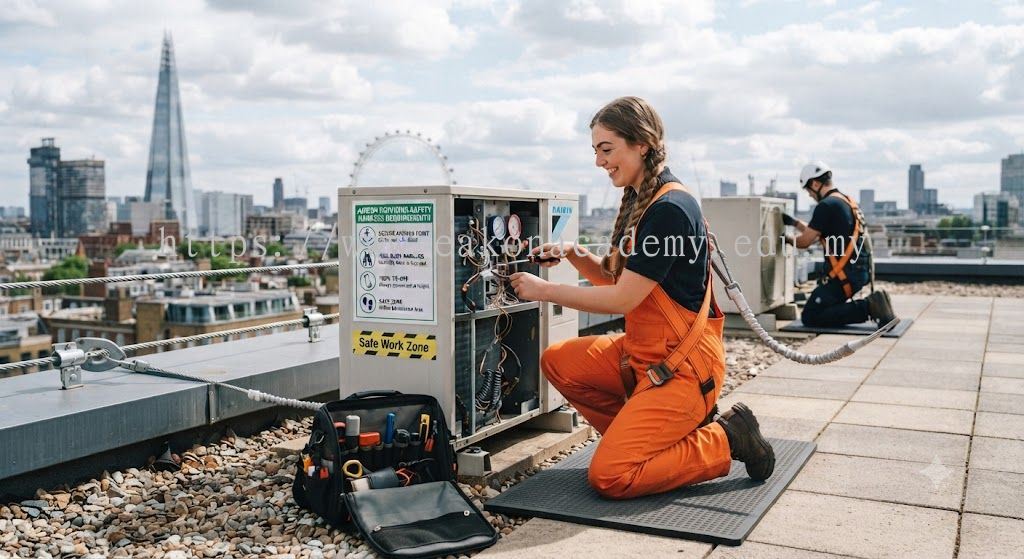
Aircon Servicing Safety Harness Requirements: Essential Fall Protection Guide for HVAC Technicians
Air conditioning servicing involves various technical tasks that require technicians to inspect, repair, clean, and maintain HVAC systems in different working environments. Many air conditioning units, especially commercial and industrial systems, are installed in elevated locations such as rooftops, external walls, ceiling areas, service platforms, and high-rise buildings. When technicians perform servicing activities at height, they may face serious hazards including falls, unstable surfaces, falling objects, and difficult access conditions. Understanding the correct aircon servicing safety harness requirements is essential to protect HVAC technicians, improve workplace safety, and ensure professional servicing practices. At Eakon Academy (eakonacadem.edu.my), our HVAC training programmes focus on developing skilled technicians who understand both technical air conditioning servicing procedures and the importance of proper fall protection systems when working at height.
A safety harness is one of the most important components of a fall protection system for air conditioning technicians. Unlike traditional safety belts that only support the waist area, a full-body safety harness is designed to distribute fall forces across stronger areas of the body, including the shoulders, chest, thighs, and pelvis. This design helps reduce the risk of serious injury if an accidental fall occurs. Technicians performing aircon servicing at elevated locations should understand how to select, wear, inspect, and maintain safety harness systems correctly.
The first requirement for an aircon servicing safety harness is selecting the correct full-body harness suitable for working at height activities. The harness should be designed for fall arrest purposes and meet appropriate workplace safety requirements. A suitable harness should provide secure attachment points, adjustable straps, comfortable fitting, and durable construction. HVAC technicians should ensure the harness size is suitable for their body and that all adjustment points are properly secured before starting servicing work.
Proper harness inspection is another important safety requirement. Before every use, technicians should check the condition of the harness components, including webbing straps, stitching, buckles, D-rings, connectors, and attachment points. Any signs of damage such as cuts, frayed materials, broken stitching, corrosion, or chemical damage may affect the performance of the harness. Damaged harnesses should not be used and must be removed from service immediately to prevent safety failures during elevated air conditioning servicing activities.
Correct harness fitting and adjustment are essential for effective fall protection. A loose or incorrectly worn harness may not provide proper support during a fall event and may increase the risk of injury. Technicians should ensure shoulder straps, chest straps, leg loops, and waist adjustments are properly positioned according to manufacturer guidelines. Proper fitting improves comfort, mobility, and safety while performing air conditioning servicing tasks.
A complete safety harness system requires additional components beyond the harness itself. Aircon technicians working at height may need to use shock-absorbing lanyards, self-retracting lifelines (SRLs), connectors, and approved anchor points depending on the work environment. These components work together to provide reliable fall protection. Shock-absorbing lanyards help reduce impact forces during a fall, while self-retracting lifelines allow greater movement while maintaining connection to a secure anchorage point.
Anchor point selection is another critical part of aircon servicing safety harness requirements. Technicians must connect their harness systems only to suitable and approved anchor points designed to withstand fall forces. Unsafe attachment locations, including refrigerant piping, electrical conduits, ductwork, handrails, or temporary structures, should never be used. Proper anchor point assessment helps prevent equipment failure and provides better protection during rooftop and elevated servicing activities.
Air conditioning technicians should also understand the importance of maintaining safe working conditions when using harness systems. Before servicing begins, the work area should be inspected for hazards such as roof edges, slippery surfaces, weather conditions, electrical equipment, and obstacles that may affect movement. A proper risk assessment helps determine whether additional safety measures are required before using a harness system.
Personal protective equipment (PPE) should always be used together with a safety harness during elevated aircon servicing. Essential PPE may include safety helmets with chin straps, safety footwear, protective gloves, safety glasses, and suitable work clothing. While the harness protects against falls, other PPE protects technicians from additional hazards such as falling objects, sharp metal edges, electrical risks, refrigerant exposure, and workplace impacts.
Safe access equipment is also an important consideration when using safety harness systems. Technicians may use ladders, scaffolding, boom lifts, or scissor lifts to reach elevated air conditioning equipment. All access equipment should be inspected before use and operated according to safety procedures. Proper access planning reduces unnecessary climbing risks and improves overall servicing efficiency.
Tool management is another important safety practice when technicians are connected to a harness system. Tools should be secured using tool belts, tool bags, or tool lanyards to prevent them from falling. Dropped tools can create serious hazards for workers below and may damage air conditioning equipment. Organised tool handling improves safety and professionalism during servicing work.
Emergency rescue planning is a necessary part of using safety harness systems during aircon servicing. In the event of a fall, technicians may experience suspension trauma if rescue is delayed. Employers should prepare rescue procedures, provide suitable rescue equipment, maintain emergency communication methods, and train workers on emergency response actions. Proper rescue planning ensures a faster and safer response during workplace incidents.
Regular safety training is essential for ensuring technicians understand aircon servicing safety harness requirements. Training should include harness inspection, correct wearing techniques, fall protection systems, anchor point selection, PPE usage, ladder safety, hazard identification, and emergency rescue procedures. Skilled technicians who receive proper training can perform air conditioning servicing tasks more safely and confidently.
At Eakon Academy (eakonacadem.edu.my), we are committed to developing professional HVAC technicians who understand the importance of safety in every servicing activity. Our specialised HVAC training programmes provide practical knowledge in air conditioning installation, servicing, maintenance, troubleshooting, working at height safety, fall protection equipment, PPE requirements, electrical safety, refrigerant handling, and industry best practices. Through hands-on training and practical learning, students gain the skills required to perform HVAC work safely and professionally. By following the correct Aircon Servicing Safety Harness Requirements, technicians can minimise workplace hazards, improve safety performance, protect themselves and others, comply with safety standards, and deliver reliable air conditioning services with confidence and professionalism.
More detail about EAKON ACADEMY SDN BHD Malaysia
