
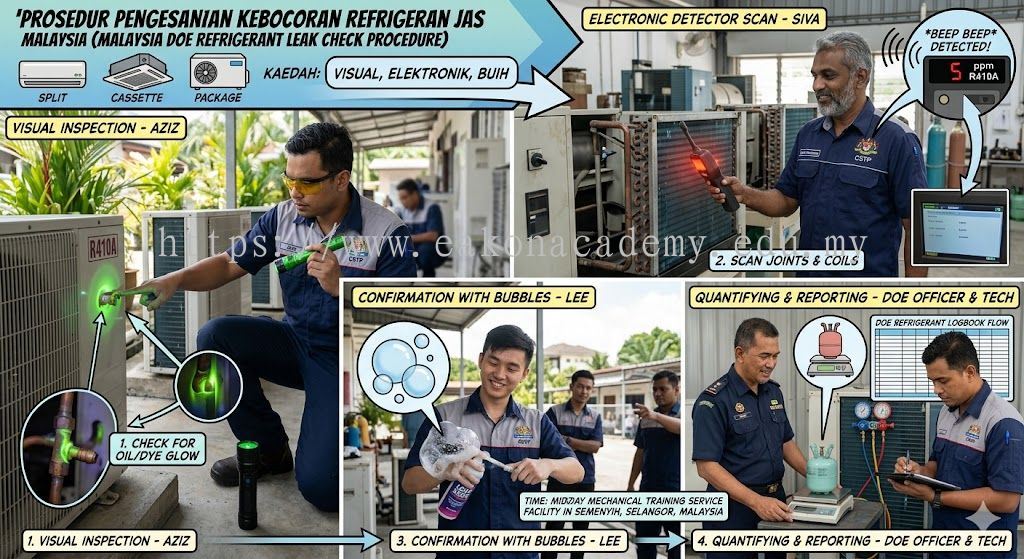
DOE MALAYSIA REFRIGERANT SYSTEM LEAK CHECKS
DOE Malaysia refrigerant system leak checks are an essential requirement under the Department of Environment (DOE) regulations aimed at controlling greenhouse gas emissions and ensuring safe operation of HVACR (Heating, Ventilation, Air Conditioning, and Refrigeration) systems. These leak checks are designed to detect and prevent the release of refrigerant gases such as hydrofluorocarbons (HFCs) and hydrochlorofluorocarbons (HCFCs), which have high global warming potential (GWP) and contribute significantly to climate change when emitted into the atmosphere. Understanding DOE Malaysia refrigerant system leak checks is crucial for technicians, engineers, contractors, and facility operators responsible for maintaining refrigeration and air conditioning systems in compliance with environmental standards.
The primary purpose of DOE-required leak checks is to ensure that HVACR systems operate efficiently without unnecessary refrigerant loss. Leak checks are typically conducted during installation, routine maintenance, system servicing, and emergency repairs. Technicians are required to inspect all critical components of the system, including compressors, evaporators, condensers, valves, piping joints, and connection points, to identify any signs of refrigerant leakage. Early detection is important because even small leaks can lead to significant environmental damage over time, as well as reduced system efficiency and increased operational costs.
DOE Malaysia refrigerant system leak checks involve a combination of visual inspections and advanced diagnostic methods. Visual inspection is the first step, where technicians look for oil stains, corrosion, frost buildup, or physical damage that may indicate a leak. Following this, electronic leak detectors are commonly used to identify the presence of refrigerant gases in the surrounding air. These devices provide fast and accurate readings, making them highly effective for routine maintenance and compliance inspections. Pressure testing using nitrogen gas is also a standard procedure, where the system is pressurized and monitored for any drop in pressure that would indicate a leak.
Other approved methods include ultraviolet (UV) dye testing, where a fluorescent dye is added to the refrigerant system and detected using UV light equipment, allowing technicians to locate even small or hidden leaks. Soap bubble testing is another simple yet effective method where a soap solution is applied to suspected areas, and bubble formation reveals escaping refrigerant gas. These combined methods ensure a comprehensive approach to leak detection and system integrity verification.
In Malaysia, DOE refrigerant system leak checks are aligned with international environmental agreements such as the Montreal Protocol and Kigali Amendment, which aim to phase down high-GWP refrigerants and promote sustainable cooling technologies. As the HVACR industry transitions toward low-GWP refrigerants such as R32, R290 (propane), and carbon dioxide (CO ) systems, regular leak checks remain essential to ensure safety, efficiency, and environmental protection.
Training and certification play a vital role in ensuring proper implementation of DOE Malaysia refrigerant system leak checks. Skilled HVACR technicians must be trained in leak detection methods, system diagnostics, refrigerant handling, and environmental compliance procedures. Institutions such as Eakon Academy (eakonacadem.edu.my) provide structured HVACR training programs that align with DOE standards and industry requirements. These programs equip learners with practical skills and technical knowledge needed to perform accurate and reliable leak checks in real-world applications.
In conclusion, DOE Malaysia refrigerant system leak checks are a critical component of environmental sustainability, HVACR system reliability, and regulatory compliance. By conducting regular inspections, using approved detection methods, following standardized procedures, and investing in professional training through institutions like Eakon Academy (eakonacadem.edu.my), the HVACR industry in Malaysia can significantly reduce refrigerant emissions. These efforts support national environmental goals and contribute to a cleaner, safer, and more sustainable future.
More detail about EAKON ACADEMY SDN BHD Malaysia
