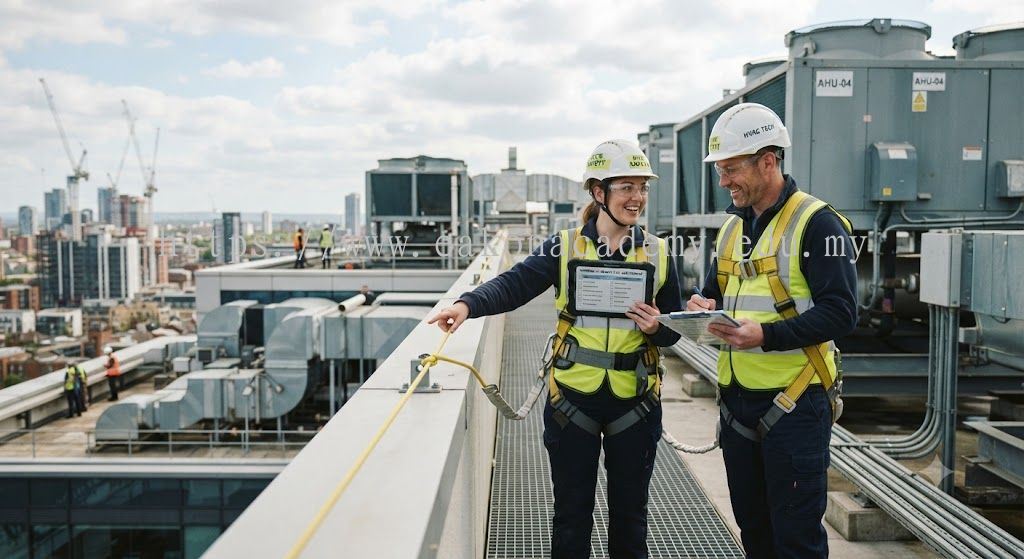
Commercial HVAC Working at Height Risk Assessment for Safe Industrial and Building HVAC Operations
Commercial HVAC working at height risk assessment is an essential safety management process designed to identify, evaluate, and control hazards when HVAC professionals perform installation, servicing, repair, and maintenance activities at elevated locations. Commercial HVAC systems are commonly installed in large buildings such as offices, shopping centres, factories, warehouses, hospitals, and industrial facilities where technicians may need to work on rooftops, high ceilings, mechanical rooms, external building structures, and large air conditioning equipment. A proper working at height risk assessment ensures that commercial HVAC activities are performed safely while reducing the possibility of falls, injuries, equipment damage, and operational disruptions.
At Eakon Academy, eakonacadem.edu.my, professional HVAC training focuses on developing competent technicians who understand the importance of safety procedures in commercial HVAC environments. The commercial HVAC working at height risk assessment process provides technicians and contractors with a systematic approach to identify workplace hazards, analyse risk levels, and implement effective control measures before starting elevated HVAC work. This approach helps create safer working conditions while improving efficiency and professionalism within the HVAC industry.
Commercial HVAC projects often involve complex working environments that require detailed safety planning. Technicians may perform tasks such as installing rooftop air conditioning units, maintaining air handling units (AHU), servicing ventilation systems, inspecting ductwork, repairing chilled water systems, and accessing equipment located at significant heights. These activities involve potential hazards including unstable access platforms, incorrect ladder usage, unsafe scaffolding, falling tools, electrical risks, heavy equipment handling, restricted movement areas, and changing weather conditions. A comprehensive risk assessment helps technicians identify these hazards and establish appropriate safety procedures.
A professional commercial HVAC working at height risk assessment begins with a detailed evaluation of the workplace environment. Technicians must inspect access routes, determine the required working height, assess equipment location, review surrounding conditions, and select suitable safety equipment. For example, servicing rooftop HVAC equipment requires careful planning of access methods, fall protection systems, lifting arrangements, and emergency response procedures. Proper assessment ensures that every task is carried out with minimal risk and maximum operational efficiency.
Safety equipment selection and correct usage are important elements of commercial HVAC height risk management. HVAC technicians should be trained in the proper application of personal protective equipment (PPE), including safety helmets, protective footwear, gloves, and fall prevention systems. In addition, knowledge of ladder safety, scaffolding requirements, mobile elevated work platform (MEWP) operation, and secure tool handling procedures is essential for technicians working in commercial environments. These practices help prevent accidents and maintain high standards of HVAC service quality.
For commercial building owners, HVAC contractors, and maintenance teams in Malaysia, implementing a strong working at height risk assessment process is important for protecting workers and ensuring reliable system performance. Commercial HVAC systems require regular inspection and maintenance, and many of these activities involve elevated work conditions. By applying proper risk assessment methods, companies can reduce workplace incidents, improve maintenance efficiency, and strengthen their overall safety culture.
Training in commercial HVAC working at height risk assessment helps technicians develop practical skills in hazard identification, risk evaluation, safe work planning, and emergency prevention. Skilled HVAC professionals are better prepared to manage complex commercial projects while maintaining safety standards and delivering reliable services. A trained workforce also helps companies improve reputation, customer trust, and compliance with workplace safety expectations.
Eakon Academy provides professional HVAC training programmes designed to enhance technical competency and workplace safety awareness for HVAC technicians, contractors, and industry professionals. By learning commercial HVAC working at height risk assessment methods, participants can improve their ability to perform installation, servicing, and maintenance tasks safely in demanding environments. Visit eakonacadem.edu.my to explore HVAC training solutions that support safer commercial HVAC operations, professional development, and industry excellence in Malaysia.
更多 EAKON ACADEMY SDN BHD 相关资料 Malaysia