
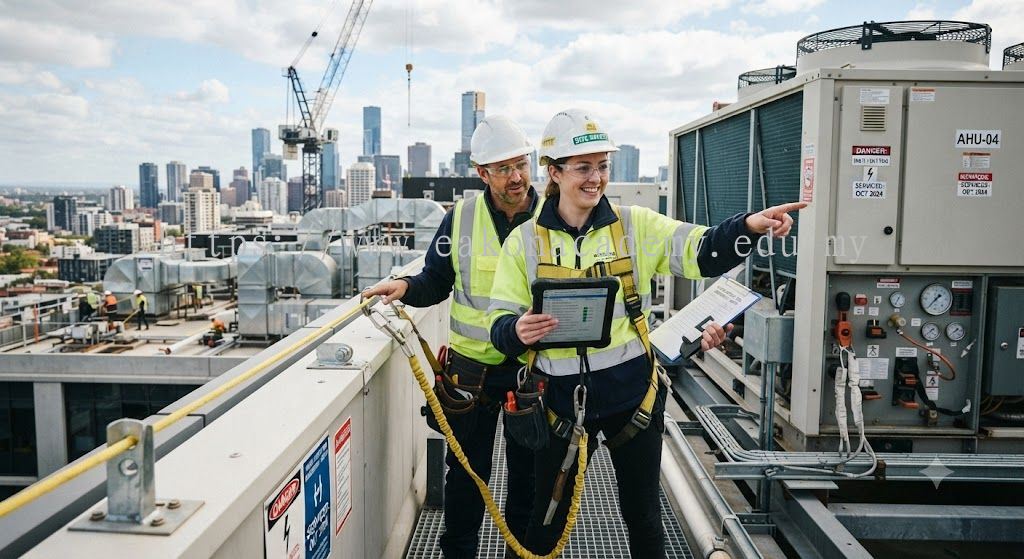
Air Conditioning Servicing Height Safety Risk Assessment for Safe HVAC Maintenance Practices
Air conditioning servicing height safety risk assessment is an essential safety procedure used to identify, evaluate, and control hazards when HVAC technicians perform maintenance and servicing work at elevated locations. Air conditioning servicing activities often require technicians to access high positions for tasks such as cleaning indoor units, repairing outdoor condenser units, checking refrigerant systems, inspecting electrical components, maintaining commercial HVAC equipment, and servicing air conditioning systems installed on walls, ceilings, rooftops, or difficult-to-reach areas. A proper height safety risk assessment ensures that HVAC maintenance work is carried out safely while reducing the possibility of falls, injuries, equipment damage, and workplace accidents.
At Eakon Academy, eakonacadem.edu.my, professional HVAC training focuses on improving technician safety awareness and practical skills for air conditioning servicing operations. A detailed air conditioning servicing height safety risk assessment helps technicians understand how to recognise workplace hazards before beginning maintenance tasks. Through proper assessment methods, HVAC professionals can identify potential risks, select suitable safety equipment, and apply effective control measures to create a safer working environment.
Working at height during air conditioning servicing involves various risks that require careful planning and professional attention. Common hazards include unstable ladders, incorrect ladder placement, unsafe access areas, slippery surfaces, poor lighting conditions, falling tools, electrical exposure, improper use of safety equipment, and unexpected environmental conditions. By conducting a comprehensive risk assessment, technicians can determine the safest approach for completing servicing activities while protecting themselves, their colleagues, customers, and surrounding property.
An effective air conditioning servicing height safety risk assessment begins with evaluating the work area before maintenance starts. Technicians should inspect access points, determine the required working height, identify obstacles, assess surface conditions, and select the correct tools and equipment. For example, servicing an air conditioning outdoor unit located on a high wall or rooftop requires careful consideration of ladder stability, fall prevention methods, equipment handling procedures, and emergency response planning. Proper preparation helps prevent accidents and improves overall servicing efficiency.
The selection and correct use of safety equipment are important elements in height safety risk assessment for HVAC servicing. Personal protective equipment (PPE), including safety helmets, protective footwear, gloves, and fall protection systems, helps minimise workplace hazards. Technicians should also understand safe ladder practices, proper use of mobile elevated work platforms (MEWP), and secure handling of servicing tools when working at elevated positions. These practices support safer maintenance procedures and improve the professionalism of HVAC service providers.
For HVAC technicians and contractors in Malaysia, air conditioning servicing height safety risk assessment is increasingly important as cooling systems are installed in more complex locations. Residential buildings, commercial properties, industrial facilities, and high-rise developments often require servicing work in challenging environments. Proper risk assessment allows technicians to manage these conditions effectively while maintaining safety, productivity, and quality service standards.
Training in air conditioning servicing height safety risk assessment helps HVAC professionals develop stronger knowledge of hazard identification, risk control methods, safe work procedures, and emergency prevention strategies. Employers can also benefit from improved workplace safety performance, reduced accident risks, better compliance with safety requirements, and increased customer confidence. Skilled technicians who understand height safety principles are better prepared to perform reliable HVAC maintenance services.
Eakon Academy provides professional HVAC training programmes designed to strengthen technical competency and workplace safety knowledge. By learning proper height safety risk assessment methods, HVAC technicians can improve their ability to conduct air conditioning servicing tasks safely and efficiently. Visit eakonacadem.edu.my to explore HVAC training solutions that support safer maintenance practices, professional development, and higher industry standards in Malaysia.
更多 EAKON ACADEMY SDN BHD 相关资料 Malaysia
