
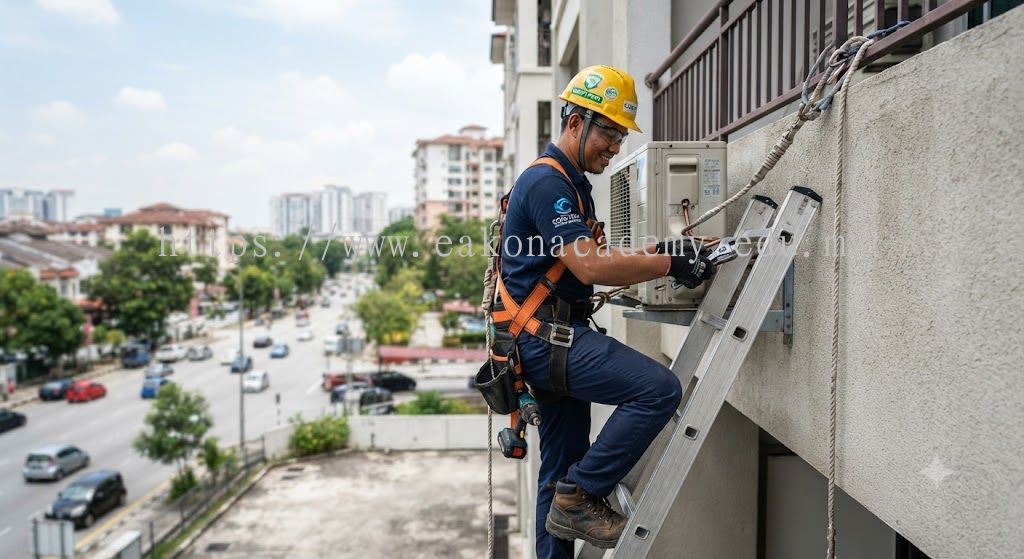
Aircond Installer Safety Gear for Height Work: Essential Fall Protection Equipment for Safe Air Conditioning Installation
Working at height is one of the most hazardous aspects of air conditioning installation, making the use of proper aircond installer safety gear for height work essential for every HVAC technician. Whether installing outdoor condenser units on high-rise buildings, servicing rooftop package units, maintaining VRF and VRV systems, or repairing commercial air conditioning equipment, technicians are regularly exposed to fall hazards that can result in serious injuries or fatalities if appropriate safety measures are not followed. Investing in high-quality safety gear, conducting thorough risk assessments, and receiving professional work-at-height training are vital steps in creating a safe working environment. At Eakon Academy (eakonacadem.edu.my), we prepare HVAC professionals with both advanced technical skills and comprehensive safety knowledge, ensuring they are equipped to perform installation and maintenance work safely and efficiently across residential, commercial, and industrial projects.
The most important component of height work safety is a properly fitted full-body safety harness. Unlike traditional safety belts that only support the waist, a full-body harness distributes fall arrest forces across the shoulders, chest, thighs, and pelvis, significantly reducing the risk of severe injury during a fall. Aircond installers should wear a certified full-body harness whenever working where there is a potential fall hazard. Before each use, technicians must carefully inspect the harness for worn webbing, damaged stitching, cracked buckles, corrosion, or deformation of metal components. Proper adjustment is equally important, as a loose or incorrectly fitted harness may not provide adequate protection in an emergency. Professional HVAC safety training teaches technicians how to inspect, fit, and use harnesses correctly while complying with Malaysian occupational safety standards.
A reliable harness must always be connected to an appropriate fall protection system. Shock-absorbing lanyards are widely used because they reduce the force exerted on the body during a fall. Self-retracting lifelines (SRLs) provide greater mobility while limiting fall distance, making them suitable for many commercial HVAC installations. Adjustable restraint lanyards help prevent technicians from reaching hazardous roof edges, while positioning lanyards allow workers to maintain secure working positions when both hands are required for installation tasks. Selecting the correct lanyard or lifeline depends on the work location, available anchor points, and the nature of the air conditioning installation or maintenance activity.
Anchor points are one of the most critical elements of any height safety system. Even the highest quality harness cannot provide protection if it is attached to an unsuitable structure. Certified anchor points should be capable of supporting the required fall arrest loads and comply with recognised safety standards. Aircond installers should never connect their lanyards to refrigerant pipes, electrical conduits, temporary railings, or other structures not designed for fall protection. During professional HVAC training, technicians learn how to identify approved anchor points, assess structural integrity, and safely install temporary or permanent anchorage systems before beginning elevated work.
Safety helmets are another essential item of personal protective equipment for height work. Helmets designed specifically for working at height feature secure chin straps that help prevent the helmet from falling off during movement or in the event of a fall. These helmets protect technicians from falling objects, accidental impacts, and head injuries that may occur while working on rooftops, scaffolding, elevated work platforms, or ladders. Eye protection should also be worn throughout the installation process. Safety glasses or impact-resistant goggles protect against dust, drilling debris, metal particles, refrigerant splashes, and sparks generated during cutting, grinding, and brazing operations.
Appropriate footwear plays an important role in preventing slips and falls. Aircond installers should wear safety boots with steel toe protection, puncture-resistant midsoles, and anti-slip soles that provide excellent grip on wet roofs, ladders, metal platforms, and uneven construction surfaces. Comfortable, supportive footwear also reduces fatigue during long installation projects while improving stability when carrying heavy equipment such as outdoor condenser units or installation tools.
Elevated work platforms (EWPs) provide a safer alternative to ladders for many air conditioning installation projects. Scissor lifts offer stable vertical access for indoor and outdoor work, while boom lifts provide extended reach for difficult-to-access condenser locations. When operating elevated work platforms, technicians should follow manufacturer guidelines, complete pre-use inspections, verify platform load capacities, and wear fall protection equipment whenever required. Proper training in elevated work platform operation significantly reduces workplace accidents while improving installation efficiency.
Although ladders remain commonly used in residential air conditioning installation, they should only be used after careful inspection. Technicians should check for damaged rungs, loose fittings, and structural defects before climbing. Ladders must be positioned on firm, level surfaces and secured to prevent movement. Maintaining three points of contact while climbing, avoiding overreaching, and using tool belts or hoisting systems instead of carrying equipment by hand all contribute to safer ladder use. For extended work at height or tasks involving heavy materials, elevated work platforms or scaffolding are often safer alternatives.
Every air conditioning installation project should begin with a detailed workplace risk assessment. Aircond installers should identify hazards such as fragile roofs, slippery surfaces, overhead electrical lines, unstable structures, adverse weather conditions, falling object risks, and restricted access areas. This assessment determines which safety gear is required, identifies additional control measures, and establishes emergency rescue procedures before work begins. Proper planning reduces accidents while ensuring technicians are fully prepared for the work environment.
Regular inspection and maintenance of safety gear are essential for long-term reliability. Harnesses, lanyards, connectors, helmets, lifelines, and anchor devices should be stored in clean, dry locations away from excessive heat, direct sunlight, moisture, chemicals, and sharp objects that may damage the materials. Equipment should be inspected before every use and undergo scheduled detailed inspections according to manufacturer recommendations. Any equipment involved in a fall arrest incident should be removed from service immediately and replaced to ensure continued protection.
Emergency preparedness is another critical aspect of working safely at height. Air conditioning technicians should understand suspension trauma, emergency rescue procedures, first aid response, and communication protocols in the event of an accident. Rescue plans should be developed before work begins, ensuring that assistance can be provided quickly if a fall occurs. Regular emergency drills help improve response times and increase worker confidence in real-world situations.
As Malaysia's air conditioning and HVAC industry continues to grow, employers increasingly seek technicians who combine technical expertise with strong workplace safety knowledge. Understanding the correct use of fall protection equipment, safe access systems, personal protective equipment, and risk assessment procedures enhances career opportunities while improving customer confidence and project quality.
At Eakon Academy (eakonacadem.edu.my), our specialised HVAC training programmes combine practical air conditioning installation skills with comprehensive work-at-height safety education. Students receive hands-on experience using full-body harnesses, lanyards, self-retracting lifelines, anchor systems, elevated work platforms, ladders, and other industry-standard safety equipment under the guidance of experienced instructors. By mastering the principles outlined in this Aircond Installer Safety Gear for Height Work guide, technicians can minimise fall risks, comply with Malaysian occupational safety regulations, improve productivity, and deliver safe, reliable, and professional air conditioning installation services that meet the highest industry standards.
更多 EAKON ACADEMY SDN BHD 相关资料 Malaysia
