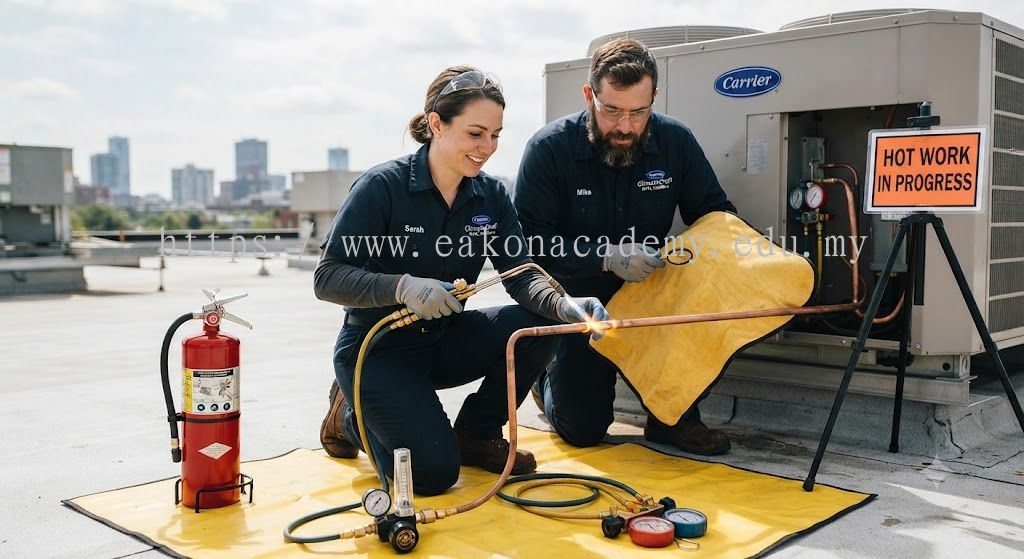
HVAC BRAZING SAFETY TRAINING FOR TECHNICIANS | PROFESSIONAL REFRIGERATION BRAZING COURSE & HANDS-ON SKILLS DEVELOPMENT
HVAC brazing safety training for technicians is an essential program designed to equip refrigeration and air-conditioning professionals with the technical knowledge, practical skills, and safety awareness required to perform high-quality brazing work in residential, commercial, and industrial HVAC-R systems. Brazing is one of the most important techniques used to join copper tubing and refrigeration piping, creating durable, leak-free connections capable of withstanding high operating pressures and temperature variations. Since brazing involves the use of open flames, high temperatures, pressurized gases, and specialized equipment, proper safety training is vital for preventing workplace accidents, protecting equipment, and ensuring long-term system reliability. At eakonacadem.edu.my, HVAC brazing safety training focuses on developing competent technicians who understand both industry best practices and modern safety standards.
A comprehensive HVAC brazing safety training course begins with a strong understanding of refrigeration piping systems and the principles of copper tube joining. Participants learn why proper brazing techniques are critical for maintaining refrigerant containment, energy efficiency, and equipment longevity. Training covers the properties of copper tubing, different types of brazing filler alloys, and the importance of selecting compatible materials for various HVAC applications. Understanding these fundamentals allows technicians to produce high-strength joints that minimize refrigerant leakage and maximize overall system performance.
An important part of HVAC brazing safety training is learning proper pipe preparation techniques. Before brazing can begin, technicians are taught how to accurately measure, cut, deburr, ream, clean, and fit copper tubing to achieve precise joint alignment. Clean pipe surfaces are essential because contaminants such as oil, dirt, moisture, or oxidation can interfere with filler metal flow and weaken the brazed connection. Practical workshop exercises provide hands-on experience that enables trainees to consistently prepare professional-quality copper joints before applying heat.
Torch operation and flame control are among the most valuable skills taught during HVAC brazing safety training. Technicians learn how to safely handle oxy-acetylene and air-acetylene brazing equipment, inspect regulators and hoses, ignite torches correctly, and adjust the flame to achieve a neutral flame suitable for copper brazing. Proper flame adjustment prevents overheating, minimizes oxidation, and allows even heat distribution throughout the joint. Students also practice correct torch movement and positioning techniques that improve capillary action and create smooth, leak-free brazed connections.
Nitrogen purging is another essential topic covered in professional HVAC brazing safety training. Modern refrigeration installation standards recommend maintaining a continuous low flow of dry nitrogen through copper tubing while brazing to prevent internal oxidation. Without nitrogen purging, black oxide scale can develop inside the piping system and later circulate through compressors, expansion valves, and filter driers, causing expensive damage and reduced system efficiency. Trainees learn proper nitrogen regulator setup, safe flow control, and best practices that help maintain clean refrigeration piping and improve long-term equipment reliability.
Personal Protective Equipment (PPE) and workplace safety awareness are also major components of HVAC brazing safety training. Participants learn the importance of wearing safety goggles, heat-resistant gloves, flame-resistant clothing, long trousers, and safety footwear during brazing operations. The training emphasizes proper workplace organization, ventilation requirements, fire prevention measures, and safe handling of oxygen and acetylene cylinders. Students are also instructed on identifying workplace hazards, preventing burns, avoiding gas leaks, and responding appropriately to emergency situations involving fire or equipment malfunction.
Quality control and post-brazing inspection procedures are incorporated throughout the training program. Technicians are taught how to visually inspect brazed joints for complete filler penetration, smooth joint appearance, and uniform bonding. Pressure testing using dry nitrogen and leak detection methods are practiced to verify system integrity before refrigerant charging begins. These inspection procedures ensure every installation meets professional HVAC quality standards while reducing future maintenance costs and service callbacks.
Hands-on practical training is one of the greatest advantages of professional HVAC brazing safety courses. Instead of relying solely on classroom theory, participants perform multiple brazing exercises using industry-standard tools, copper tubing, and refrigeration components. This practical experience builds confidence, improves manual skills, and allows technicians to gain valuable real-world experience under the supervision of experienced instructors. Repeated practice helps develop consistency, precision, and adherence to safe working procedures that employers expect from qualified HVAC professionals.
At eakonacadem.edu.my, our HVAC brazing safety training programs are carefully developed to meet current industry requirements while preparing technicians for successful careers in refrigeration and air-conditioning services. Our instructors emphasize practical competency, workplace safety, technical accuracy, and professional workmanship through structured classroom lessons and intensive workshop sessions. Students receive comprehensive training in copper pipe preparation, flame control, nitrogen purging, silver brazing techniques, leak testing, pressure testing, fire safety, PPE usage, and complete refrigeration piping installation procedures.
HVAC brazing safety training for technicians is an investment in professional excellence, workplace safety, and long-term career development. Technicians who master proper brazing procedures produce stronger joints, safer installations, higher system efficiency, and greater customer satisfaction. By combining technical expertise with comprehensive safety knowledge, HVAC professionals become better equipped to meet the growing demands of the HVAC-R industry while maintaining the highest standards of quality, reliability, and safety. Continuous training and practical experience ensure technicians remain competitive, confident, and fully prepared to deliver professional refrigeration and air-conditioning installations throughout their careers.
更多 EAKON ACADEMY SDN BHD 相关资料 Malaysia