
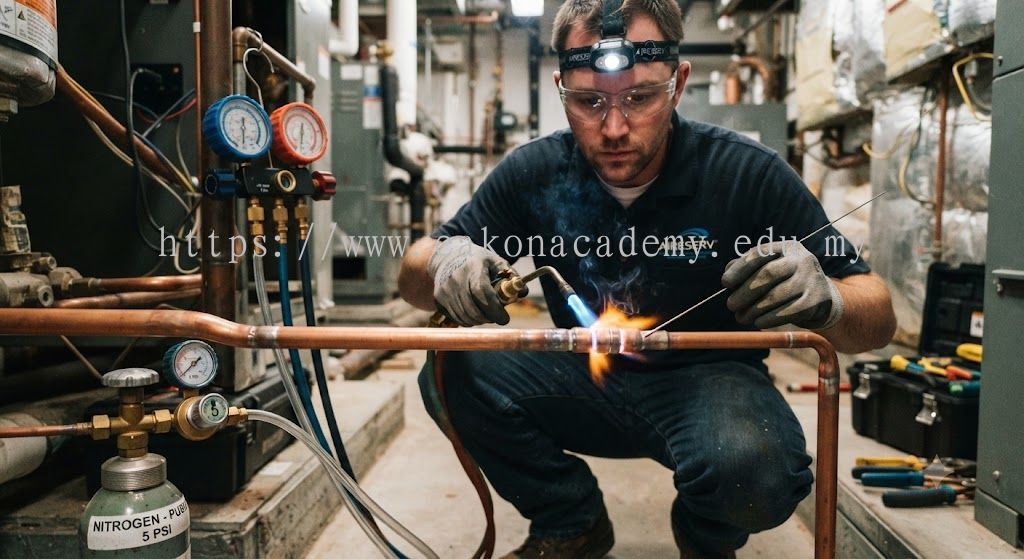
HVAC Brazing Nitrogen Purging Best Practices Refrigeration
Eakon Academy provides professional HVAC-R training programs designed to equip learners with advanced technical skills required in modern refrigeration installation, maintenance, and service work. One of the most important advanced competencies in this field is HVAC brazing nitrogen purging best practices refrigeration, which plays a critical role in ensuring internal pipe cleanliness, system efficiency, and long-term reliability. In refrigeration and air conditioning systems, copper piping is the primary pathway for refrigerant flow, and brazed joints connect the entire system. While brazing is essential for joining copper pipes, improper procedures can lead to internal oxidation, contamination, and reduced system performance. This is where nitrogen purging becomes a vital industry-standard practice.
HVAC brazing nitrogen purging best practices refrigeration begins with understanding the purpose of nitrogen flow during brazing operations. When copper tubing is heated in the presence of oxygen, oxidation occurs on the inner surface of the pipe, forming a black scale known as copper oxide. This contamination can break loose and circulate through the refrigeration system, potentially clogging expansion valves, damaging compressors, and reducing heat transfer efficiency. By introducing a controlled low-pressure flow of nitrogen gas through the piping system during brazing, technicians can displace oxygen and prevent oxidation from forming inside the pipe, ensuring a clean and efficient refrigeration system.
Proper setup of nitrogen purging is one of the most important best practices in HVAC brazing operations. Technicians must regulate nitrogen flow to a very low and steady rate, typically just enough to gently displace air without creating turbulence inside the pipe. Excessive nitrogen pressure can disturb the brazing process or cause weak joints, while insufficient flow may not fully prevent oxidation. Achieving the correct balance is a key skill taught in professional HVAC training programs such as those offered by Eakon Academy.
Another important aspect of HVAC brazing nitrogen purging best practices refrigeration is ensuring proper system setup before brazing begins. All pipe ends should be sealed except for the nitrogen inlet and outlet point, allowing controlled flow throughout the system. Technicians must also ensure that nitrogen is introduced before heating begins and maintained throughout the entire brazing process. This continuous flow prevents oxygen from entering the system at any stage, ensuring consistent protection against internal oxidation.
Heat control still plays an essential role even when nitrogen purging is used. Technicians must apply heat evenly around the joint while maintaining nitrogen flow inside the pipe. This combination ensures that the brazing filler metal flows properly without contamination from oxidation. Proper coordination between heating technique and nitrogen flow is a hallmark of advanced HVAC brazing skills and is essential for achieving high-quality, leak-free joints.
The selection of appropriate brazing filler metals also complements nitrogen purging best practices. Silver-based alloys are commonly used in HVAC-R systems due to their excellent flow characteristics and strong bonding with copper. When combined with nitrogen purging, these materials help ensure clean, durable, and high-performance brazed joints that meet industry standards.
Post-brazing inspection is another critical step in HVAC brazing nitrogen purging best practices refrigeration. Technicians must visually inspect joints for uniform appearance, verify that no internal contamination has occurred, and perform pressure or leak testing before system commissioning. These quality assurance steps ensure that the refrigeration system operates efficiently and safely under real-world conditions.
At Eakon Academy, students are trained through hands-on HVAC-R programs that emphasize HVAC brazing nitrogen purging best practices refrigeration in real-world applications. The training focuses on practical skills, industry standards, and safety procedures to ensure learners are fully prepared for professional fieldwork in residential, commercial, and industrial refrigeration systems.
In conclusion, mastering HVAC brazing nitrogen purging best practices refrigeration is essential for preventing internal oxidation, improving system efficiency, and ensuring long-term reliability of HVAC-R systems. Proper training, precise technique, and adherence to industry standards guarantee high-quality brazed joints and professional excellence in the refrigeration industry.
更多 EAKON ACADEMY SDN BHD 相关资料 Malaysia
