
Copper Joint Brazing Refrigeration Best Practices
Eakon Academy provides professional HVAC-R training designed to enhance technical excellence in refrigeration system installation, maintenance, and troubleshooting. One of the most essential competencies in this field is copper joint brazing refrigeration best practices, which plays a critical role in ensuring system reliability, leak prevention, and long-term operational efficiency. In modern refrigeration systems, copper piping is widely used due to its excellent thermal conductivity, corrosion resistance, and durability. However, the performance of the entire system heavily depends on the quality of brazed joints. A poorly executed copper joint can result in refrigerant leakage, pressure loss, compressor damage, and costly system failures. Therefore, mastering best practices in copper joint brazing is fundamental for every HVAC technician and engineer.
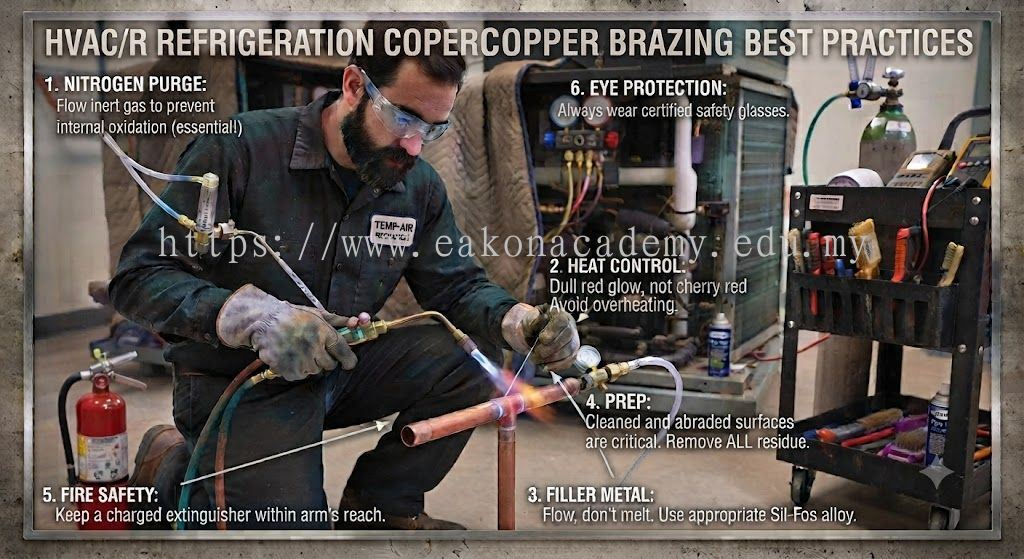
Copper joint brazing in refrigeration systems requires a precise combination of preparation, technique, and material selection. One of the most important best practices is proper pipe preparation before brazing. This includes cutting copper tubes cleanly, deburring edges, and ensuring that all surfaces are free from oil, dirt, and oxidation. Clean surfaces allow for proper bonding and ensure that the brazing filler metal can flow evenly through the joint via capillary action. Proper fitting alignment is also crucial, as even a small misalignment can compromise joint strength and lead to long-term system failure.
Another key aspect of copper joint brazing refrigeration best practices is controlled heating technique. Applying heat evenly around the joint ensures that the copper reaches the correct brazing temperature without overheating or damaging the material. Overheating can weaken the copper structure and burn off flux, while insufficient heat can prevent the filler rod from flowing properly. Skilled HVAC technicians are trained to move the flame continuously around the joint to achieve uniform heating and optimal brazing results.
The use of nitrogen purging during brazing is considered an advanced industry best practice. When copper is heated in the presence of oxygen, oxidation can form inside the pipe, creating scale that contaminates the refrigeration system. This contamination can damage compressors and reduce system efficiency. By introducing a low-flow nitrogen purge during brazing, technicians can eliminate internal oxidation and maintain a clean, high-performance refrigeration system.
Selecting the correct brazing filler metal is another critical factor. Silver-based alloys are commonly used in refrigeration copper joint brazing due to their superior strength, melting properties, and compatibility with copper tubing. Understanding the appropriate filler rod composition for different system requirements is an important part of professional HVAC training. Additionally, applying flux correctly (when required) ensures smooth filler flow and strong metallurgical bonding between copper surfaces.
Post-brazing inspection is equally important in ensuring system integrity. This includes visual inspection for uniform joint appearance, checking for cracks or voids, and performing pressure or leak tests before commissioning the system. Proper inspection ensures that the brazed joint meets industry safety and performance standards.
At Eakon Academy, learners are trained through hands-on practical sessions that focus on real-world copper joint brazing refrigeration best practices. The training emphasizes precision, safety, and industry compliance, preparing students to meet the demands of commercial and industrial HVAC-R applications. By mastering these skills, technicians can significantly improve system reliability, reduce maintenance costs, and enhance energy efficiency in refrigeration systems.
In conclusion, copper joint brazing refrigeration best practices are essential for achieving durable, leak-free, and efficient HVAC systems. Proper training, combined with disciplined workmanship and adherence to industry standards, ensures long-lasting system performance and professional excellence in the HVAC-R field.
更多 EAKON ACADEMY SDN BHD 相关资料 Malaysia
