HVAC COPPER TUBE SOLDERING VS BRAZING FOR PROFESSIONAL AIR CONDITIONING AND REFRIGERATION SYSTEM INSTALLATION
HVAC copper tube soldering vs brazing is a fundamental comparison topic in the air conditioning and refrigeration industry, helping technicians and learners understand the differences between two widely used copper joining methods. Both soldering and brazing are used to connect copper tubes in HVAC systems, but they differ significantly in temperature, strength, application, and long-term performance. At eakonacadem.edu.my, understanding HVAC copper tube soldering vs brazing is essential for developing professional installation skills and ensuring high-quality, reliable HVAC system performance in real-world applications.
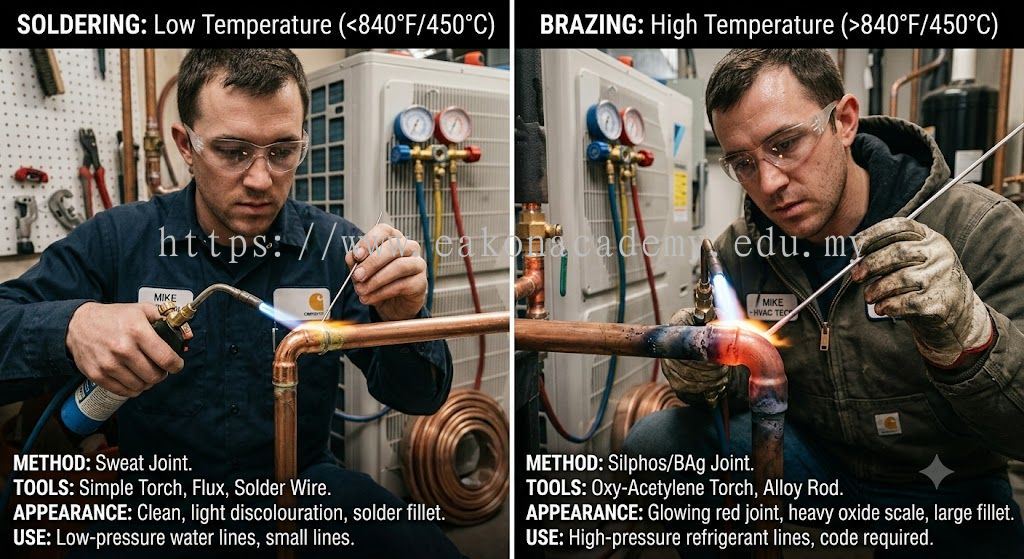
Copper tube soldering in HVAC systems is a low-temperature joining method that uses a filler metal with a melting point below 450°C. It is commonly used in low-pressure applications where extreme strength is not required. Soldering is easier to perform and requires less heat compared to brazing, making it suitable for simple plumbing or light-duty HVAC tasks. However, in refrigeration and air conditioning systems where refrigerant pressure is high, soldered joints are generally not preferred due to lower mechanical strength and reduced resistance to vibration and thermal stress.
In contrast, HVAC copper tube brazing is a high-temperature joining method that uses filler metals with melting points above 450°C, typically silver-based alloys. Brazing creates a much stronger metallurgical bond between copper pipes, making it suitable for high-pressure refrigeration systems. This method is widely used in commercial air conditioning, industrial refrigeration, chillers, and cold storage systems. One of the key advantages of brazing over soldering is its superior joint strength, which allows it to withstand high pressure, vibration, and temperature fluctuations without failure.
A critical aspect of HVAC copper tube soldering vs brazing is the use of nitrogen purging during brazing. Nitrogen is introduced into the copper tubing during heating to prevent oxidation inside the pipe. This ensures clean internal surfaces, improves refrigerant flow efficiency, and enhances long-term system reliability. Soldering does not typically require nitrogen purging because of its lower operating temperature, but this also means it does not provide the same level of internal cleanliness and durability.
Another important difference in HVAC copper tube soldering vs brazing is application suitability. Soldering is generally limited to non-critical or low-pressure systems, while brazing is the industry standard for modern HVAC and refrigeration systems. Brazed joints are more resistant to leaks, making them essential for maintaining energy efficiency and preventing refrigerant loss, which is critical for environmental compliance and system performance.
Skill level is also an important factor when comparing HVAC copper tube soldering vs brazing. Soldering is relatively easier to learn and requires less heat control, while brazing demands higher technical skill, precise temperature control, and proper torch handling. Professional HVAC technicians are trained extensively in brazing techniques to ensure safe, reliable, and high-quality installations.
In conclusion, HVAC copper tube soldering vs brazing highlights the importance of selecting the correct joining method based on system requirements. While soldering may be suitable for light-duty applications, brazing remains the preferred method for high-pressure and professional HVAC systems due to its superior strength and reliability. At eakonacadem.edu.my, we are committed to providing comprehensive HVAC training that helps technicians master both soldering and brazing techniques, ensuring industry-standard installation quality and optimal system performance in every project.
更多 EAKON ACADEMY SDN BHD 相关资料 Malaysia