
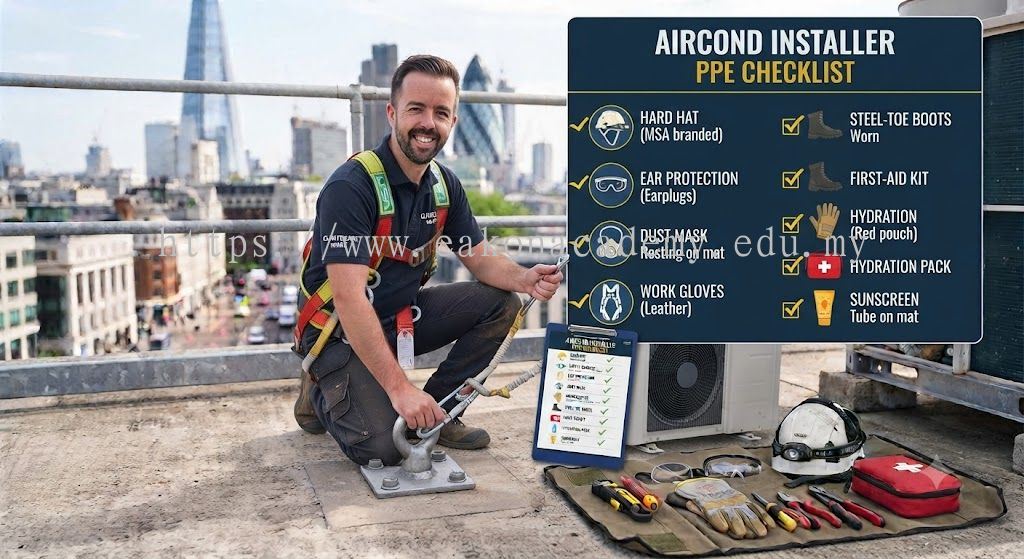
Aircond Installer Protective Equipment Checklist: Essential PPE and Safety Gear for Professional Air Conditioning Installation
Every aircond installer faces a variety of workplace hazards during installation, servicing, maintenance, and repair of air conditioning systems. From handling electrical wiring and refrigerants to working at height and operating power tools, each task requires proper planning and the correct protective equipment. Following a comprehensive Aircond Installer Protective Equipment Checklist helps reduce workplace accidents, improves job efficiency, and ensures compliance with occupational safety regulations in Malaysia. Whether installing residential split air conditioners, commercial VRF and VRV systems, cassette units, ducted air conditioning systems, or industrial HVAC equipment, using the appropriate personal protective equipment (PPE) is essential for protecting technicians and delivering professional services. At Eakon Academy (eakonacadem.edu.my), safety is integrated into every HVAC training programme, enabling future air conditioning technicians to combine technical expertise with industry best practices in workplace safety.
The foundation of every protective equipment checklist is Personal Protective Equipment (PPE). Aircond installers should always wear a certified safety helmet to protect against falling tools, accidental impacts, and overhead hazards commonly encountered during installation projects. Safety helmets are particularly important when working on construction sites, commercial buildings, and renovation projects where multiple trades are operating simultaneously. High-quality safety footwear with steel toe protection and anti-slip soles helps prevent foot injuries caused by heavy outdoor condenser units, compressors, installation tools, and construction materials. The anti-slip design also provides better traction when working on wet rooftops, ladders, balconies, or uneven flooring, reducing the likelihood of slips and falls.
Protective gloves are another essential item on every aircond installer protective equipment checklist. Air conditioning technicians frequently handle copper tubing, aluminium fins, sheet metal, brackets, electrical cables, and sharp installation tools that can easily cause cuts, abrasions, or puncture injuries. Cut-resistant work gloves provide excellent protection while maintaining the flexibility required for precise installation tasks. Heat-resistant gloves should also be used during brazing operations to protect against burns from hot copper pipes, welding torches, and molten filler materials. Choosing the correct glove for each task improves both safety and productivity while reducing the risk of hand injuries.
Eye protection is equally important during air conditioning installation. Safety glasses or impact-resistant goggles protect technicians from dust, flying debris, refrigerant splashes, metal particles, sparks, and fragments generated during drilling, grinding, pipe cutting, and brazing activities. Clear vision is essential when performing detailed HVAC work, making properly fitted eye protection an important part of every installation project. Where brazing or welding is performed, specialised protective eyewear should be used to guard against intense light and heat.
Working at height is common when installing outdoor air conditioning units, rooftop package systems, VRF condensers, or commercial HVAC equipment. Fall protection equipment should therefore be included in every aircond installer protective equipment checklist. Full-body safety harnesses, shock-absorbing lanyards, self-retracting lifelines (SRLs), certified anchor points, and elevated work platforms help protect technicians from serious fall injuries. Before each use, all fall protection equipment should be carefully inspected for damaged webbing, worn stitching, faulty connectors, or signs of deterioration. Proper training ensures technicians understand how to wear harnesses correctly, select appropriate anchor points, and use fall protection systems safely while working at height.
Electrical safety equipment is another critical component of safe air conditioning installation. Aircond installers regularly work with electrical circuits, control panels, disconnect switches, and power supplies. Insulated hand tools, voltage testers, insulated gloves, lockout/tagout devices, and electrical warning signs help reduce the risk of electric shock and accidental energisation. Before beginning any electrical work, technicians should isolate the power source, verify that no voltage is present using approved testing equipment, and apply lockout/tagout procedures to prevent unexpected activation of electrical systems. These safe work practices significantly reduce electrical hazards and improve overall workplace safety.
Refrigerant handling equipment also plays an important role in protecting technicians and the environment. Refrigerant cylinders should always be transported using suitable cylinder trolleys and stored upright in well-ventilated locations away from direct sunlight and ignition sources. Leak detectors, refrigerant recovery machines, manifold gauge sets, vacuum pumps, charging scales, recovery cylinders, and refrigerant identification tools should be inspected before use to ensure safe and efficient operation. When working with mildly flammable refrigerants such as R32 or highly flammable refrigerants such as R290 (propane), technicians should eliminate ignition sources, ensure adequate ventilation, and follow Department of Environment (DOE) Malaysia regulations for safe refrigerant handling.
Power tools and installation equipment should also be inspected before every project. Drills, grinders, vacuum pumps, torque wrenches, flaring tools, swaging tools, brazing torches, and pipe cutters should be checked for damaged electrical cables, loose handles, worn insulation, or mechanical defects. During brazing operations, fire extinguishers, fire-resistant blankets, nitrogen purging equipment, and heat-resistant protective gear should always be available. Proper equipment maintenance reduces breakdowns, prevents workplace accidents, and improves installation quality.
Manual handling safety should never be overlooked. Outdoor condenser units, compressors, copper coils, refrigerant cylinders, and installation materials are often heavy and difficult to move. Aircond installers should use proper lifting techniques, mechanical lifting equipment, trolleys, lifting straps, and team lifting whenever necessary. Correct manual handling practices reduce the risk of back injuries, muscle strains, and long-term musculoskeletal disorders while improving overall work efficiency.
Maintaining a clean and organised worksite is another important aspect of accident prevention. Electrical cables should be routed safely to avoid trip hazards, installation tools should be stored properly, waste materials should be removed regularly, and work areas should remain free of unnecessary clutter. Safety barriers and warning signs should be installed where overhead work, electrical activities, or refrigerant servicing is taking place. Good housekeeping not only creates a safer workplace but also reflects the professionalism of the installation team.
Before beginning any air conditioning installation, a detailed workplace risk assessment should be carried out. Technicians should identify hazards related to electrical systems, working at height, weather conditions, confined spaces, manual handling, nearby traffic, structural stability, and environmental factors. Appropriate protective equipment should then be selected based on the specific risks identified. Emergency procedures, rescue plans, first aid arrangements, and communication methods should also be established before work begins to ensure technicians are prepared for unexpected situations.
At Eakon Academy (eakonacadem.edu.my), we are committed to producing highly skilled HVAC professionals who understand that workplace safety is a fundamental part of successful air conditioning installation. Our comprehensive training programmes combine hands-on technical instruction with practical safety education covering personal protective equipment, working at height, electrical safety, refrigerant management, safe brazing techniques, manual handling, workplace risk assessments, and emergency response procedures. Students gain valuable experience using industry-standard safety equipment while learning the best practices followed by professional HVAC companies throughout Malaysia. By following this comprehensive Aircond Installer Protective Equipment Checklist, technicians can minimise workplace accidents, comply with occupational safety regulations, improve installation quality, enhance customer confidence, and build successful long-term careers in the rapidly growing air conditioning and HVAC industry.
More detail about EAKON ACADEMY SDN BHD Malaysia
