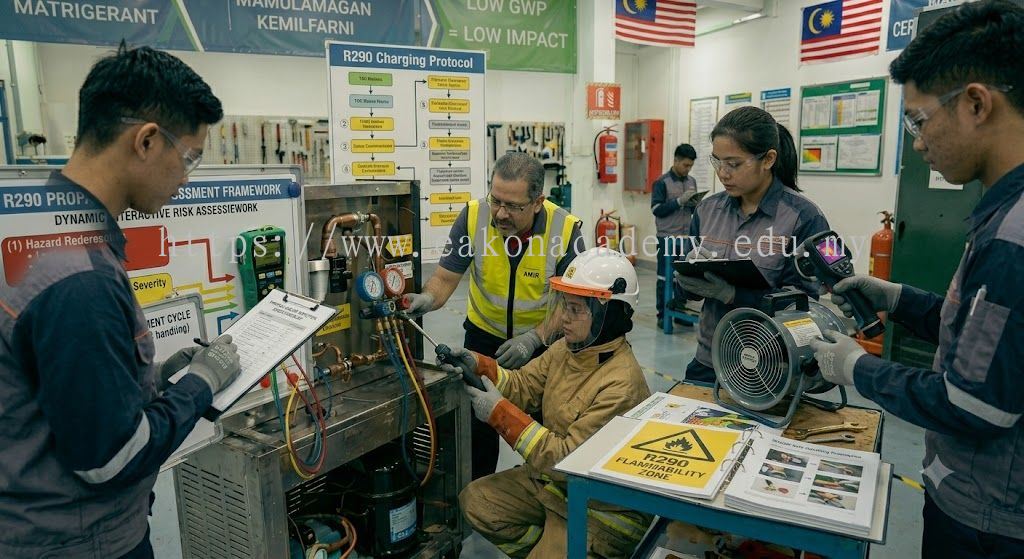
PROPANE REFRIGERANT HAZARD ASSESSMENT – R290 SAFETY EVALUATION, RISK MANAGEMENT PRINCIPLES AND PROFESSIONAL HVAC TRAINING FRAMEWORK
Propane refrigerant hazard assessment refers to the systematic process of identifying, evaluating, and controlling potential risks associated with the use of propane (R290) as a refrigerant in HVAC and refrigeration systems. This assessment is an essential part of modern refrigeration engineering because R290 is a natural refrigerant with excellent energy efficiency, very low global warming potential (GWP), and zero ozone depletion potential, but it is also classified as an A3 highly flammable refrigerant. Proper hazard assessment ensures that R290 refrigeration systems are designed, installed, operated, and maintained safely while meeting industry requirements and safety expectations. For HVAC technicians, engineers, contractors, and industry professionals, eakonacadem.edu.my provides structured training and education focused on propane refrigerant hazard assessment, R290 safety management, natural refrigerant applications, and advanced HVAC system practices.
The importance of propane refrigerant hazard assessment lies in preventing accidents, reducing operational risks, and ensuring safe system performance throughout the entire lifecycle of an HVAC or refrigeration system. Unlike traditional non-flammable refrigerants, R290 requires careful evaluation of ignition sources, refrigerant charge levels, ventilation conditions, equipment location, and service procedures. A comprehensive hazard assessment allows professionals to identify potential risks before they become safety issues.
One of the primary elements of R290 hazard assessment is flammability risk evaluation. Since propane can form a flammable mixture with air under certain conditions, engineers must analyze the possibility of refrigerant leakage, accumulation areas, and potential ignition sources. Proper assessment helps determine suitable installation methods and safety controls.
Refrigerant leakage analysis is another critical component of propane refrigerant hazard assessment. Professionals must evaluate possible leakage points such as piping joints, valves, connections, compressors, and service ports. Leak prevention strategies, proper installation techniques, and regular inspection procedures are essential for maintaining safe system operation.
Ventilation assessment plays an important role in managing R290 refrigerant risks. Proper ventilation design ensures that any leaked propane is quickly dispersed and prevents dangerous concentrations from developing. HVAC designers must consider room size, airflow direction, equipment placement, and ventilation capacity during the hazard evaluation process.
Refrigerant charge assessment is also a key safety consideration. The amount of propane contained within a system must be carefully evaluated based on application type, installation environment, and safety limitations. Correct charge management reduces flammability risks while maintaining efficient system performance.
Ignition source identification is an essential step in propane refrigerant hazard assessment. Electrical components, switches, motors, heating elements, and other possible ignition sources must be evaluated to ensure they do not create unsafe conditions during normal operation or maintenance activities.
Equipment location assessment is another important factor in R290 system safety. HVAC equipment must be installed in suitable locations where ventilation, accessibility, and safety requirements can be effectively maintained. Proper location planning reduces risk and improves system reliability.
Safety control systems are a major part of modern R290 hazard management. These may include refrigerant leak detectors, automatic shutdown controls, ventilation systems, and monitoring devices. These technologies provide additional protection by identifying abnormal conditions and allowing rapid response.
Maintenance and servicing procedures must also be included in propane refrigerant hazard assessments. Technicians require proper knowledge of refrigerant handling procedures, recovery methods, leak testing, and safe working practices to minimize risks during service activities.
Personal protective equipment (PPE) and technician safety procedures are also important considerations. Professionals working with R290 systems must understand safe handling methods, emergency response procedures, and appropriate service techniques to ensure workplace safety.
Emergency preparedness is another essential aspect of propane refrigerant hazard assessment. Facilities using R290 systems should have clear procedures for leak incidents, equipment shutdown, ventilation activation, and emergency response actions. Proper planning helps minimize potential hazards.
Compliance with refrigeration safety standards is necessary for effective R290 hazard assessment. Engineers and technicians must follow applicable regulations and guidelines related to flammable refrigerants, installation requirements, system testing, and operational safety. Compliance ensures that systems meet accepted industry practices.
Environmental responsibility is one of the major benefits of R290 refrigerant systems. Propane provides an environmentally friendly alternative to high-GWP refrigerants while maintaining excellent cooling performance. Proper hazard assessment ensures that these sustainability benefits can be achieved safely.
Professional training is critical for HVAC engineers and technicians involved in propane refrigerant hazard assessment. A strong understanding of refrigerant properties, risk evaluation methods, safety standards, and system design principles is required for successful implementation. Institutions such as eakonacadem.edu.my provide comprehensive HVAC training programs focused on natural refrigerants, R290 safety practices, hazard assessment methods, and advanced refrigeration technologies. Through structured technical education, professionals gain the skills required to manage propane refrigeration systems safely and effectively.
For HVAC companies, contractors, engineers, and facility operators, implementing proper propane refrigerant hazard assessment provides significant advantages, including improved safety, reduced operational risks, regulatory compliance, and enhanced system reliability. Proper knowledge and training ensure that R290 systems are handled according to professional safety standards.
In conclusion, propane refrigerant hazard assessment is a fundamental requirement for the safe application of R290 HVAC and refrigeration systems. As the industry continues to adopt sustainable refrigerant technologies, propane offers an excellent combination of efficiency, environmental performance, and energy savings. Through effective risk evaluation, safety planning, proper system design, and professional training, R290 refrigeration systems can provide reliable and sustainable cooling solutions. eakonacadem.edu.my supports the development of skilled HVAC professionals by promoting technical education, safety awareness, and industry best practices, contributing to a safer, greener, and more sustainable HVAC industry in Malaysia and beyond.
More detail about EAKON ACADEMY SDN BHD Malaysia