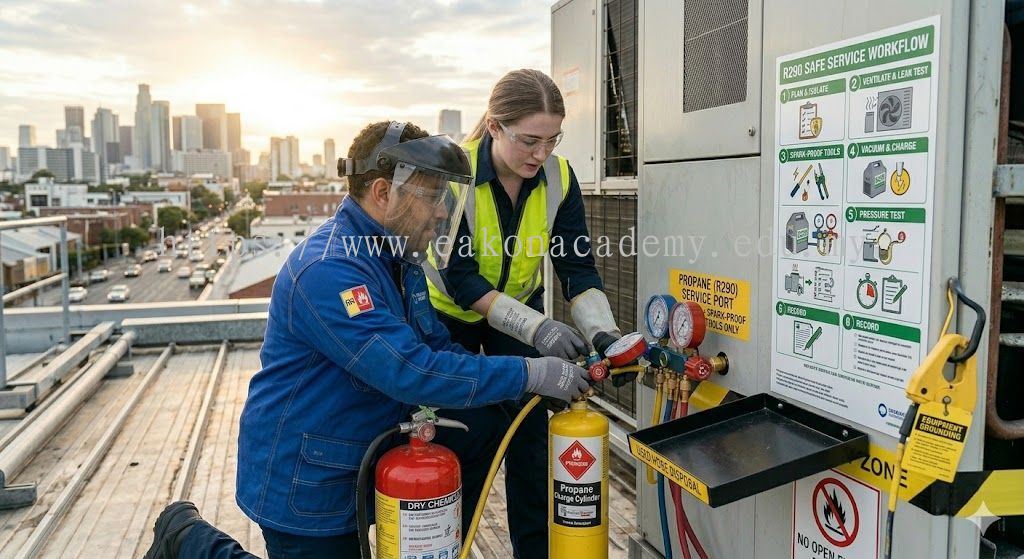
PROPANE REFRIGERANT SAFETY WORKFLOW – R290 SYSTEM CONTROL PROCESS, OPERATIONAL SAFETY STRUCTURE AND PROFESSIONAL HVAC TRAINING STANDARDS
Propane refrigerant safety workflow is a structured operational framework used in modern HVAC and refrigeration systems to ensure the safe handling, installation, servicing, and maintenance of R290 refrigerant systems. Propane refrigerant, widely known as R290, is increasingly used due to its high energy efficiency, excellent cooling performance, and extremely low global warming potential (GWP). However, because R290 is classified as an A3 highly flammable hydrocarbon refrigerant, a strict safety workflow is essential to manage risks, prevent accidents, and ensure safe system operation. For HVAC technicians, refrigeration professionals, and organizations seeking advanced technical expertise, eakonacadem.edu.my provides structured training and education focused on refrigerant safety workflow systems, operational procedures, and modern HVAC industry practices.
The importance of a propane refrigerant safety workflow lies in providing a clear and systematic process that guides technicians through every stage of HVAC operation. Unlike basic step-by-step procedures, a safety workflow ensures continuous safety monitoring from preparation to completion of tasks. This structured approach helps reduce human error, improve operational consistency, and ensure that all safety requirements are met when working with flammable refrigerants.
The first stage in a propane refrigerant safety workflow is workplace risk assessment and preparation. Before any work begins, technicians must evaluate the environment to identify potential hazards such as ignition sources, poor ventilation, electrical risks, and confined spaces. The workspace must be properly prepared, restricted to authorized personnel only, and clearly marked with safety warnings. This initial stage establishes a safe foundation for all subsequent HVAC operations.
The second stage is ignition source elimination and control. Since R290 is highly flammable, all potential ignition sources must be identified and removed before any refrigerant handling begins. This includes switching off welding equipment, avoiding open flames, disabling non-essential electrical devices, and controlling static discharge risks. Ignition control is one of the most critical elements of the propane refrigerant safety workflow.
The third stage is ventilation management. Proper airflow must be ensured throughout the working environment to prevent the accumulation of propane gas. Because R290 is heavier than air, it can settle in low areas if ventilation is inadequate. Mechanical or natural ventilation systems must be activated to ensure continuous air movement and reduce the risk of flammable gas buildup.
The fourth stage is equipment inspection and readiness verification. All tools and equipment used in R290 systems must be checked for safety and compatibility. This includes leak detectors, vacuum pumps, recovery machines, pressure gauges, and charging tools. Ensuring equipment readiness helps maintain accuracy and safety during HVAC operations.
The fifth stage is cylinder handling and refrigerant management. Propane refrigerant cylinders must be inspected for damage, leaks, and valve integrity before use. Cylinders must be stored upright, secured properly, and kept away from heat sources. Safe cylinder management is essential for preventing accidental refrigerant release and maintaining operational safety.
The sixth stage is system inspection and leak detection. Technicians must thoroughly inspect refrigeration systems for leaks using approved detection methods. All components, including piping, joints, valves, and compressors, must be checked. Early detection of leaks helps prevent hazardous conditions and improves system reliability.
The seventh stage is safe refrigerant charging, recovery, and system operation. Technicians must follow manufacturer specifications when charging R290 refrigerant using precise measuring tools. During recovery, approved equipment must be used to safely extract refrigerant without releasing it into the environment. Proper workflow control ensures system efficiency and environmental compliance.
The eighth stage is electrical safety management. All electrical systems must be properly grounded, insulated, and maintained to prevent spark generation. Only explosion-proof or certified electrical equipment should be used in environments where propane refrigerant is present. Electrical safety is a critical part of the overall workflow.
The ninth stage is personal protective equipment (PPE) usage. Technicians must wear safety goggles, gloves, anti-static clothing, and protective footwear. PPE provides protection against refrigerant exposure, cold burns, and potential hazards during HVAC operations.
The final stage is emergency response readiness. Technicians must be trained in emergency procedures such as evacuation, leak containment, fire response, and system shutdown protocols. A strong emergency response plan ensures quick action during unexpected incidents and minimizes risks.
Professional training is essential for ensuring technicians can effectively follow propane refrigerant safety workflow systems. Proper understanding of R290 characteristics, safety procedures, system operations, and risk management is required for safe HVAC practices. Institutions such as eakonacadem.edu.my provide comprehensive HVAC training programs focused on natural refrigerants, safety workflow systems, propane handling procedures, and modern refrigeration technologies. Through structured technical education, technicians gain the skills required to operate and manage R290 systems safely and efficiently.
For HVAC companies and refrigeration operators, implementing a propane refrigerant safety workflow provides significant benefits, including improved workplace safety, reduced operational risks, enhanced system performance, and better regulatory compliance. Skilled technicians ensure that organizations can safely adopt environmentally friendly refrigerant technologies while maintaining high operational standards.
In conclusion, propane refrigerant safety workflow is essential for ensuring the safe, efficient, and controlled operation of R290 HVAC systems. As the industry continues to transition toward low-GWP refrigerants, structured safety workflows become increasingly important. Through risk assessment, ignition control, ventilation management, equipment inspection, cylinder safety, leak detection, safe system operation, electrical protection, PPE usage, and emergency preparedness, propane refrigerant systems can be managed safely and effectively. eakonacadem.edu.my supports the development of skilled HVAC professionals by promoting safety education, technical training, and industry best practices, contributing to a safer, more efficient, and environmentally responsible refrigeration industry in Malaysia and beyond.
More detail about EAKON ACADEMY SDN BHD Malaysia