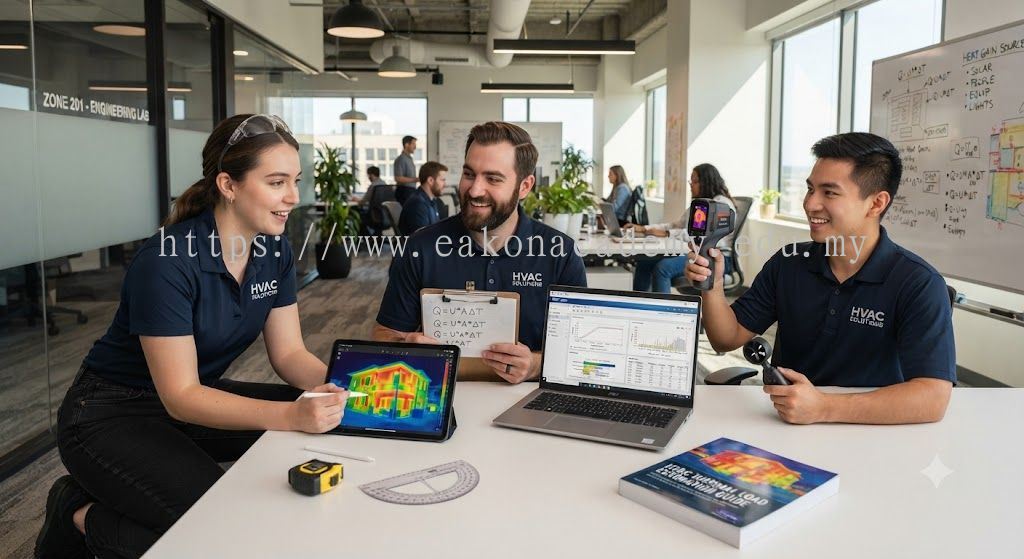
HVAC Cooling Load Analysis Method: A Complete Guide for Accurate Air Conditioning Design, System Efficiency, and Professional HVAC Engineering
The HVAC cooling load analysis method is an essential process used by HVAC engineers, designers, consultants, and technicians to determine the accurate cooling requirements of buildings. Proper cooling load analysis is the foundation of effective air conditioning system design because it ensures that HVAC equipment is selected according to actual heat gain conditions. By applying professional HVAC cooling load analysis methods, engineers can optimise system performance, improve indoor comfort, reduce energy consumption, and achieve long-term equipment reliability. Whether designing HVAC systems for residential buildings, commercial offices, industrial facilities, hotels, hospitals, or large-scale developments, accurate cooling load analysis is necessary to ensure efficient temperature control and sustainable building performance. At Eakon Academy (eakonacadem.edu.my), we provide professional HVAC training programmes that help participants understand cooling load calculation principles, HVAC design techniques, equipment sizing procedures, and practical engineering applications.
The HVAC cooling load analysis method refers to the systematic process of evaluating all sources of heat entering a conditioned space and determining the amount of cooling capacity required to remove that heat. Unlike basic air conditioning estimation methods that rely only on room size or simple rules, professional cooling load analysis considers multiple factors that influence indoor thermal conditions. These factors include building construction, outdoor temperature, solar radiation, occupancy levels, lighting systems, electrical equipment, ventilation requirements, air infiltration, and moisture generation. A detailed HVAC cooling load analysis allows professionals to design air conditioning systems that operate efficiently under actual building conditions.
One of the most important stages in the HVAC cooling load analysis method is evaluating the building envelope. The building envelope consists of walls, roofs, ceilings, floors, windows, doors, and insulation systems that affect heat transfer between indoor and outdoor environments. HVAC professionals analyse thermal properties, insulation performance, surface areas, and building orientation to determine external heat gain. Buildings with poor insulation, large glass surfaces, or direct solar exposure often require higher cooling capacity compared to energy-efficient buildings. Accurate building envelope analysis helps HVAC designers select suitable air conditioning equipment and prevent problems caused by incorrect system sizing.
Solar heat gain analysis is another critical component of professional HVAC cooling load analysis. Heat from sunlight entering through windows, glass walls, skylights, and exposed surfaces can significantly increase indoor temperatures and cooling requirements. HVAC engineers evaluate window orientation, glazing characteristics, shading devices, solar radiation intensity, and geographical location to calculate solar heat gain accurately. In tropical climates such as Malaysia, solar load analysis is especially important because high outdoor temperatures and strong sunlight can create significant cooling challenges. Proper solar heat gain evaluation helps improve system efficiency while maintaining comfortable indoor conditions.
Internal heat gain calculation is also an important part of the HVAC cooling load analysis method. Heat generated by occupants, lighting fixtures, computers, appliances, office equipment, and industrial machinery contributes to the overall cooling requirement of a building. Different spaces have different cooling demands depending on their usage and occupancy patterns. For example, offices with computer equipment, classrooms with high occupancy, restaurants with cooking appliances, and factories with production machinery require different cooling load calculations. Accurate internal heat gain assessment allows HVAC professionals to develop effective zoning strategies and select appropriate cooling systems.
Ventilation and infiltration analysis are essential elements of HVAC cooling load analysis. Fresh outdoor air is required to maintain indoor air quality, but it introduces additional heat and moisture into conditioned spaces. Air leakage through doors, windows, and building openings can also increase cooling demand. HVAC engineers evaluate ventilation rates, outdoor air conditions, infiltration levels, and humidity effects to determine the additional cooling capacity required. Proper ventilation load calculation ensures that HVAC systems can maintain comfortable indoor environments while meeting air quality requirements.
A complete HVAC cooling load analysis method includes the calculation of both sensible cooling load and latent cooling load. Sensible heat affects indoor air temperature, while latent heat relates to moisture removal from the air. Both components must be accurately analysed because HVAC systems must provide temperature reduction and humidity control simultaneously. In hot and humid climates, incorrect latent load estimation may result in uncomfortable indoor conditions, condensation issues, mould development, and reduced indoor air quality. HVAC professionals use psychrometric analysis to evaluate air properties and determine the correct cooling requirements.
Professional HVAC cooling load analysis methods commonly follow internationally recognised standards such as ASHRAE (American Society of Heating, Refrigerating and Air-Conditioning Engineers) guidelines. Common calculation approaches include the Heat Balance Method (HBM), Radiant Time Series (RTS), and Cooling Load Temperature Difference (CLTD) method. These methods provide structured procedures for analysing heat transfer, solar effects, occupancy schedules, equipment loads, and ventilation requirements. Applying recognised HVAC standards ensures that cooling systems are designed accurately and perform efficiently throughout their operating life.
Modern HVAC design software has become an important tool in performing advanced cooling load analysis. Professional software allows engineers to create building models, analyse thermal behaviour, calculate heat gain sources, simulate different operating conditions, and evaluate HVAC system performance. These tools improve calculation accuracy, reduce design errors, and help professionals select suitable air conditioning equipment. Combining software capability with HVAC engineering knowledge enables designers to develop efficient and reliable HVAC solutions for complex building projects.
At Eakon Academy, our HVAC training programmes provide practical learning on HVAC cooling load analysis methods through technical lessons, engineering calculations, software applications, and real-world project examples. Participants learn how to analyse building information, identify heat gain sources, calculate cooling requirements, perform psychrometric analysis, evaluate ventilation loads, determine equipment capacity, and apply professional HVAC design principles. The training is suitable for HVAC technicians, engineers, contractors, consultants, and facility managers who want to strengthen their technical knowledge and improve their ability to design efficient air conditioning systems.
Accurate HVAC cooling load analysis provides significant benefits for building owners, operators, and HVAC professionals. Proper analysis helps prevent oversized and undersized systems, reduce electricity consumption, improve occupant comfort, enhance humidity management, minimise maintenance costs, and extend equipment lifespan. Oversized HVAC systems may cause unnecessary energy usage, frequent compressor cycling, higher installation costs, and poor moisture removal. Undersized systems may fail to achieve required comfort levels during peak cooling periods. Professional cooling load analysis ensures that HVAC systems are correctly designed for maximum performance.
The HVAC cooling load analysis method also supports other important HVAC design activities, including equipment selection, ductwork design, airflow calculation, chilled water system planning, VRF system application, refrigeration design, and Building Management System (BMS) integration. As modern buildings continue to adopt energy-efficient technologies, smart controls, and sustainable HVAC solutions, accurate cooling load analysis has become an essential skill for HVAC professionals.
Through specialised HVAC training at Eakon Academy (eakonacadem.edu.my), participants gain the technical knowledge, practical skills, and industry-focused experience required to perform HVAC cooling load analysis accurately, optimise air conditioning system design, improve energy efficiency, and deliver reliable HVAC solutions. Mastering professional cooling load analysis methods enables engineers, technicians, and contractors to develop comfortable, efficient, and sustainable buildings while advancing their expertise in the growing HVAC industry.
Lihat detail lebih lanjut tentang EAKON ACADEMY SDN BHD Malaysia