
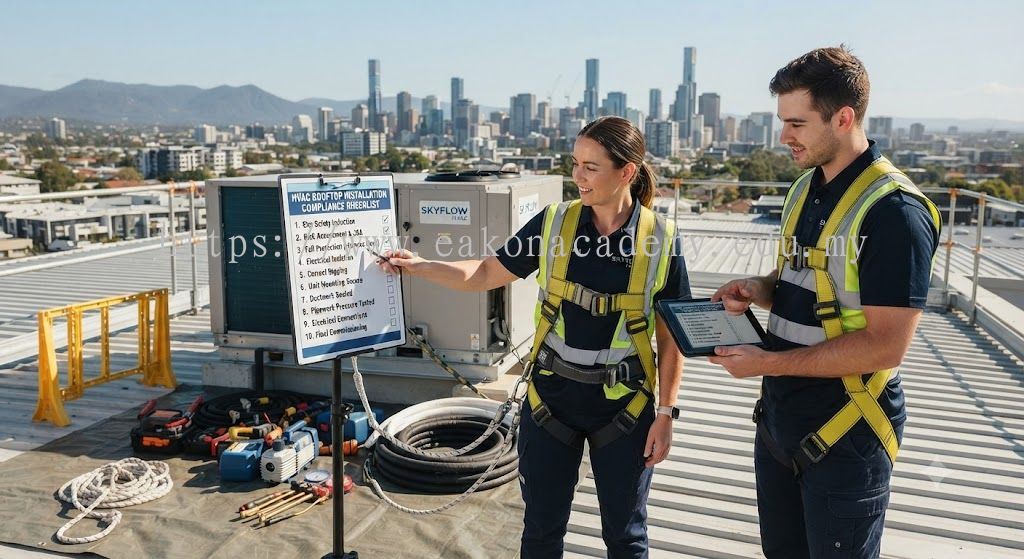
HVAC Rooftop Installation Compliance Checklist: Essential Safety Guidelines for Professional Rooftop Air Conditioning Installation
HVAC rooftop installation compliance checklist is an essential guide used by air conditioning technicians and contractors to ensure rooftop HVAC installation activities are performed safely, efficiently, and according to professional industry practices. Rooftop air conditioning installation involves working in elevated environments where technicians may face risks such as falls, dropped tools, unstable surfaces, electrical hazards, heavy equipment handling, and changing weather conditions. A proper HVAC rooftop installation compliance checklist helps technicians identify potential hazards, prepare suitable safety controls, and complete installation work with better quality and reliability. At Eakon Academy (eakonacadem.edu.my), we provide professional HVAC training programs that focus on rooftop installation safety, working at height procedures, risk assessment, tool handling, and practical air conditioning installation skills required for modern HVAC professionals.
Rooftop HVAC installation requires careful preparation because technicians are often required to handle heavy equipment and complex installation procedures at elevated locations. Before beginning any rooftop installation project, technicians should review the working environment, assess potential hazards, and prepare the necessary tools and safety equipment. A detailed compliance checklist ensures that important safety procedures are not overlooked and helps create a more organized installation process.
The first step in an HVAC rooftop installation compliance checklist is conducting a comprehensive risk assessment. Technicians should inspect the rooftop area and identify potential hazards such as uneven surfaces, roof edges, access difficulties, electrical systems, weather conditions, and nearby equipment. Understanding these risks allows technicians to implement suitable control measures before starting work. Proper risk assessment improves safety awareness and reduces the likelihood of workplace accidents.
Access equipment inspection is another important part of rooftop HVAC installation compliance. Technicians may use ladders, scaffolding systems, mobile access platforms, or elevated work platforms to reach rooftop areas. All access equipment should be checked before use to ensure stability, safety, and suitability for the task. Proper ladder positioning, secure access routes, and safe climbing procedures help reduce fall risks when technicians move between ground level and rooftop work areas.
Personal protective equipment (PPE) verification should also be included in every HVAC rooftop installation compliance checklist. Technicians should ensure they have suitable PPE such as safety helmets, safety footwear, protective gloves, eye protection, and fall protection equipment when required. Rooftop environments may expose workers to falling objects, sharp materials, slippery surfaces, and edge hazards. Proper PPE usage provides additional protection and supports safer installation activities.
Tool inspection and management are essential during rooftop air conditioning installation. HVAC technicians use various tools including drills, impact drivers, screwdrivers, torque wrenches, pipe cutters, flaring tools, multimeters, vacuum pumps, refrigerant gauges, and leak detection devices. Before starting work, tools should be inspected to confirm they are safe and functional. When working on rooftops, tools must be secured using tool tethering systems, safety lanyards, and organized storage solutions to prevent dropped object incidents.
Equipment lifting and handling procedures are also important components of rooftop installation compliance. Outdoor units, compressors, mounting brackets, copper piping, and other HVAC components can be heavy and difficult to transport. Technicians should apply proper lifting techniques, use suitable lifting equipment, and follow safe handling procedures when moving materials to rooftop locations. Effective equipment handling reduces injuries and protects valuable HVAC components.
Electrical safety checks should be included in the rooftop installation checklist before connecting or testing HVAC systems. Technicians must verify electrical isolation procedures, inspect wiring connections, use approved testing equipment, and follow safe electrical installation practices. Proper electrical safety reduces the risk of electric shock, short circuits, and equipment damage during rooftop installation.
Refrigerant handling verification is another critical step in professional HVAC rooftop installation. Technicians should ensure correct procedures are followed for refrigerant piping, pressure testing, vacuum processes, leak detection, and charging activities. Proper refrigerant management improves system efficiency, prevents environmental impact, and ensures reliable HVAC performance.
Weather condition assessment is also necessary before performing rooftop installation work. Rain, strong winds, extreme heat, and slippery roof surfaces can increase safety risks and affect installation quality. Technicians should evaluate weather conditions and apply additional precautions when required to maintain a safe working environment.
Final inspection and documentation are important parts of the HVAC rooftop installation compliance checklist. After installation, technicians should verify equipment positioning, piping connections, electrical systems, drainage, refrigerant performance, and overall system operation. Proper documentation provides evidence of professional installation practices and supports future maintenance activities.
Continuous training is essential to ensure HVAC technicians understand rooftop installation safety requirements. Professional training programs should cover risk assessment, working at height safety, PPE usage, tool management, electrical procedures, refrigerant handling, and installation best practices. Hands-on training helps technicians develop practical skills and confidence when working in real rooftop environments.
At Eakon Academy (eakonacadem.edu.my), we are committed to developing skilled HVAC professionals through practical and industry-focused training programs. Our courses cover air conditioning installation safety, rooftop HVAC procedures, working at height practices, tool control, electrical safety, refrigerant management, and professional HVAC standards. By applying an effective HVAC rooftop installation compliance checklist, technicians can reduce workplace hazards, improve installation quality, protect equipment, and deliver reliable air conditioning solutions. Proper compliance knowledge is essential for building a safer, more efficient, and professional HVAC industry.
Lihat detail lebih lanjut tentang EAKON ACADEMY SDN BHD Malaysia
