
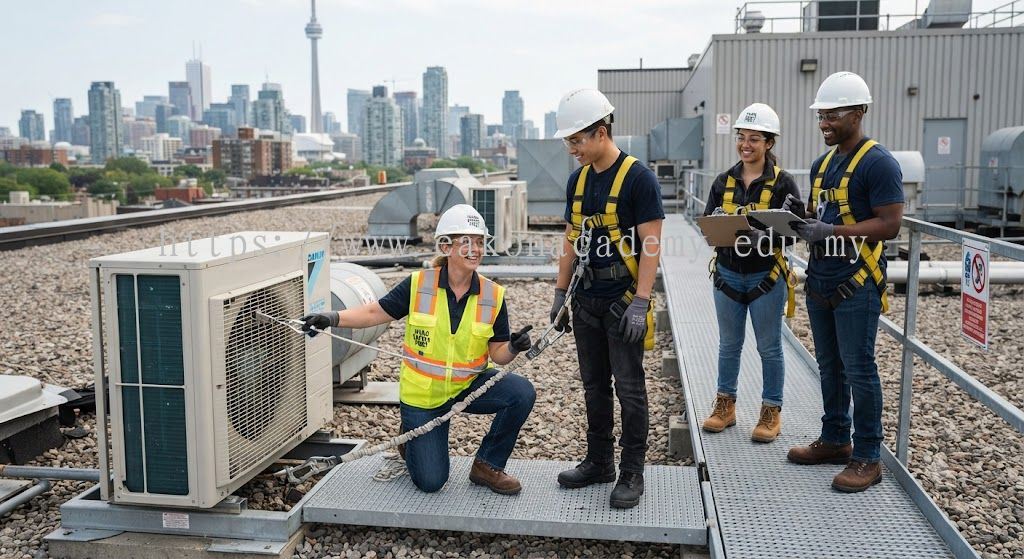
HVAC Occupational Safety Training Working at Height: Professional Safety Skills for Air Conditioning and Refrigeration Technicians
HVAC occupational safety training working at height is a comprehensive professional training program developed to equip air conditioning and refrigeration technicians with the knowledge, practical skills, and safety awareness required to perform HVAC installation, maintenance, servicing, inspection, and repair work safely in elevated environments. As HVAC systems become more advanced and are commonly installed in commercial buildings, industrial facilities, hospitals, hotels, shopping malls, high-rise residential developments, and manufacturing plants, technicians are increasingly required to work on rooftops, ladders, scaffolding, elevated work platforms, ceiling spaces, and external building structures. These working conditions expose technicians to various occupational hazards that require structured safety training, proper risk management, and strict compliance with workplace safety standards. At Eakon Academy, HVAC occupational safety training working at height is designed to prepare technicians with industry-relevant knowledge and practical experience that promotes a safer, more productive, and highly skilled HVAC workforce throughout Malaysia.
Working at height is one of the most critical occupational safety concerns in the HVAC industry. Air conditioning technicians regularly install split air conditioning systems, maintain VRF and VRV systems, service rooftop package units, inspect air handling units (AHUs), replace compressors, connect refrigerant piping, perform electrical troubleshooting, and conduct preventive maintenance at elevated locations. Each worksite presents different challenges, including unstable surfaces, roof edges, slippery conditions, changing weather, limited access points, overhead electrical hazards, and confined working spaces. HVAC occupational safety training working at height helps technicians recognize these hazards and implement appropriate control measures before beginning any installation or maintenance activity.
One of the core components of the training program is workplace hazard identification. Before performing HVAC work at height, technicians are trained to carry out detailed site inspections to identify hazards that may compromise safety. Participants learn how to evaluate rooftop conditions, ladder placement, platform stability, structural integrity, ceiling access points, environmental conditions, nearby electrical installations, and pedestrian traffic. Identifying workplace hazards at an early stage allows technicians to establish safer work procedures and significantly reduce the risk of accidents.
Risk assessment is another essential element of HVAC occupational safety training working at height. Technicians learn structured methods for evaluating workplace risks by considering the probability and severity of potential hazards associated with elevated HVAC work. Participants are trained to select appropriate access methods, determine suitable fall protection measures, evaluate environmental factors, and implement effective risk control strategies before commencing work. Proper risk assessment improves planning, supports compliance with occupational safety regulations, and enhances overall workplace safety.
Personal protective equipment (PPE) plays a vital role in protecting HVAC technicians during elevated work activities. The training program provides practical instruction on selecting, inspecting, fitting, and correctly using essential PPE such as safety helmets, full-body harnesses, shock-absorbing lanyards, anchor connectors, lifelines, safety footwear, gloves, eye protection, and high-visibility clothing. Participants also learn proper inspection and maintenance procedures to ensure protective equipment remains effective throughout its service life. Correct PPE usage significantly reduces the consequences of falls and other workplace incidents.
Ladder safety is another major focus of HVAC occupational safety training working at height. Since ladders are among the most frequently used access tools during air conditioning installation and maintenance, technicians receive detailed instruction on ladder selection, inspection, setup, safe climbing techniques, positioning, and load limitations. The training emphasizes maintaining three points of contact, avoiding overreaching, securing ladders correctly, and recognizing situations where alternative access equipment is more appropriate.
For larger commercial and industrial HVAC projects, technicians are introduced to the safe use of scaffolding and Mobile Elevating Work Platforms (MEWPs). Participants learn pre-operation inspections, equipment stability principles, safe operating procedures, emergency controls, platform load capacities, and manufacturer operating recommendations. Understanding the correct use of elevated access equipment enables technicians to perform complex HVAC tasks safely while improving operational efficiency.
Safe handling of HVAC tools and materials is another important component of occupational safety training. Technicians regularly transport vacuum pumps, refrigerant recovery machines, electrical testing equipment, copper tubing, compressors, mounting brackets, power tools, and installation materials while working above ground level. Improperly secured equipment can create falling object hazards that threaten both workers and members of the public below. The course teaches participants how to organize equipment, secure tools, maintain good housekeeping practices, and safely transport materials during elevated work.
Electrical safety is integrated throughout the HVAC occupational safety training working at height program. Air conditioning technicians often work near energized electrical systems while connecting compressors, motors, control panels, circuit boards, and electrical wiring. Participants learn safe isolation procedures, lockout and tagout (LOTO) practices, voltage verification techniques, insulated tool usage, and methods for maintaining safe distances from live electrical equipment. These procedures reduce electrical hazards while supporting safe working practices at height.
Emergency preparedness and rescue planning are essential components of professional occupational safety training. Participants receive instruction on emergency communication procedures, incident reporting, rescue planning, evacuation methods, first-response actions, and fall rescue techniques. Preparing technicians for emergency situations ensures they can respond quickly and effectively while minimizing the impact of workplace incidents.
For HVAC contractors, maintenance companies, facility management organizations, and engineering firms, investing in HVAC occupational safety training working at height offers substantial long-term benefits. Properly trained technicians contribute to fewer workplace accidents, improved compliance with occupational safety regulations, increased productivity, stronger safety culture, enhanced customer confidence, and higher service quality. Organizations that prioritize professional safety training also strengthen their reputation while protecting both employees and business operations.
Eakon Academy is dedicated to developing highly competent HVAC professionals through practical, industry-focused education and comprehensive workplace safety training. The HVAC occupational safety training working at height program equips participants with advanced knowledge of hazard identification, workplace risk assessment, ladder safety, rooftop safety, elevated platform operation, fall prevention systems, PPE management, electrical safety, emergency response planning, and professional HVAC installation and maintenance procedures. Through expert instruction and hands-on practical exercises, technicians develop the confidence, technical expertise, and safety mindset required to perform air conditioning work safely and efficiently. Completing this professional training program helps build a safer, more productive, and highly qualified HVAC workforce while supporting the continued growth and excellence of Malaysia's air conditioning and refrigeration industry.
Lihat detail lebih lanjut tentang EAKON ACADEMY SDN BHD Malaysia
