
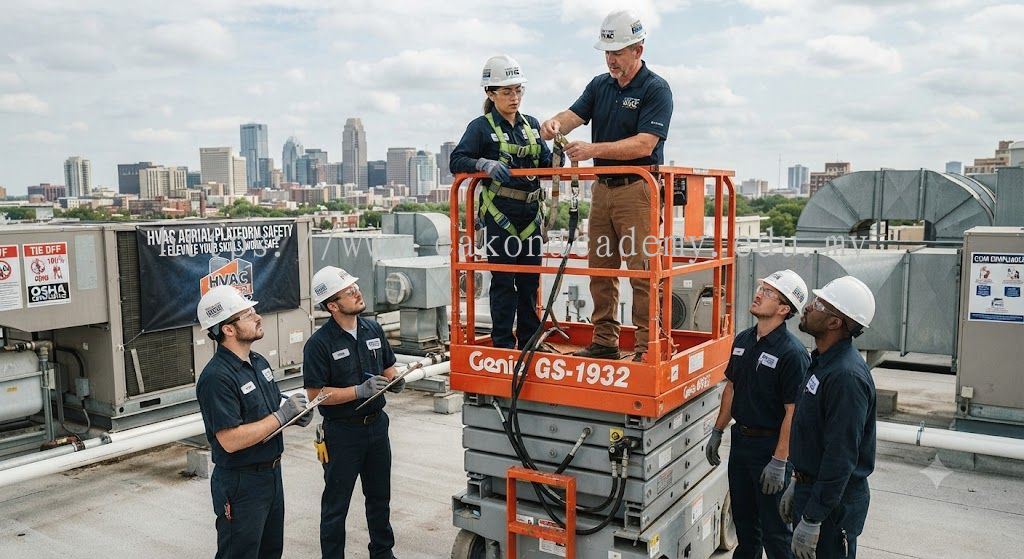
HVAC Safety Training for Aerial Platforms: Developing Safer Skills for Air Conditioning Work at Height
The HVAC industry continues to expand with increasing demand for professional air conditioning installation, maintenance, repair, and servicing solutions across residential, commercial, and industrial sectors. Many HVAC systems are installed in elevated locations such as rooftops, factories, warehouses, shopping centres, hospitals, high-rise buildings, and large mechanical facilities. To safely access these areas, technicians often rely on aerial platforms such as boom lifts, scissor lifts, and other Mobile Elevated Work Platforms (MEWPs). However, operating aerial platforms requires proper knowledge, technical competency, and strong safety awareness. HVAC safety training for aerial platforms provides technicians with essential skills to safely operate elevated access equipment while reducing workplace hazards. At Eakon Academy (eakonacadem.edu.my), we provide professional HVAC safety training programmes designed to improve technician competency, enhance workplace safety, and prepare HVAC professionals for real-world working-at-height challenges throughout Malaysia.
Aerial platforms are important tools in modern HVAC operations because they provide safe and efficient access to equipment installed in difficult locations. HVAC technicians commonly use aerial platforms for rooftop air conditioning installation, commercial HVAC maintenance, VRF and VRV system servicing, ductwork inspection, ventilation system repair, chiller maintenance, and preventive servicing of large mechanical systems. Compared with unsafe climbing methods, aerial platforms provide a more stable working environment and allow technicians to perform detailed tasks with improved efficiency. However, incorrect operation of aerial platforms can result in serious accidents, including falls from height, platform instability, equipment damage, electrical contact, collisions, and falling objects. Proper safety training ensures technicians understand how to operate these machines responsibly and safely.
One of the most important elements of HVAC safety training for aerial platforms is understanding workplace hazards and conducting proper risk assessments. Before beginning elevated HVAC work, technicians must evaluate the job site to identify possible risks such as uneven surfaces, unstable ground conditions, overhead electrical cables, nearby structures, limited access areas, moving vehicles, pedestrian activity, and changing weather conditions. By learning how to identify and control these hazards, technicians can select suitable equipment, plan safer work procedures, establish exclusion zones, and reduce the possibility of workplace incidents. Effective risk assessment is a key foundation of safe aerial platform operation.
Equipment inspection is another essential part of aerial platform safety training. Before operating any aerial platform, HVAC technicians must understand the importance of conducting a complete pre-use inspection. Training covers inspection procedures for hydraulic systems, tyres, batteries, platform controls, emergency stop functions, guardrails, warning alarms, stabilizers, emergency lowering systems, and other critical components. Identifying mechanical problems before operation helps prevent equipment failure and ensures technicians only use platforms that are safe and suitable for the intended HVAC task.
Professional operator training also focuses on developing practical skills for safe aerial platform operation. Participants learn how to correctly start, move, position, raise, and lower aerial platforms while following manufacturer recommendations. The training covers load capacity limits, safe operating distances, emergency procedures, platform stability, and correct positioning techniques. Hands-on practical exercises allow HVAC technicians to gain real experience operating different types of aerial platforms while developing confidence and awareness of workplace risks. This practical approach ensures technicians are better prepared to handle actual HVAC installation and maintenance situations.
Personal Protective Equipment (PPE) is a critical component of safe aerial platform operation. HVAC safety training teaches technicians the correct use of essential safety equipment, including safety helmets, protective gloves, safety footwear, eye protection, high-visibility clothing, and fall protection systems. When required, technicians are trained to properly use full-body safety harnesses and approved lanyards connected to suitable anchor points. Proper PPE selection and inspection provide additional protection against falls and injuries while performing elevated HVAC tasks.
Maintaining aerial platform stability is another important safety practice. HVAC technicians must understand equipment limitations and ensure platforms are positioned on stable surfaces before operation. Training teaches participants how to manage platform loads, avoid overloading with excessive tools or materials, and safely arrange HVAC equipment such as refrigerant cylinders, spare parts, and installation components. Proper load management reduces the risk of platform instability and helps create safer working conditions.
Environmental awareness is also included in HVAC safety training for aerial platforms. Outdoor HVAC activities, especially rooftop servicing and equipment installation, can expose technicians to strong winds, rain, lightning, extreme temperatures, and poor visibility. Technicians learn how environmental factors affect aerial platform safety and how to make appropriate decisions when conditions become unsafe. Monitoring weather conditions and following safe operating limits help protect workers and equipment.
Communication and teamwork are essential for safe aerial platform operations. HVAC projects often involve multiple workers, including technicians, electricians, engineers, contractors, and facility management personnel. Effective communication between aerial platform operators and ground workers helps coordinate movement, maintain safe work zones, prevent collisions, and improve emergency response. A strong safety culture ensures everyone involved understands their responsibilities and follows proper procedures.
Emergency response training is another important area covered in aerial platform safety programmes. Technicians learn how to respond to equipment malfunction, power failure, emergency lowering situations, and other unexpected incidents. Understanding rescue procedures and communication methods allows teams to react quickly and reduce the impact of emergencies while protecting workers.
Regular maintenance and inspection of aerial platforms are also necessary to maintain safe operations. Scheduled servicing, hydraulic inspections, battery checks, lubrication, brake testing, and replacement of worn components ensure equipment remains reliable and efficient. Well-maintained aerial platforms support safer HVAC operations, reduce downtime, and improve overall productivity.
At Eakon Academy (eakonacadem.edu.my), we are committed to providing professional HVAC education that combines technical expertise with workplace safety excellence. Our HVAC safety training for aerial platforms equips technicians with the knowledge and practical skills required to safely operate elevated access equipment during air conditioning installation, servicing, and maintenance activities. Through comprehensive training in hazard identification, risk assessment, equipment inspection, safe operating procedures, PPE usage, emergency response, and workplace safety practices, participants become more competent and confident HVAC professionals. By investing in professional aerial platform safety training, HVAC technicians can improve workplace safety, strengthen technical capabilities, enhance career opportunities, and contribute to a safer and more efficient HVAC industry throughout Malaysia.
Lihat detail lebih lanjut tentang EAKON ACADEMY SDN BHD Malaysia
