
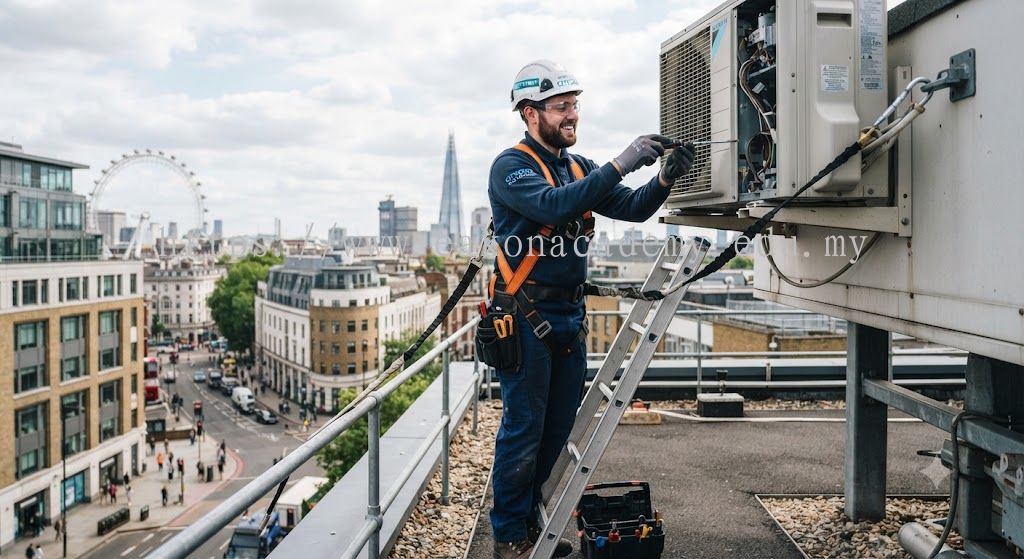
Air Conditioning Maintenance Safety at Height: Essential Safety Guide for HVAC Technicians
Air conditioning maintenance often requires technicians to perform tasks at elevated locations, including rooftops, high-rise buildings, commercial facilities, ceiling-mounted systems, mechanical rooms, and industrial HVAC areas. These maintenance activities may involve inspecting outdoor units, cleaning components, repairing electrical systems, checking refrigerant circuits, replacing parts, and performing preventive maintenance procedures. Working at height creates additional safety challenges, including fall hazards, unstable surfaces, falling objects, and difficult access conditions. Understanding proper air conditioning maintenance safety at height practices is essential for protecting technicians, reducing workplace accidents, and ensuring professional HVAC maintenance standards. At Eakon Academy (eakonacadem.edu.my), our HVAC training programmes focus on combining technical air conditioning knowledge with essential workplace safety skills to prepare technicians for safe and efficient maintenance operations.
Safety at height begins with proper planning and hazard assessment before any air conditioning maintenance activity starts. Technicians should evaluate the work environment and identify possible risks such as roof edges, slippery surfaces, electrical systems, weather conditions, equipment weight, access methods, and surrounding workplace activities. A detailed risk assessment allows technicians and employers to determine the correct safety controls, select appropriate personal protective equipment (PPE), and establish safe working procedures. Proper preparation reduces the possibility of accidents and ensures maintenance work is completed in a controlled and professional manner.
One of the most important safety requirements for air conditioning maintenance at height is the use of a full-body safety harness system. A harness provides essential fall protection when technicians work in areas where a fall could occur. Unlike traditional safety belts, full-body harnesses are designed to distribute fall forces across stronger areas of the body, including the shoulders, chest, thighs, and pelvis. HVAC technicians performing maintenance on rooftop air conditioning units, outdoor condensers, VRF and VRV systems, and commercial HVAC equipment should understand how to properly select, wear, inspect, and maintain harness systems.
A complete fall protection system includes more than just a harness. It also requires suitable equipment such as shock-absorbing lanyards, self-retracting lifelines (SRLs), connectors, and certified anchor points. These components work together to provide reliable protection during elevated maintenance activities. Shock-absorbing lanyards reduce the impact force generated during a fall, while self-retracting lifelines allow technicians to move more freely while remaining connected to a secure point. Certified anchor points must be properly selected and should never be replaced with unsuitable structures such as refrigerant pipes, electrical conduits, ductwork, or temporary supports.
Proper access equipment is another important factor in air conditioning maintenance safety at height. Technicians may use ladders, scaffolding, boom lifts, or scissor lifts depending on the working environment and maintenance requirements. Ladders should be inspected before use, positioned on stable surfaces, and secured properly to prevent movement. For larger commercial and industrial HVAC systems, elevated work platforms often provide safer access and improved working conditions. Operators must receive proper training and follow equipment safety procedures to reduce risks.
A safety helmet with chin strap is essential when performing HVAC maintenance at elevated locations. Technicians may be exposed to falling tools, loose components, overhead structures, and accidental impacts during maintenance activities. A suitable safety helmet protects the head while the chin strap ensures the helmet remains secure during climbing, movement, and emergency situations. Regular helmet inspection is necessary to identify cracks, damaged suspension systems, or signs of wear.
Safety footwear also plays an important role in preventing accidents during elevated HVAC maintenance. Rooftops and mechanical areas may contain slippery surfaces, dust, water, oil, or uneven flooring. Safety boots with anti-slip soles, steel toe protection, and durable construction provide better stability and protect technicians from dropped tools, heavy components, and sharp materials. Proper footwear improves balance and reduces the risk of slips and falls while working at height.
Protective gloves and eye protection are also necessary for safe air conditioning maintenance. Technicians often handle copper piping, sheet metal, electrical components, filters, tools, and refrigerant systems that may create injury risks. Cut-resistant gloves protect hands from sharp edges, while heat-resistant gloves are suitable for brazing activities. Safety glasses protect the eyes from dust, metal particles, refrigerant splashes, and debris generated during maintenance work.
Electrical safety is another critical consideration when maintaining air conditioning systems at height. Rooftop and commercial HVAC units often contain electrical panels, compressors, motors, and control systems. Technicians should use insulated tools, voltage testers, electrical gloves, and lockout/tagout procedures to prevent electrical accidents. Proper isolation of electrical supplies before maintenance reduces the risk of electric shock and equipment damage.
Refrigerant safety must also be considered during elevated air conditioning maintenance. Technicians may perform leak testing, refrigerant recovery, vacuum procedures, and charging activities. Proper refrigerant handling equipment, including leak detectors, recovery machines, recovery cylinders, charging scales, and protective PPE, helps reduce exposure risks and supports safe maintenance practices. Understanding refrigerant characteristics and safe handling procedures is essential for professional HVAC technicians.
Emergency rescue planning is an important part of working at height safety. If a technician falls while connected to a harness system, immediate rescue is required to reduce the risk of suspension trauma. Employers should prepare rescue procedures, provide suitable rescue equipment, maintain communication systems, and ensure workers receive emergency response training. A prepared rescue plan improves workplace readiness and protects technician safety.
Regular inspection and maintenance of safety equipment are essential to ensure reliability. Harnesses, lanyards, helmets, ladders, access equipment, and PPE should be checked regularly for damage, wear, or defects. Damaged equipment must be removed from service immediately to prevent failures during critical situations. Proper storage and maintenance extend equipment lifespan and maintain safety performance.
Continuous safety training helps HVAC technicians develop the knowledge and confidence required for safe maintenance activities. Training should cover working-at-height procedures, fall protection systems, PPE selection, ladder safety, electrical protection, refrigerant handling, hazard identification, and emergency response. Professional technicians who understand safety requirements can complete maintenance work more efficiently while reducing workplace risks.
At Eakon Academy (eakonacadem.edu.my), we are committed to developing highly skilled HVAC technicians who understand that safety is a fundamental part of professional air conditioning maintenance. Our specialised HVAC training programmes provide practical learning in installation, servicing, troubleshooting, maintenance, working at height safety, fall protection equipment, PPE usage, electrical safety, refrigerant management, and emergency procedures. Through hands-on training and industry-focused education, students gain the skills required to perform HVAC maintenance safely and professionally. By applying proper Air Conditioning Maintenance Safety at Height practices, technicians can minimise workplace hazards, improve service quality, comply with safety requirements, protect themselves and others, and build successful careers in the HVAC industry.
Lihat detail lebih lanjut tentang EAKON ACADEMY SDN BHD Malaysia
