
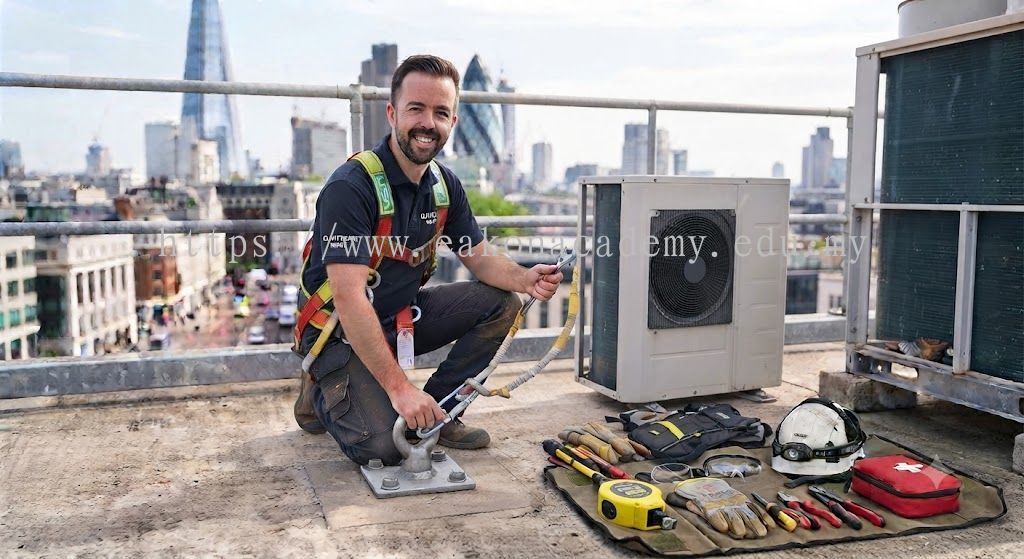
Air Conditioning Technician Accident Prevention Gear: Essential Safety Equipment for Professional HVAC Work
Air conditioning technicians work in environments that present a wide range of occupational hazards, making the use of air conditioning technician accident prevention gear essential for every installation, servicing, maintenance, and repair project. From working at height on rooftops and balconies to handling electrical systems, refrigerants, heavy equipment, and power tools, HVAC professionals face risks that require proper preparation and high-quality personal protective equipment (PPE). Accident prevention is not only about complying with workplace safety regulations but also about protecting lives, improving productivity, reducing downtime, and delivering professional air conditioning services. At Eakon Academy (eakonacadem.edu.my), we believe that technical expertise and workplace safety go hand in hand. Our HVAC training programmes equip technicians with practical installation skills while emphasising the importance of using the correct accident prevention gear for every job.
Personal Protective Equipment (PPE) is the first line of defence against workplace hazards. Every air conditioning technician should wear a certified safety helmet to protect against falling tools, overhead obstructions, and accidental impacts commonly encountered on construction sites and during renovation work. Safety footwear with steel toe protection and anti-slip soles helps prevent crushing injuries while providing secure footing on wet, uneven, or elevated surfaces. Cut-resistant work gloves protect hands from sharp sheet metal, copper tubing, fins, and installation tools, while also reducing the risk of burns during brazing operations. Safety glasses or impact-resistant goggles shield the eyes from dust, flying debris, refrigerant splashes, metal shavings, and sparks generated by drilling, grinding, or pipe cutting. High-visibility reflective clothing enhances worker visibility, particularly on busy commercial or industrial sites where machinery and vehicles are in operation.
Working at height is one of the leading causes of serious injuries in the HVAC industry, making fall protection equipment an essential part of any accident prevention strategy. Air conditioning technicians frequently install outdoor condenser units, service rooftop package units, inspect cooling towers, and maintain large commercial HVAC systems in elevated locations. Full-body safety harnesses, shock-absorbing lanyards, self-retracting lifelines (SRLs), certified anchor points, elevated work platforms, and properly secured scaffolding help reduce the risk of falls and ensure safe access to difficult work areas. Before every task, technicians should inspect their fall protection equipment for wear, damage, or defects and verify that anchor points meet the required safety standards. Proper fall protection training enables technicians to use this equipment correctly while complying with Malaysia's occupational safety requirements.
Electrical hazards are another significant concern during air conditioning installation and servicing. HVAC technicians routinely connect power supplies, troubleshoot electrical faults, replace components, and commission air conditioning systems. To minimise the risk of electric shock, insulated hand tools, voltage testers, insulated gloves, lockout/tagout devices, and electrical warning signs should always be included in an accident prevention equipment checklist. Before beginning electrical work, technicians must isolate the power source, verify zero voltage using approved testing equipment, and apply lockout/tagout procedures to prevent accidental energisation. These simple but essential practices greatly reduce the likelihood of electrical accidents while protecting both workers and equipment.
Safe refrigerant handling is equally important in preventing workplace incidents. Air conditioning technicians regularly work with refrigerants such as R32, R410A, R134a, and increasingly R290 (propane), each of which requires specific handling procedures and safety precautions. Refrigerant cylinders should be stored upright in well-ventilated areas away from direct sunlight and ignition sources. Leak detectors, refrigerant recovery machines, manifold gauge sets, charging scales, vacuum pumps, and recovery cylinders should be inspected before use to ensure safe and efficient operation. When working with flammable refrigerants such as R290, technicians should eliminate ignition sources, maintain adequate ventilation, use intrinsically safe equipment where required, and follow Department of Environment (DOE) Malaysia guidelines to minimise fire and explosion risks.
Power tools and installation equipment also contribute significantly to workplace safety. Drills, grinders, flaring tools, pipe cutters, torque wrenches, vacuum pumps, and brazing equipment should be regularly inspected for damaged cables, worn insulation, loose fittings, or mechanical defects. During brazing operations, technicians should wear heat-resistant gloves, eye protection, and fire-resistant clothing when appropriate. Fire extinguishers, fire blankets, and nitrogen purging equipment should always be available to reduce the risk of fire and prevent oxidation inside refrigeration pipework. Maintaining tools in good condition not only improves safety but also increases installation quality and equipment reliability.
Manual handling injuries remain one of the most common workplace accidents among HVAC professionals. Air conditioning systems, compressors, condensers, copper tubing, and installation materials can be heavy and awkward to transport. Technicians should use proper lifting techniques, mechanical lifting aids, trolleys, lifting straps, and team lifting whenever necessary to reduce strain on the back, shoulders, and joints. Ergonomic work practices help minimise fatigue while improving overall efficiency during installation and maintenance activities.
Good housekeeping is another important aspect of accident prevention. A clean and organised worksite reduces slip, trip, and fall hazards while creating a safer working environment for technicians, clients, and other contractors. Electrical cables should be routed safely, tools should be stored properly, waste materials should be removed promptly, and installation areas should remain free from unnecessary obstructions. Safety barriers and warning signs should also be used to protect members of the public and other workers from overhead activities or hazardous work zones.
Comprehensive risk assessments should be completed before every air conditioning project. Technicians should identify hazards associated with electrical systems, working at height, confined spaces, weather conditions, manual handling, nearby traffic, structural stability, and refrigerant use. Effective planning allows the correct accident prevention gear to be selected while ensuring emergency procedures, rescue plans, first aid arrangements, and communication methods are established before work begins. Preventing accidents starts with recognising potential hazards before they become incidents.
Continuous professional training plays a vital role in improving workplace safety throughout the HVAC industry. As equipment, refrigerants, installation methods, and safety regulations continue to evolve, technicians must regularly update their knowledge and practical skills. Ongoing education covering personal protective equipment, fall protection, electrical safety, refrigerant management, fire prevention, emergency response, and occupational health requirements helps create safer workplaces while improving technical competency and customer confidence.
At Eakon Academy (eakonacadem.edu.my), we are dedicated to producing highly skilled HVAC professionals who understand that accident prevention is a fundamental part of successful air conditioning installation and servicing. Our industry-focused training programmes combine practical technical instruction with comprehensive workplace safety education, including the correct selection and use of accident prevention gear, working-at-height procedures, electrical safety practices, refrigerant handling, safe brazing techniques, and workplace risk assessments. Through hands-on learning and expert guidance, students develop the confidence, competence, and safety awareness needed to succeed in Malaysia's growing HVAC industry. By investing in the right Air Conditioning Technician Accident Prevention Gear and applying proven safety practices, technicians can reduce workplace injuries, improve operational efficiency, comply with occupational safety regulations, and deliver reliable, high-quality air conditioning services with professionalism and confidence.
Lihat detail lebih lanjut tentang EAKON ACADEMY SDN BHD Malaysia
