
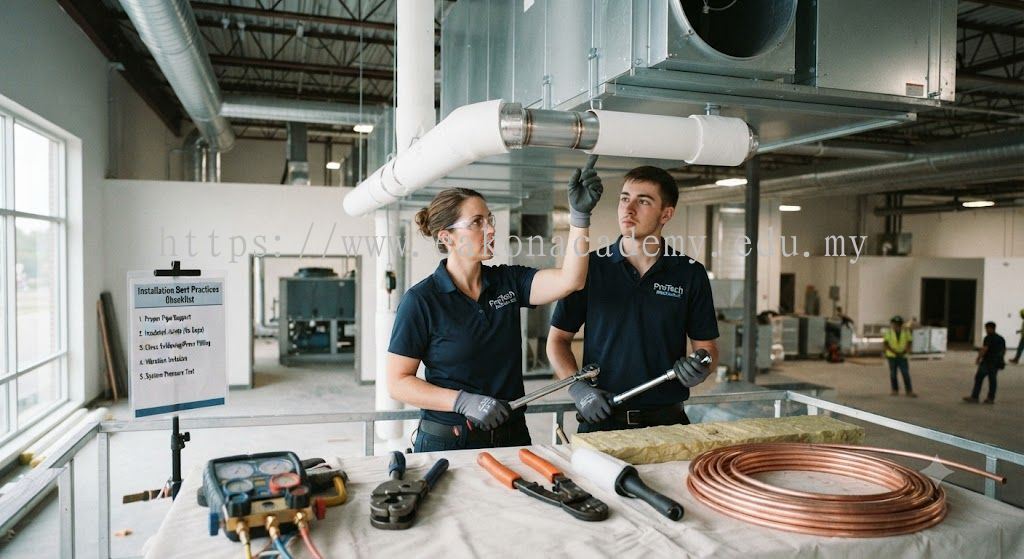
Commercial HVAC Installation Best Practices for Professional Training and High-Performance Building Systems
Commercial HVAC installation best practices are essential guidelines for ensuring that heating, ventilation, and air conditioning systems are installed correctly, efficiently, and according to professional industry requirements. Commercial HVAC systems require advanced technical knowledge because they often serve larger spaces, complex building layouts, and demanding operational conditions. Proper installation directly affects energy efficiency, indoor comfort, equipment reliability, and long-term maintenance costs. Eakon Academy provides professional HVAC training programs designed to develop practical skills and technical knowledge in commercial HVAC installation best practices for technicians, contractors, and industry professionals.
A successful commercial HVAC installation begins with detailed planning and system assessment. HVAC technicians must evaluate building requirements, cooling capacity, airflow needs, equipment specifications, and installation conditions before starting any project. Proper planning helps ensure that the selected HVAC system can meet the building’s operational demands while maintaining efficient performance. Professional HVAC training teaches participants how to analyze installation requirements and apply suitable methods for different commercial applications.
One of the most important commercial HVAC installation best practices is accurate equipment selection and system design. Commercial buildings often require carefully planned HVAC solutions to provide consistent temperature control, proper ventilation, and energy-efficient operation. Technicians must understand cooling load calculations, equipment sizing, zoning requirements, and system configurations to support effective installation. Proper system planning reduces performance issues and improves overall building comfort.
Correct ductwork installation is another essential aspect of commercial HVAC installation. Proper duct design, sizing, sealing, and insulation help maintain efficient airflow distribution throughout commercial spaces. Poor duct installation can result in air leakage, uneven cooling, increased energy consumption, and reduced system performance. Professional HVAC training helps technicians understand ductwork principles and apply quality installation techniques to achieve better system efficiency.
Refrigerant piping installation is also a critical part of commercial HVAC best practices. Technicians must follow correct procedures when handling copper piping, refrigerant connections, insulation, pressure testing, and system evacuation. Proper refrigerant piping ensures stable system operation and prevents issues such as refrigerant leakage, compressor stress, and reduced cooling capacity. Hands-on HVAC training allows participants to develop practical skills in refrigerant system installation and troubleshooting.
Electrical installation and control system setup are important components of commercial HVAC installation. Technicians must ensure proper wiring connections, power supply requirements, protection devices, and control system integration. Modern commercial HVAC systems often include advanced automation and monitoring features, requiring technicians to understand electrical controls and system communication. Professional installation practices help improve safety, reliability, and operational efficiency.
Testing and commissioning are key stages in achieving successful commercial HVAC installation. After installation, technicians must verify airflow performance, refrigerant conditions, electrical operation, temperature control, and overall system functionality. Proper commissioning ensures that the HVAC system operates according to design requirements and helps identify potential issues before building operation begins. Accurate testing improves system reliability and reduces future maintenance problems.
Safety and quality control are also essential parts of commercial HVAC installation best practices. Technicians must follow workplace safety procedures, use appropriate tools, handle equipment correctly, and maintain professional installation standards. High-quality workmanship reduces installation risks and supports long-term system performance.
Learning commercial HVAC installation best practices provides valuable benefits for HVAC professionals who want to improve their technical expertise and career opportunities. Skilled technicians are better prepared to handle complex commercial projects, deliver efficient solutions, and meet industry expectations.
Eakon Academy offers HVAC training courses that combine technical knowledge with practical hands-on experience. By learning commercial HVAC installation best practices, participants can strengthen their installation abilities, improve troubleshooting skills, and develop professional confidence. Comprehensive HVAC training prepares technicians to deliver safe, efficient, and reliable commercial HVAC solutions for offices, industrial facilities, retail buildings, and other large-scale applications.
Lihat detail lebih lanjut tentang EAKON ACADEMY SDN BHD Malaysia
