VRV System Maintenance Best Practices
A VRV System Maintenance Best Practices program is an advanced HVAC training course designed to provide technicians, engineers, facility managers, maintenance teams, and air conditioning professionals with the essential knowledge and practical skills required to maintain Variable Refrigerant Volume (VRV) systems effectively. As VRV air conditioning technology continues to expand across commercial buildings, office towers, hotels, hospitals, shopping malls, industrial facilities, educational institutions, and modern high-rise developments, implementing proper maintenance practices has become increasingly important to ensure reliable operation, energy efficiency, and long-term equipment performance. At Eakon Academy (eakonacadem.edu.my), our VRV System Maintenance Best Practices training focuses on developing professional maintenance techniques that help participants improve system reliability, reduce unexpected failures, optimize energy consumption, and extend the service life of advanced VRV HVAC equipment. This industry-focused training combines technical understanding with practical application to prepare HVAC professionals for real-world maintenance challenges.
Effective VRV system maintenance requires a structured approach that includes regular inspection, preventive servicing, performance monitoring, troubleshooting, and accurate documentation. Unlike conventional air conditioning systems, VRV systems consist of complex components that work together through advanced refrigeration and electronic control technologies. These components include outdoor condensing units, indoor fan coil units, inverter compressors, refrigerant piping networks, electronic expansion valves (EEVs), sensors, printed circuit boards (PCBs), communication systems, drainage systems, and centralized controllers. The VRV System Maintenance Best Practices training helps participants understand how each component operates and how proper maintenance procedures contribute to overall system performance. By following professional maintenance methods, technicians can identify potential issues early and prevent costly equipment failures.
A major focus of VRV system maintenance best practices is preventive maintenance planning. Regular preventive maintenance helps maintain cooling performance, reduce energy consumption, minimize downtime, and protect valuable HVAC assets. Participants learn how to develop effective maintenance schedules, create inspection checklists, monitor equipment conditions, and perform systematic servicing procedures. The training covers important maintenance activities including indoor unit inspection, outdoor unit servicing, air filter cleaning, evaporator and condenser coil maintenance, refrigerant condition checking, leak detection, electrical inspection, compressor performance analysis, fan motor testing, drainage system maintenance, sensor verification, communication testing, and complete system performance evaluation. These practices ensure VRV systems continue operating efficiently while reducing the risk of unexpected breakdowns.
The VRV System Maintenance Best Practices training at Eakon Academy emphasizes the importance of accurate system inspection and professional diagnostic techniques. Participants learn how to analyze operating conditions, identify abnormal system behavior, and determine the causes of performance problems. Common VRV issues such as insufficient cooling, refrigerant leakage, abnormal pressure readings, compressor faults, inverter problems, sensor errors, communication failures, electrical abnormalities, airflow restrictions, and control system issues are discussed in detail. Through systematic troubleshooting methods, technicians learn how to evaluate symptoms, collect operating data, identify root causes, and implement suitable corrective actions. These skills help improve maintenance efficiency, reduce repair time, and increase customer satisfaction.
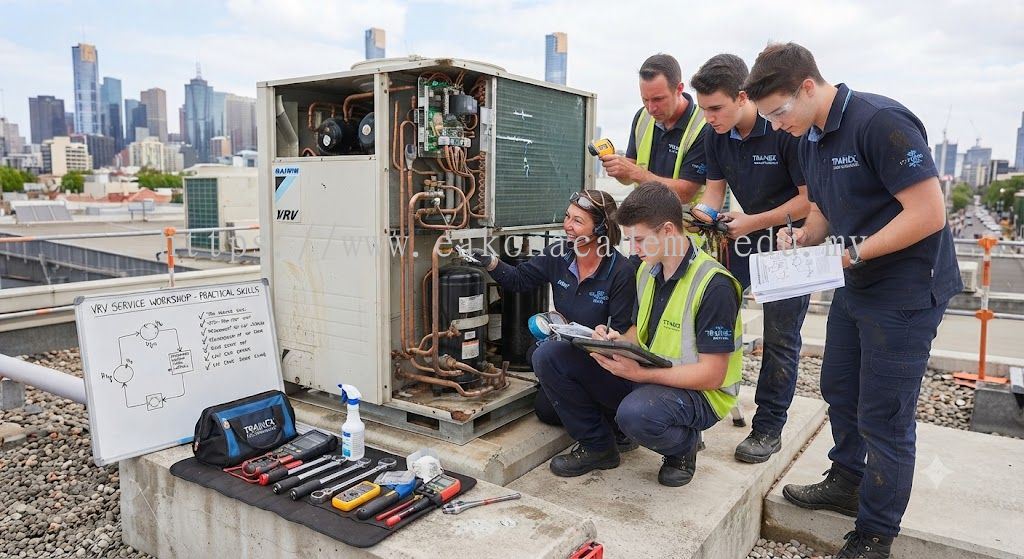
Hands-on practical learning is an essential part of developing professional VRV maintenance skills. Participants gain experience using industry-standard HVAC tools and diagnostic equipment including digital manifold gauges, electronic refrigerant leak detectors, vacuum pumps, refrigerant recovery machines, digital multimeters, clamp meters, infrared thermometers, insulation resistance testers, airflow measurement devices, and manufacturer diagnostic software. Practical exercises include refrigerant pressure analysis, leak inspection, vacuum testing, electrical measurement, component checking, system cleaning, performance testing, and maintenance reporting. These activities provide realistic experience that prepares participants to handle VRV maintenance tasks confidently in commercial and industrial environments.
Energy efficiency optimization is another important element of VRV System Maintenance Best Practices. Proper maintenance ensures VRV systems operate at their intended efficiency levels while reducing unnecessary electricity consumption. Participants learn how maintenance activities influence system performance through refrigerant management, heat exchanger cleaning, airflow improvement, compressor monitoring, electrical inspection, and control system verification. Poor maintenance practices can result in increased energy usage, reduced cooling capacity, higher operating costs, and premature equipment failure. By applying effective maintenance strategies, technicians can help organizations improve HVAC efficiency, reduce operational expenses, and support sustainable building management goals.
Professional documentation and maintenance reporting are also important aspects covered in VRV system maintenance best practices. Participants learn how to record inspection results, track equipment performance, document repair history, identify recurring issues, and recommend improvement actions. Proper documentation allows facility managers and building owners to make informed decisions regarding HVAC operation, maintenance planning, and equipment investment. A well-managed maintenance program improves system reliability and supports better long-term facility performance.
Safety and environmental responsibility are integrated throughout the VRV System Maintenance Best Practices training program. Participants receive guidance on electrical safety procedures, lockout-tagout practices, safe refrigerant handling, refrigerant recovery and recycling, pressure testing, vacuum procedures, leak prevention techniques, and proper use of personal protective equipment (PPE). These professional practices protect technicians, building occupants, HVAC equipment, and the environment while ensuring maintenance activities are performed safely and responsibly.
Completing the VRV System Maintenance Best Practices training at Eakon Academy (eakonacadem.edu.my) provides participants with advanced technical knowledge and practical skills required to maintain modern VRV HVAC systems effectively. Graduates are prepared to perform preventive maintenance, system inspections, troubleshooting support, performance optimization, and professional servicing for commercial and industrial applications. These skills are highly valuable for HVAC contractors, engineering companies, facilities management providers, property developers, hospitals, hotels, factories, educational institutions, and commercial building operators. Whether you are an HVAC technician seeking advanced maintenance knowledge, an organization improving your maintenance workforce, or a professional specializing in VRV technology, the VRV System Maintenance Best Practices training at Eakon Academy provides industry-focused learning designed to enhance technical competency and professional growth. By applying proper VRV maintenance practices, participants can improve system reliability, reduce maintenance costs, increase energy efficiency, and contribute to safer and more sustainable HVAC operations.
Lihat detail lebih lanjut tentang EAKON ACADEMY SDN BHD Malaysia