
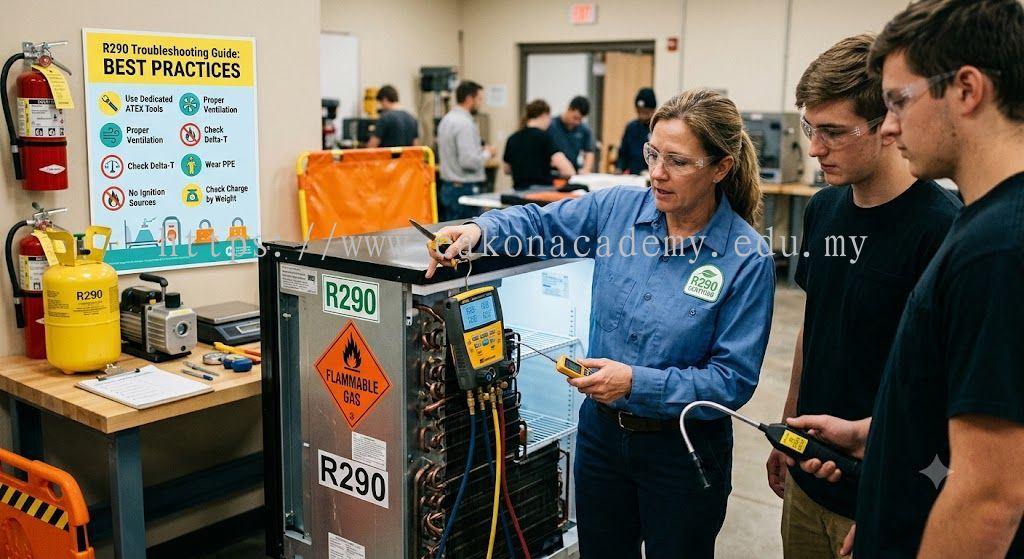
R290 Refrigerant System Troubleshooting Best Practices for HVAC Technicians and Sustainable Cooling Professionals
R290 refrigerant system troubleshooting best practices are essential guidelines for HVAC technicians, refrigeration engineers, air conditioning contractors, and maintenance professionals who work with modern propane refrigerant systems. As the HVAC industry continues to transition towards sustainable and energy-efficient cooling technologies, R290 refrigerant systems are becoming increasingly important due to their excellent performance, low environmental impact, zero ozone depletion potential, and very low global warming potential. However, achieving safe and reliable operation requires proper troubleshooting knowledge, systematic inspection procedures, and professional maintenance practices. At eakonacadem.edu.my, HVAC training programmes focus on developing technician expertise in R290 system operation, fault diagnosis, refrigerant handling, and safe troubleshooting methods to support the advancement of sustainable HVAC solutions.
Following the best practices for R290 refrigerant system troubleshooting helps technicians identify problems accurately, reduce equipment downtime, improve energy efficiency, and maintain long-term system reliability. Unlike conventional refrigerant systems, R290 propane refrigerant requires specialised attention because of its flammable characteristics and unique operating conditions. A professional troubleshooting approach combines technical knowledge, proper tools, safety awareness, and accurate system analysis to ensure effective maintenance and repair.
The first best practice in R290 refrigerant system troubleshooting is performing a complete visual and operational inspection before beginning any repair work. HVAC technicians should examine the overall condition of the system, including refrigerant piping, electrical connections, compressor operation, condenser condition, evaporator performance, airflow conditions, sensors, and control systems. Early identification of visible issues such as refrigerant leaks, damaged components, loose connections, poor installation practices, or contamination can prevent more serious system failures.
Accurate fault diagnosis is another important practice when troubleshooting R290 systems. Technicians should avoid replacing components without confirming the actual cause of failure. A structured diagnostic process involves checking operating pressure, temperature measurements, refrigerant flow, electrical performance, airflow conditions, and system response. Understanding the relationship between these factors allows technicians to identify whether problems are caused by refrigerant issues, mechanical faults, electrical failures, or installation problems.
Proper refrigerant management is one of the most important R290 troubleshooting best practices. Technicians must understand correct charging procedures, refrigerant recovery methods, leak detection techniques, and cylinder handling requirements. Incorrect refrigerant charging can reduce cooling efficiency, increase compressor stress, and create unstable operating conditions. Accurate refrigerant measurement and system evaluation help maintain optimal performance while reducing unnecessary energy consumption.
Compressor troubleshooting should also follow professional best practices when diagnosing R290 system problems. Technicians need to inspect compressor electrical conditions, operating current, discharge temperature, vibration levels, and pressure performance. Common compressor issues may include overheating, overload protection activation, electrical faults, and mechanical wear. Early detection of compressor problems helps prevent major system breakdowns and extends equipment service life.
Condenser and evaporator inspections are also critical components of effective R290 troubleshooting. Technicians should evaluate condenser cleanliness, airflow performance, fan operation, evaporator temperature, frost patterns, and heat transfer efficiency. Problems such as dirty coils, restricted airflow, refrigerant starvation, or improper heat exchange can significantly reduce system performance. Regular inspection and preventive maintenance help maintain efficient refrigeration cycles.
Safety procedures must always be included in R290 refrigerant system troubleshooting best practices. Since R290 propane refrigerant is classified as an A3 flammable refrigerant, technicians must apply proper safety measures such as ensuring adequate ventilation, controlling ignition sources, using suitable tools, and following correct refrigerant handling procedures. Professional training helps technicians manage risks effectively while performing installation, maintenance, and repair activities.
The use of appropriate troubleshooting tools is also essential for achieving accurate results. HVAC professionals may use digital manifold gauges, temperature measuring instruments, refrigerant leak detectors, electrical testing equipment, charging scales, and recovery equipment to analyse system performance. Correct tool usage improves diagnostic accuracy and allows technicians to make informed repair decisions.
As the demand for environmentally responsible HVAC solutions increases, technicians with knowledge of R290 refrigerant system troubleshooting best practices are becoming highly valuable in the industry. Businesses, contractors, and facility operators require skilled professionals who can maintain sustainable cooling systems safely and efficiently. Applying proper troubleshooting methods helps reduce operational costs, improve system reliability, and support energy-saving objectives.
At eakonacadem.edu.my, HVAC and ACMV training programmes are designed to equip technicians, contractors, and industry learners with practical skills in advanced refrigeration technologies. Learning R290 refrigerant system troubleshooting best practices enables professionals to improve technical confidence, enhance diagnostic abilities, and support the safe implementation of low-GWP refrigerant systems. Through training in refrigeration principles, system analysis, safety procedures, and maintenance strategies, HVAC professionals can provide high-quality service solutions.
Whether you are an HVAC technician, refrigeration engineer, maintenance specialist, or someone developing expertise in sustainable cooling technology, understanding R290 refrigerant system troubleshooting best practices provides valuable knowledge for future career growth. Professional training helps technicians improve system performance, prevent equipment failures, reduce energy consumption, and contribute to the development of safer and more environmentally friendly HVAC solutions in Malaysia and beyond.
Lihat detail lebih lanjut tentang EAKON ACADEMY SDN BHD Malaysia
