
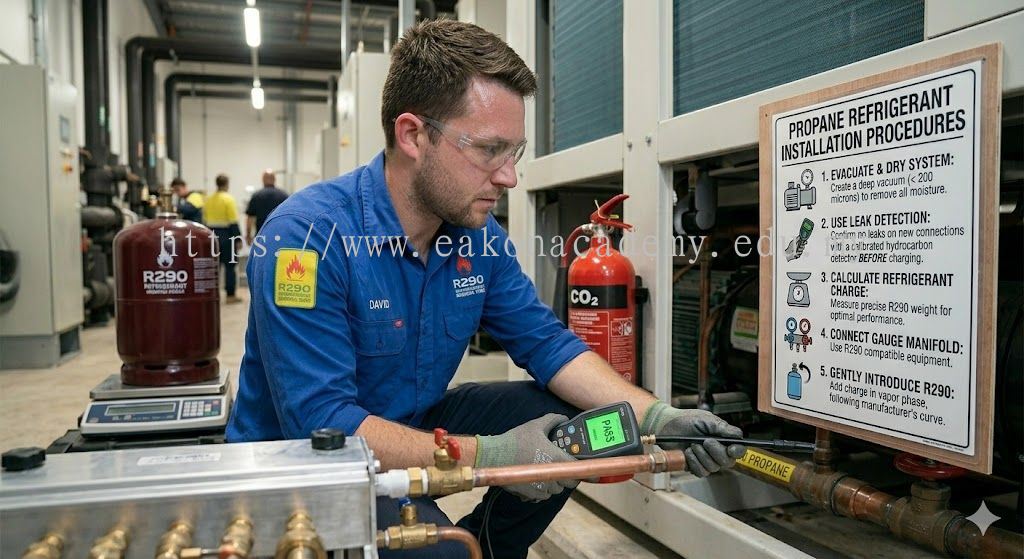
PROPANE REFRIGERANT INSTALLATION PROCEDURES – R290 SYSTEM SETUP GUIDELINES, SAFETY PRACTICES AND PROFESSIONAL HVAC TRAINING STANDARDS
Propane refrigerant installation procedures are a fundamental aspect of modern HVAC and refrigeration engineering as the industry continues to adopt environmentally friendly refrigerants with low global warming potential (GWP). Propane refrigerant, commonly known as R290, is widely used in air conditioning and refrigeration systems due to its excellent energy efficiency, strong cooling performance, and minimal environmental impact. However, because R290 is classified as an A3 highly flammable hydrocarbon refrigerant, strict installation procedures must be followed to ensure system safety, reliability, and compliance with industry standards. For HVAC technicians, refrigeration professionals, and organizations seeking advanced technical expertise, eakonacadem.edu.my provides structured training and education focused on refrigerant safety, installation procedures, and modern HVAC industry practices.
The importance of propane refrigerant installation procedures lies in ensuring that HVAC systems are designed and installed correctly from the beginning to prevent safety risks and operational failures. Improper installation can result in refrigerant leaks, fire hazards, inefficient system performance, compressor damage, and increased maintenance costs. A properly executed installation process ensures that R290 systems operate safely, efficiently, and in compliance with manufacturer specifications.
One of the key steps in propane refrigerant installation procedures is proper site assessment and planning. Before installation begins, technicians must evaluate the installation environment to ensure it is suitable for a flammable refrigerant system. The area must have adequate ventilation, safe equipment placement, and controlled access to prevent exposure to ignition sources such as open flames, sparks, welding activities, and unsuitable electrical devices. Proper planning ensures that safety risks are minimized before physical installation work begins.
System design compliance is another essential part of propane refrigerant installation procedures. R290 systems must be installed according to manufacturer guidelines and relevant safety standards. This includes correct piping design, proper component selection, safe electrical installation, and appropriate system sizing. All components used in the system must be compatible with hydrocarbon refrigerants and certified for flammable gas operation to ensure safe and efficient performance.
Proper equipment handling and installation techniques are critical for propane refrigerant systems. Technicians must ensure that compressors, condensers, evaporators, valves, and piping systems are installed securely and correctly aligned. All joints and connections must be properly sealed to prevent refrigerant leaks. Careful installation practices help maintain system integrity and reduce the risk of operational failures.
Vacuum and pressure testing are important stages in propane refrigerant installation procedures. After system assembly, technicians must perform pressure testing to ensure there are no leaks in the refrigeration circuit. Once pressure testing is complete, the system must be properly evacuated to remove moisture and non-condensable gases. These steps are essential for ensuring system efficiency and preventing internal contamination.
Refrigerant charging is another critical step in the installation process. Propane refrigerant must be charged accurately using calibrated weighing equipment according to manufacturer specifications. Overcharging or undercharging the system can negatively impact performance and safety. Proper charging ensures optimal cooling efficiency and stable system operation.
Electrical safety is also a major consideration during propane refrigerant installation. All electrical components must be properly grounded, insulated, and installed according to safety standards for flammable refrigerants. Explosion-proof or appropriately rated electrical equipment should be used where necessary. Ensuring electrical safety reduces the risk of ignition in environments where propane refrigerant is present.
Ventilation design and airflow management are important aspects of safe installation procedures. Proper ventilation systems must be in place to prevent the accumulation of flammable refrigerant gas in case of leaks. Adequate airflow reduces the risk of ignition and ensures safer working conditions for technicians and end users.
Personal protective equipment (PPE) is also required during propane refrigerant installation procedures. Technicians should wear safety gloves, goggles, anti-static clothing, and suitable footwear to protect against refrigerant exposure and potential hazards. PPE provides an additional layer of safety during installation activities.
Leak detection and system inspection are essential before commissioning the system. All connections, joints, and components must be thoroughly inspected using approved leak detection methods. Identifying and fixing leaks at the installation stage prevents future safety risks and improves system reliability.
Professional training is essential for ensuring technicians can perform propane refrigerant installation procedures correctly. Technicians must understand R290 properties, system design principles, safety requirements, and installation techniques. Institutions such as eakonacadem.edu.my provide comprehensive HVAC training programs focused on natural refrigerants, installation procedures, safety practices, and modern refrigeration technologies. Through structured technical education, technicians gain the practical skills required to install propane refrigerant systems safely and effectively.
For HVAC companies and refrigeration operators, implementing proper propane refrigerant installation procedures provides many benefits, including improved system safety, reduced maintenance issues, enhanced performance, and better compliance with industry standards. Skilled technicians help organizations successfully adopt environmentally friendly refrigerant technologies while maintaining high-quality HVAC operations.
In conclusion, propane refrigerant installation procedures are essential for ensuring the safe and efficient setup of R290 HVAC systems. As the demand for sustainable refrigerant solutions continues to grow, proper installation knowledge becomes increasingly important. Through site assessment, system design compliance, correct equipment installation, pressure testing, evacuation, accurate charging, electrical safety, ventilation control, leak detection, and professional training, propane refrigerant systems can be installed safely and effectively. eakonacadem.edu.my supports the development of skilled HVAC professionals by promoting safety education, technical training, and industry best practices, contributing to a safer, more efficient, and environmentally responsible refrigeration industry in Malaysia and beyond.
Lihat detail lebih lanjut tentang EAKON ACADEMY SDN BHD Malaysia
